nexusstc/Love, Friendship, and Narrative Form After Bloomsbury: The Progress of Intimacy in History/2e61cd09d27ab7f5e89e18ee30ec908d.pdf
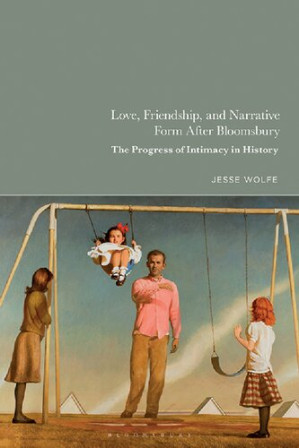
Love, Friendship, and Narrative Form After Bloomsbury : The Progress of Intimacy in History 🔍
Jesse Wolfe
Bloomsbury Academic; Bloomsbury, 2022
英语 [en] · PDF · 4.3MB · 2022 · 📘 非小说类图书 · 🚀/lgli/lgrs/nexusstc/zlib · Save
描述
## Acknowledgments
For decades, thanks largely to modernist legacies, four forms of historical pessimism and philosophical skepticism have been common in the humanities and de rigueur in some bastions of literary theory. One does not logically entail another, but they share family resemblances, and when two or more combine, they capture a complex attitude of non-complicity in a stultifying status quo, disillusionment that yields intellectual liberation.
First, disbelief in historical progress-the steady improvement of public-sphere life-was a major symptom of the First World War and an impetus to modernist originality across the arts. The Second World War, the social unrest of 1968, wars in Vietnam and elsewhere, the gathering threat of anthropogenic climate change, and in the last half decade, the global rise of ethnonationalism have been among the many reasons why this modernist-inflected form of skepticism has retained cachet.
Second, disbelief in love, whether in the restricted forms that social norms permit, or in any form, has been a recurrent theme in literature by modernists and their legatees. While the "era of mandatory marriage" persisted, roughly through 1960, critiques of love often focused on its normative conventions; with the commencement of the era of "mass divorce" c. 1970, 1 such critiques have often focused on the fragility and impermanence of intimacy. But in each case, critics have linked public-and private-sphere woes. If civilization is ailing, then it makes sense that love relations would suffer-and vice versa.
Third, a disbelief in the coherence of the human subject has been among modernism's philosophical legacies. E. M. Forster said in "What I Believe" that "Psychology has split and shattered the idea of a 'Person, ' and has shown that there is something incalculable in each of us, which may at any moment rise to the surface and destroy our normal balance. " 2 From Lacan's linguistically inflected readings of Freud, down through poststructuralism, this intuition has been revisited. It is not surprising that Foucault admired Beckett's subject-dissolving formulation from the third of his Texts for Nothing ("What matter who's speaking, someone said what matter who's speaking?"): Beckett's linguistic experiments foreshadow an array of French theories. When Women in Love's Ursula attempts to extract a confession of love from Birkin, he resists this conventional emotion with the claim that her selfhood-even if it is real-is not what allures him. "I want to find you, where you don't know your own existence, " he explains, "the you that your common self denies utterly. " 3 However annoying a lover Birkin makes, with his lapses into weariness and cynicism, he might seem like an astute reader of Forster's theory-were the portion of "What I Believe" quoted above taken out of context. If the "I" that people present to the world and the "you" by which they know their lovers, friends, parents, children, etc. are reductive-perhaps inaccurate-presentations of a dynamic and unstable core, then, Birkin in effect asks, aren't intimacies based on the pledge "I love you" made in bad faith, and always in peril? Shouldn't he and Ursula strive for a more adventurous bond, one that is truer to their changeable and unknowable natures?
Forster cagily embeds his talk of a "split and shattered" person within a pragmatic Pascalian defense of this same humanist concept. As if he were reassuring his inner Birkin-his own doubts about subjecthood and hence intimate bonds-Forster asserts his "faith" in "personal relationships ... something comparatively solid in a world full of violence." Although "Psychology" has taught us that "in theory" we cannot put trust in them, "in practice we can and do." Although "A is not unchangeably A, or B unchangeably B," he maintains, "there can still be love and loyalty between the two." 4 Forster's and Lawrence's doubts are sometimes appeased by this reassurance and sometimes not. Birkin's skepticism always threatens to undermine Ursula's Forsterian faith in the love between (more or less) coherent subjects, and Ursula's love always threatens to contain and normalize Birkin's radical modernist quest to transvalue the terms on which bourgeois men and women construct lives together.
Finally, a mistrust of realist narrative techniques-those relics of Victorian intellectual confidence that modernists so delighted in revaluing-has for a century provoked poets, novelists, and other artists to "remake it new, " in the words of Lynn Keller. (But modernists so effectively made so many things new that in their wake, avant gardism has passed through phases of exhaustion and replenishment. 5 ) Why shouldn't literary realism seem anachronistic? If civilization is unstable-with world wars and totalitarian states threatening to emerge-if love feels like a cage to those who have it and like a fairytale to those who don't, and if the coherent self is a mirage, then how could a storyteller not dispense with the techniques appropriate to a more epistemologically naïve and sedate epoch? Virginia Woolf famously opined in "Modern Fiction" that "if a writer were a free man and not a slave ... there would be no plot ... in the accepted style. " 6 Some of her works, such as The Waves, test this hypothesis severely, while her more popular efforts, including Mrs Dalloway, balance the demands and rewards of radical post-realism with fiction's familiar comforts. Forster's ruminations on Gertrude Stein (he said that her attempt to "abolish time" in her fiction was an instructive "failure" 7 ) suggest not merely his personal ambivalence toward avant-garde extremes. They suggest modernism's general uncertainty about how far it should go, in what directions, toward dismantling novels and short stories as they have been known and training readers of literary fiction to develop new epistemological habits. critics to privilege a hermeneutics of suspicion over other styles of reading. Felski was preceded by, among others, Eve Kosofsky Sedgwick, whose Touching Feeling (2003) complained that paranoid reading practices have become so common in queer studies that they have lost critical power. 23 Questioning the value of critiques unleavened by appreciation for past social progress or hope for further gains, José Muñoz and others have theorized time and futurity in hopeful veins. 24 Muñoz argues that a "romance [with] negativity" leads many queer critics-including Edelman, whom he admires-to jettison the utopian energies that he sees as necessary to a flourishing resistance. 25 He credits some theorists, including Sedgwick, with thinking flexibly about "negativity" and not foregoing hope in the process. His own project turns toward the future, toward "queer utopianism, " in language strongly reminiscent of Forster.
The subtitle of Muñoz's Cruising Utopia: The Then and There of Queer Futurity recalls Passage's final words ("not yet ... not there"). Reiterating Forsterian motifs of deferral and longing, Muñoz asserts that "queerness is not yet here" and that "we must vacate the here and now" and look toward "openings" and "horizons. " 26 It may seem disheartening that Cruising Utopia (2009) still postpones the dream that the conclusion of Passage (1924) held in such poignant suspense almost a century earlier. As Muñoz acknowledges, "disappointment is a big part of utopian longing. " 27 But he values the longing. He does not see negativity as necessary to rigorous dissidence, nor as the best route to jouissance for the sexually dispossessed. Instead, as Judith (Jack) Halberstam says in praise of Cruising Utopia, "for some queers, particularly for queers of color, " hope and futurity are not luxuries to be dispensed with. 28 Robyn Wiegman and Elizabeth Wilson broaden critiques of historical pessimism into a wide-ranging meditation on oppositionality in an essay entitled "Antinormativity's Queer Conventions. " These co-authors describe "antinormativity" as a tendency in queer theory to adopt narrowly oppositional stances with regard to "norms" thatin the eyes of such radicals-are themselves fixed and narrow. Wiegman and Wilson conceive of norms as broad constellations, not wholly oppressive, whose boundaries can be difficult for dissidents to step "outside" of. 29 With their Derridean approach to containment, subversion, and social change, Wiegman and Wilson represent a strain in queer and feminist theory akin to Bloomsbury's ambivalent, insider/outsider spirit. 30 Woolf 's father and his library gave her an insider's access to great men of letters, yet her sex barred her from Oxbridge. Her bisexual curiosity, including her passionate, erotic bond with Vita Sackville-West, gave her an outsider's perspective on a world emerging from Victorian proprieties. But her long and stable partnership with a patient and caring spouse ensconced her in the bourgeois redoubt of marriage. Forster's fear of having his sexual orientation exposed likely motivated his remaining a virgin until he was nearly thirty-eight, and his ninety years of unmarried life (the latter of which may have suited his temperament). But his academic talents; his early brilliance as a prose fiction writer; his inheritance from his great-aunt, combined with his widowed mother's finances; and his sane, ambivalent, liberal, not exactly middle-of-the-road politics-an object of Smith's admiration-all helped to ensconce him in English privilege. Bloomsburians had footholds from which to experiment in their personal Christopher Reed promotes Bloomsburian values in less heroic terms than Froula. He shares Williams's frustration with formulaic Marxist indictments, but he demurs from Williams's call for a comprehensive "alternative idea"-which is, after all, another formulaic standard of evaluation. 36 Reed distinguishes subculture from utopia, seeing Bloomsbury as a shining example of the former. Unlike utopian schemes, he argues, subcultures oppose dominant norms "without the promise of eventually becoming, themselves, normative. " While interior design is not my primary focus, as it is for Reed, his valuation of Bloomsbury's "domestic avant garde" informs this study. Modernist creators such as Le Corbusier and theorists such as Clement Greenberg would have seen this label as oxymoronic, given their associations of domesticity with feminine artistry and avant gardism with masculine heroism. But Reed values Bloomsburian "housework" in contrast to Corbusian "heroism. " Although he admires Bloomsbury's dissidence, he recognizes-pace Wiegman and Wilson-that "counter-hegemonic movements ... are never completely outside the mainstream cultural forms they challenge. "
Todd Avery also discusses Bloomsbury's dissident individualism in examining their experiments in art and life. 37 Avery asks, in a Bloomsburian spirit, whether it is more important to write a great novel or paint a church mural than to achieve blissful intimacy with a friend or lover. The group had a "foundational, self-defining understanding of sexuality, " he explains, "as a private psychophysical capacity with public implications. " Sexuality was central to their way of being, Avery says, and he quotes Virginia Woolf 's description in her memoir "Old Bloomsbury" of how there was "nothing that one could not say, nothing that one could not do, at 46 Gordon Square. It was, I think, a great advance in civilization. "
There may be playful hyperbole in this assertion, but not much. For Woolf, the word "civilization" had no taint of the Victorian high diction that Paul Fussell lampoons. 38 "Civilization" did not ring to Woolf 's or Bloomsbury's ears with the hollowness of the word "empire, " for example. 39 Instead, Clive Bell employed it as a book title, and group members including John Maynard Keynes and Lytton Strachey use it as a standard against which to measure contemporary society's shortcomings. That Woolf speaks of "advance" is also noteworthy: it underscores this volume's theme of progress: Bloomsbury's belief in progress already achieved and the hope of more progress in the future.
Brenda Helt and Madelyn Detloff 's 2016 Queer Bloomsbury 40 shares Avery's interest in the public implications of the "psychophysical" phenomena of "sexuality. " The editors acknowledge the impossibility of imagining an "unqueer" Bloomsbury, but they nonetheless reanimate the group's dissident queerness for readers a century later, when the term "queer" may have lost its edge, given the LGBT community's focus on mainstream acceptance. In Helt and Detloff 's telling, the group courageously pushed beyond families as units of cohabitation, living with friends in the city and countryside. They pursued sexual intimacy with friends of either gender, which they saw as a "rich source of intellectual, artistic, and philosophical affinity. " Helt and Detloff honor the group's "conviviality, " a term borrowed from Paul Gilroy: he employs it in a post-imperial sense and they employ it in a post-heteronormative sense. They argue that conviviality enables the "becoming together" of multiple Contemporary novelists like Cusk (haunted as she is by Woolf and Lawrence), Smith (with her debts to Forster and other modernists), and Cunningham (whose most popular novel, The Hours, might not emerge from Woolf 's shadow) evince Bloomsbury's part in a passionate scholarly and literary engagement with "the central experiments and debates of twentieth-century modernist culture. " I borrow this language and adapt this section title from David James and Urmila Seshagiri's seminal 2014 essay "Metamodernism. " 42 At a time when scholars are widening the geographical and temporal scope of modernism 43 -witness the New Modernisms Series from Bloomsbury Academic-James and Seshagiri argue that innovative contemporary authors have been provoked by an "era, aesthetic, and archive" of innovative late nineteenth-and early twentieth-century works. They see these contemporary authors, among whom they include McEwan and Smith, engaging with this temporally and culturally bound modernism in two ways: by pushing forward modernist aesthetics (discontinuity, perspectivalism, etc.) and/or by plotting fictions around "the very creation and reception of modern arts and letters. " 44 remaining invested in the gender typologies (and flirting with the homophobia) that undergirded it.
Each of these kinds of self-divided thought helped Bloomsburian novels to transcend the easy self-confidences of both conservative and radical thinkers. Conservatives such as Coventry Patmore-Woolf 's target of critique in "Professions for Women"-envisioned a natural fit between what they believed were men's and women's innate natures on the one hand and the sexes' social roles on the other hand. For its part, the Freudian Left 48 envisioned an equally logical fit, though one that would disrupt the monogamic social order, between men's and women's innately polymorphous perversities and the sexually freer and more promiscuous society they desired. Lacking faith in any model that proposed such consistency between people's psychic endowments and society's ideal structure, Bloomsbury's novels depict self-divided characters (who aren't sure who they are or what they want) who both rebel against and embrace the psychosexual norms of a society that is also self-divided and in the process of transforming. Neither the protagonists of these novels nor their societies are ever perfected, any more than a Freudian analysand is cured. Instead, Bloomsbury makes ambivalence and irresolution a basis for its philosophical wisdom and aesthetic form-and yet frequently maintains hope for a future in which lovers and friends on the one hand, and society on the other hand, will make strides toward more perfect unions. This commitment to ambivalence, irresolution, and (in many cases) dogged hope as not only philosophical but also aesthetic principles is central to the legacy that this volume sees Bloomsbury bequeath to its varied successors.
In addition to working through philosophical ambivalences, Bloomsburians also searched for sentence styles and narrative forms appropriate to their epistemological ambitions. New ways of writing, new ways of seeking personal happiness and authenticity, and progressive ways of thinking about social organization did not present themselves in simple analogies, although Bloomsbury's excursions in each realm were mutually fructifying. A virtuous circle carried Bloomsbury from aesthetics to intimacy to politics and back to aesthetics. The group's curiosities bled from making art and decorating their homes into making love and friendship, informing their searches for beauty in exterior and interior living spaces. (Plate 1, The Walled Garden at Charleston (1916), is one of many paintings by Vanessa Bell of the garden at the farmhouse that she and Duncan Grant made their country home. They shaped the garden after designs by Roger Fry. A place for essentials during wartime-vegetables and hens-it transformed in the '20s into an aesthetic laboratory combining Mediterranean and cottage-garden elements bursting with color and texture. Plate 2 shows the dining room at Monk's House, where Virginia and Leonard Woolf lived, a few short miles from Charleston. The furniture was designed by Vanessa and Duncan and includes Virginia's initials-"VW"-in the foregrounded chair.) Bloomsbury's boundary testing in their intimate lives enriched their thinking about society and justice, including the roles of women in politics and the degree to which queer sexualities could win tolerance and respect beyond the group's charmed circles in London and Sussex. These knotty social questions supplied their literary art with new quandaries and productive tensions. suggests between progress in the public and private realms will serve as reference points. But how clear can such reference points be, if they purport to span two spheres of life and decades of history? Supposed north stars for progressive politicseven those limited to public-sphere questions-can prove to be wandering bodies. (Lyotard exposes how much aura has been drained from Marxist utopian dreams.) Forster awarded only "two cheers" to democracy, the arena governed by documents. He reserved "three cheers" for "Love the Beloved Republic, " where the heart rules. 53 If Giddens labors to draw the two together, then surely his sweeping history will collapse under the burden of its own hubris.
But perhaps there are good-faith forms of credulity toward metanarratives of progress in personal and social life. I refer not to a Pollyannaism nor to a mythopoetry untethered from historical paradoxes, ambiguities, or reversals, but instead-among other things-to the aesthetic and philosophical value of ambivalence. Building on Reinvention's treatment of Bloomsbury's ambivalences, this study traces a thread from Bloomsbury's self-divided thoughts to those of six legatees and to their philosophical kindred spirits such as Wiegman and Wilson.
For decades, thanks largely to modernist legacies, four forms of historical pessimism and philosophical skepticism have been common in the humanities and de rigueur in some bastions of literary theory. One does not logically entail another, but they share family resemblances, and when two or more combine, they capture a complex attitude of non-complicity in a stultifying status quo, disillusionment that yields intellectual liberation.
First, disbelief in historical progress-the steady improvement of public-sphere life-was a major symptom of the First World War and an impetus to modernist originality across the arts. The Second World War, the social unrest of 1968, wars in Vietnam and elsewhere, the gathering threat of anthropogenic climate change, and in the last half decade, the global rise of ethnonationalism have been among the many reasons why this modernist-inflected form of skepticism has retained cachet.
Second, disbelief in love, whether in the restricted forms that social norms permit, or in any form, has been a recurrent theme in literature by modernists and their legatees. While the "era of mandatory marriage" persisted, roughly through 1960, critiques of love often focused on its normative conventions; with the commencement of the era of "mass divorce" c. 1970, 1 such critiques have often focused on the fragility and impermanence of intimacy. But in each case, critics have linked public-and private-sphere woes. If civilization is ailing, then it makes sense that love relations would suffer-and vice versa.
Third, a disbelief in the coherence of the human subject has been among modernism's philosophical legacies. E. M. Forster said in "What I Believe" that "Psychology has split and shattered the idea of a 'Person, ' and has shown that there is something incalculable in each of us, which may at any moment rise to the surface and destroy our normal balance. " 2 From Lacan's linguistically inflected readings of Freud, down through poststructuralism, this intuition has been revisited. It is not surprising that Foucault admired Beckett's subject-dissolving formulation from the third of his Texts for Nothing ("What matter who's speaking, someone said what matter who's speaking?"): Beckett's linguistic experiments foreshadow an array of French theories. When Women in Love's Ursula attempts to extract a confession of love from Birkin, he resists this conventional emotion with the claim that her selfhood-even if it is real-is not what allures him. "I want to find you, where you don't know your own existence, " he explains, "the you that your common self denies utterly. " 3 However annoying a lover Birkin makes, with his lapses into weariness and cynicism, he might seem like an astute reader of Forster's theory-were the portion of "What I Believe" quoted above taken out of context. If the "I" that people present to the world and the "you" by which they know their lovers, friends, parents, children, etc. are reductive-perhaps inaccurate-presentations of a dynamic and unstable core, then, Birkin in effect asks, aren't intimacies based on the pledge "I love you" made in bad faith, and always in peril? Shouldn't he and Ursula strive for a more adventurous bond, one that is truer to their changeable and unknowable natures?
Forster cagily embeds his talk of a "split and shattered" person within a pragmatic Pascalian defense of this same humanist concept. As if he were reassuring his inner Birkin-his own doubts about subjecthood and hence intimate bonds-Forster asserts his "faith" in "personal relationships ... something comparatively solid in a world full of violence." Although "Psychology" has taught us that "in theory" we cannot put trust in them, "in practice we can and do." Although "A is not unchangeably A, or B unchangeably B," he maintains, "there can still be love and loyalty between the two." 4 Forster's and Lawrence's doubts are sometimes appeased by this reassurance and sometimes not. Birkin's skepticism always threatens to undermine Ursula's Forsterian faith in the love between (more or less) coherent subjects, and Ursula's love always threatens to contain and normalize Birkin's radical modernist quest to transvalue the terms on which bourgeois men and women construct lives together.
Finally, a mistrust of realist narrative techniques-those relics of Victorian intellectual confidence that modernists so delighted in revaluing-has for a century provoked poets, novelists, and other artists to "remake it new, " in the words of Lynn Keller. (But modernists so effectively made so many things new that in their wake, avant gardism has passed through phases of exhaustion and replenishment. 5 ) Why shouldn't literary realism seem anachronistic? If civilization is unstable-with world wars and totalitarian states threatening to emerge-if love feels like a cage to those who have it and like a fairytale to those who don't, and if the coherent self is a mirage, then how could a storyteller not dispense with the techniques appropriate to a more epistemologically naïve and sedate epoch? Virginia Woolf famously opined in "Modern Fiction" that "if a writer were a free man and not a slave ... there would be no plot ... in the accepted style. " 6 Some of her works, such as The Waves, test this hypothesis severely, while her more popular efforts, including Mrs Dalloway, balance the demands and rewards of radical post-realism with fiction's familiar comforts. Forster's ruminations on Gertrude Stein (he said that her attempt to "abolish time" in her fiction was an instructive "failure" 7 ) suggest not merely his personal ambivalence toward avant-garde extremes. They suggest modernism's general uncertainty about how far it should go, in what directions, toward dismantling novels and short stories as they have been known and training readers of literary fiction to develop new epistemological habits. critics to privilege a hermeneutics of suspicion over other styles of reading. Felski was preceded by, among others, Eve Kosofsky Sedgwick, whose Touching Feeling (2003) complained that paranoid reading practices have become so common in queer studies that they have lost critical power. 23 Questioning the value of critiques unleavened by appreciation for past social progress or hope for further gains, José Muñoz and others have theorized time and futurity in hopeful veins. 24 Muñoz argues that a "romance [with] negativity" leads many queer critics-including Edelman, whom he admires-to jettison the utopian energies that he sees as necessary to a flourishing resistance. 25 He credits some theorists, including Sedgwick, with thinking flexibly about "negativity" and not foregoing hope in the process. His own project turns toward the future, toward "queer utopianism, " in language strongly reminiscent of Forster.
The subtitle of Muñoz's Cruising Utopia: The Then and There of Queer Futurity recalls Passage's final words ("not yet ... not there"). Reiterating Forsterian motifs of deferral and longing, Muñoz asserts that "queerness is not yet here" and that "we must vacate the here and now" and look toward "openings" and "horizons. " 26 It may seem disheartening that Cruising Utopia (2009) still postpones the dream that the conclusion of Passage (1924) held in such poignant suspense almost a century earlier. As Muñoz acknowledges, "disappointment is a big part of utopian longing. " 27 But he values the longing. He does not see negativity as necessary to rigorous dissidence, nor as the best route to jouissance for the sexually dispossessed. Instead, as Judith (Jack) Halberstam says in praise of Cruising Utopia, "for some queers, particularly for queers of color, " hope and futurity are not luxuries to be dispensed with. 28 Robyn Wiegman and Elizabeth Wilson broaden critiques of historical pessimism into a wide-ranging meditation on oppositionality in an essay entitled "Antinormativity's Queer Conventions. " These co-authors describe "antinormativity" as a tendency in queer theory to adopt narrowly oppositional stances with regard to "norms" thatin the eyes of such radicals-are themselves fixed and narrow. Wiegman and Wilson conceive of norms as broad constellations, not wholly oppressive, whose boundaries can be difficult for dissidents to step "outside" of. 29 With their Derridean approach to containment, subversion, and social change, Wiegman and Wilson represent a strain in queer and feminist theory akin to Bloomsbury's ambivalent, insider/outsider spirit. 30 Woolf 's father and his library gave her an insider's access to great men of letters, yet her sex barred her from Oxbridge. Her bisexual curiosity, including her passionate, erotic bond with Vita Sackville-West, gave her an outsider's perspective on a world emerging from Victorian proprieties. But her long and stable partnership with a patient and caring spouse ensconced her in the bourgeois redoubt of marriage. Forster's fear of having his sexual orientation exposed likely motivated his remaining a virgin until he was nearly thirty-eight, and his ninety years of unmarried life (the latter of which may have suited his temperament). But his academic talents; his early brilliance as a prose fiction writer; his inheritance from his great-aunt, combined with his widowed mother's finances; and his sane, ambivalent, liberal, not exactly middle-of-the-road politics-an object of Smith's admiration-all helped to ensconce him in English privilege. Bloomsburians had footholds from which to experiment in their personal Christopher Reed promotes Bloomsburian values in less heroic terms than Froula. He shares Williams's frustration with formulaic Marxist indictments, but he demurs from Williams's call for a comprehensive "alternative idea"-which is, after all, another formulaic standard of evaluation. 36 Reed distinguishes subculture from utopia, seeing Bloomsbury as a shining example of the former. Unlike utopian schemes, he argues, subcultures oppose dominant norms "without the promise of eventually becoming, themselves, normative. " While interior design is not my primary focus, as it is for Reed, his valuation of Bloomsbury's "domestic avant garde" informs this study. Modernist creators such as Le Corbusier and theorists such as Clement Greenberg would have seen this label as oxymoronic, given their associations of domesticity with feminine artistry and avant gardism with masculine heroism. But Reed values Bloomsburian "housework" in contrast to Corbusian "heroism. " Although he admires Bloomsbury's dissidence, he recognizes-pace Wiegman and Wilson-that "counter-hegemonic movements ... are never completely outside the mainstream cultural forms they challenge. "
Todd Avery also discusses Bloomsbury's dissident individualism in examining their experiments in art and life. 37 Avery asks, in a Bloomsburian spirit, whether it is more important to write a great novel or paint a church mural than to achieve blissful intimacy with a friend or lover. The group had a "foundational, self-defining understanding of sexuality, " he explains, "as a private psychophysical capacity with public implications. " Sexuality was central to their way of being, Avery says, and he quotes Virginia Woolf 's description in her memoir "Old Bloomsbury" of how there was "nothing that one could not say, nothing that one could not do, at 46 Gordon Square. It was, I think, a great advance in civilization. "
There may be playful hyperbole in this assertion, but not much. For Woolf, the word "civilization" had no taint of the Victorian high diction that Paul Fussell lampoons. 38 "Civilization" did not ring to Woolf 's or Bloomsbury's ears with the hollowness of the word "empire, " for example. 39 Instead, Clive Bell employed it as a book title, and group members including John Maynard Keynes and Lytton Strachey use it as a standard against which to measure contemporary society's shortcomings. That Woolf speaks of "advance" is also noteworthy: it underscores this volume's theme of progress: Bloomsbury's belief in progress already achieved and the hope of more progress in the future.
Brenda Helt and Madelyn Detloff 's 2016 Queer Bloomsbury 40 shares Avery's interest in the public implications of the "psychophysical" phenomena of "sexuality. " The editors acknowledge the impossibility of imagining an "unqueer" Bloomsbury, but they nonetheless reanimate the group's dissident queerness for readers a century later, when the term "queer" may have lost its edge, given the LGBT community's focus on mainstream acceptance. In Helt and Detloff 's telling, the group courageously pushed beyond families as units of cohabitation, living with friends in the city and countryside. They pursued sexual intimacy with friends of either gender, which they saw as a "rich source of intellectual, artistic, and philosophical affinity. " Helt and Detloff honor the group's "conviviality, " a term borrowed from Paul Gilroy: he employs it in a post-imperial sense and they employ it in a post-heteronormative sense. They argue that conviviality enables the "becoming together" of multiple Contemporary novelists like Cusk (haunted as she is by Woolf and Lawrence), Smith (with her debts to Forster and other modernists), and Cunningham (whose most popular novel, The Hours, might not emerge from Woolf 's shadow) evince Bloomsbury's part in a passionate scholarly and literary engagement with "the central experiments and debates of twentieth-century modernist culture. " I borrow this language and adapt this section title from David James and Urmila Seshagiri's seminal 2014 essay "Metamodernism. " 42 At a time when scholars are widening the geographical and temporal scope of modernism 43 -witness the New Modernisms Series from Bloomsbury Academic-James and Seshagiri argue that innovative contemporary authors have been provoked by an "era, aesthetic, and archive" of innovative late nineteenth-and early twentieth-century works. They see these contemporary authors, among whom they include McEwan and Smith, engaging with this temporally and culturally bound modernism in two ways: by pushing forward modernist aesthetics (discontinuity, perspectivalism, etc.) and/or by plotting fictions around "the very creation and reception of modern arts and letters. " 44 remaining invested in the gender typologies (and flirting with the homophobia) that undergirded it.
Each of these kinds of self-divided thought helped Bloomsburian novels to transcend the easy self-confidences of both conservative and radical thinkers. Conservatives such as Coventry Patmore-Woolf 's target of critique in "Professions for Women"-envisioned a natural fit between what they believed were men's and women's innate natures on the one hand and the sexes' social roles on the other hand. For its part, the Freudian Left 48 envisioned an equally logical fit, though one that would disrupt the monogamic social order, between men's and women's innately polymorphous perversities and the sexually freer and more promiscuous society they desired. Lacking faith in any model that proposed such consistency between people's psychic endowments and society's ideal structure, Bloomsbury's novels depict self-divided characters (who aren't sure who they are or what they want) who both rebel against and embrace the psychosexual norms of a society that is also self-divided and in the process of transforming. Neither the protagonists of these novels nor their societies are ever perfected, any more than a Freudian analysand is cured. Instead, Bloomsbury makes ambivalence and irresolution a basis for its philosophical wisdom and aesthetic form-and yet frequently maintains hope for a future in which lovers and friends on the one hand, and society on the other hand, will make strides toward more perfect unions. This commitment to ambivalence, irresolution, and (in many cases) dogged hope as not only philosophical but also aesthetic principles is central to the legacy that this volume sees Bloomsbury bequeath to its varied successors.
In addition to working through philosophical ambivalences, Bloomsburians also searched for sentence styles and narrative forms appropriate to their epistemological ambitions. New ways of writing, new ways of seeking personal happiness and authenticity, and progressive ways of thinking about social organization did not present themselves in simple analogies, although Bloomsbury's excursions in each realm were mutually fructifying. A virtuous circle carried Bloomsbury from aesthetics to intimacy to politics and back to aesthetics. The group's curiosities bled from making art and decorating their homes into making love and friendship, informing their searches for beauty in exterior and interior living spaces. (Plate 1, The Walled Garden at Charleston (1916), is one of many paintings by Vanessa Bell of the garden at the farmhouse that she and Duncan Grant made their country home. They shaped the garden after designs by Roger Fry. A place for essentials during wartime-vegetables and hens-it transformed in the '20s into an aesthetic laboratory combining Mediterranean and cottage-garden elements bursting with color and texture. Plate 2 shows the dining room at Monk's House, where Virginia and Leonard Woolf lived, a few short miles from Charleston. The furniture was designed by Vanessa and Duncan and includes Virginia's initials-"VW"-in the foregrounded chair.) Bloomsbury's boundary testing in their intimate lives enriched their thinking about society and justice, including the roles of women in politics and the degree to which queer sexualities could win tolerance and respect beyond the group's charmed circles in London and Sussex. These knotty social questions supplied their literary art with new quandaries and productive tensions. suggests between progress in the public and private realms will serve as reference points. But how clear can such reference points be, if they purport to span two spheres of life and decades of history? Supposed north stars for progressive politicseven those limited to public-sphere questions-can prove to be wandering bodies. (Lyotard exposes how much aura has been drained from Marxist utopian dreams.) Forster awarded only "two cheers" to democracy, the arena governed by documents. He reserved "three cheers" for "Love the Beloved Republic, " where the heart rules. 53 If Giddens labors to draw the two together, then surely his sweeping history will collapse under the burden of its own hubris.
But perhaps there are good-faith forms of credulity toward metanarratives of progress in personal and social life. I refer not to a Pollyannaism nor to a mythopoetry untethered from historical paradoxes, ambiguities, or reversals, but instead-among other things-to the aesthetic and philosophical value of ambivalence. Building on Reinvention's treatment of Bloomsbury's ambivalences, this study traces a thread from Bloomsbury's self-divided thoughts to those of six legatees and to their philosophical kindred spirits such as Wiegman and Wilson.
备用文件名
lgli/Love, Friendship, and Narrative Form After Bloomsbury - The Progress of Intimacy in History_(10.5040_9781350328853).pdf
备用文件名
lgrsnf/Love, Friendship, and Narrative Form After Bloomsbury - The Progress of Intimacy in History_(10.5040_9781350328853).pdf
备用文件名
zlib/no-category/Jesse Wolfe/Love, Friendship, and Narrative Form After Bloomsbury: The Progress of Intimacy in History_25112788.pdf
备选作者
Wolfe, Jesse
备用出版商
Bloomsbury Publishing Plc
备用出版商
Taylor & Francis Ltd
备用出版商
I.B. Tauris
备用版本
United Kingdom and Ireland, United Kingdom
备用版本
Bloomsbury UK, London, 2023
备用版本
London ; New York, 2023
备用版本
1st ed, London, 9999
元数据中的注释
{"isbns":["1350328820","1350328839","1350328847","1350328855","9781350328822","9781350328839","9781350328846","9781350328853"],"publisher":"Bloomsbury Academic"}
备用描述
"Exploring how the Bloomsbury Group's cutting-edge thinkers-Virginia Woolf, Sigmund Freud, and E. M. Forster-understood the intimacy of friends, lovers, spouses, and families as historically unfolding phenomena, this book offers a compelling account of modernism's legacies in contemporary fiction and demonstrates the myriad ways in which intimacy was a guiding and persistent idea explored by writers across the 20th-century and up to the present day. Often modernists have been celebrated for their insights into social and civilizational sickness but this book unearths a strain of modernist thought that is more complex and inspiring than this. It discusses how Bloomsbury's thinkers wrestled with the question "Does intimate life improve?" as sexual egalitarianism expands, as taboos against same-sex love, interracial love, and singlehood wane, and as parents and children relate less formally and often more warmly toward one another. And it discusses how many of today's major novelists, such as Salman Rushdie, Zadie Smith, Ian McEwan and Rachel Cusk, look to Bloomsbury's thematic and formal examples when they reformulate this question for our time"-- Provided by publisher
备用描述
Exploring how the Bloomsbury Group's cutting-edge thinkers - Virginia Woolf, Sigmund Freud, and E. M. Forster - understood the intimacy of friends, lovers, spouses, and families as historically unfolding phenomena, this book offers a compelling account of modernism's legacies in contemporary fiction and demonstrates the myriad ways in which intimacy was a guiding and persistent idea explored by writers across the 20th-century and up to the present day. Often modernists have been celebrated for their insights into social and civilizational sickness but this book unearths a strain of modernist thought that is more complex and inspiring than this. It discusses how Bloomsbury's thinkers wrestled with the question "Does intimate life improve?" as sexual egalitarianism expands, as taboos against same-sex love, interracial love, and singlehood wane, and as parents and children relate less formally and often more warmly toward one another. And it discusses how many of today's major novelists, such as Salman Rushdie, Zadie Smith, Ian McEwan and Rachel Cusk, look to Bloomsbury's thematic and formal examples when they reformulate this question for our time. .
备用描述
Cover
Contents
List of Plates
List of Tables and Appendices
Acknowledgments
Introduction: Historical Despair and Bloomsbury’s Enlightened Modernism
1 Do Things Get Better?—Bloomsbury, Private Lives, and Dreams of Progress
2 Woolfian Pessimism: Rachel Cusk’s Vision of Paralysis
3 Post-Freudian Skepticism: Atonement in an Age of De-Conversion
4 Post-Freudian Hope: Regeneration in an Incredulous Milieu
5 Forsterian Skepticism: Transcontinental Eros in The Satanic Verses
6 Forsterian Optimism: Zadie Smith’s Post(?)-Realist Homage
7 Woolfian Optimism: Michael Cunningham’s Modernist Homage
8 Bloomsburian Horizons: Intimacy in a Polyamorous Light
Appendices
Bibliography
Index
Contents
List of Plates
List of Tables and Appendices
Acknowledgments
Introduction: Historical Despair and Bloomsbury’s Enlightened Modernism
1 Do Things Get Better?—Bloomsbury, Private Lives, and Dreams of Progress
2 Woolfian Pessimism: Rachel Cusk’s Vision of Paralysis
3 Post-Freudian Skepticism: Atonement in an Age of De-Conversion
4 Post-Freudian Hope: Regeneration in an Incredulous Milieu
5 Forsterian Skepticism: Transcontinental Eros in The Satanic Verses
6 Forsterian Optimism: Zadie Smith’s Post(?)-Realist Homage
7 Woolfian Optimism: Michael Cunningham’s Modernist Homage
8 Bloomsburian Horizons: Intimacy in a Polyamorous Light
Appendices
Bibliography
Index
开源日期
2023-05-22
We strongly recommend that you support the author by buying or donating on their personal website, or borrowing in your local library.
🚀 快速下载
成为会员以支持书籍、论文等的长期保存。为了感谢您对我们的支持,您将获得高速下载权益。❤️
如果您在本月捐款,您将获得双倍的快速下载次数。
🐢 低速下载
由可信的合作方提供。 更多信息请参见常见问题解答。 (可能需要验证浏览器——无限次下载!)
- 低速服务器(合作方提供) #1 (稍快但需要排队)
- 低速服务器(合作方提供) #2 (稍快但需要排队)
- 低速服务器(合作方提供) #3 (稍快但需要排队)
- 低速服务器(合作方提供) #4 (稍快但需要排队)
- 低速服务器(合作方提供) #5 (无需排队,但可能非常慢)
- 低速服务器(合作方提供) #6 (无需排队,但可能非常慢)
- 低速服务器(合作方提供) #7 (无需排队,但可能非常慢)
- 低速服务器(合作方提供) #8 (无需排队,但可能非常慢)
- 低速服务器(合作方提供) #9 (无需排队,但可能非常慢)
- 下载后: 在我们的查看器中打开
所有选项下载的文件都相同,应该可以安全使用。即使这样,从互联网下载文件时始终要小心。例如,确保您的设备更新及时。
外部下载
-
对于大文件,我们建议使用下载管理器以防止中断。
推荐的下载管理器:JDownloader -
您将需要一个电子书或 PDF 阅读器来打开文件,具体取决于文件格式。
推荐的电子书阅读器:Anna的档案在线查看器、ReadEra和Calibre -
使用在线工具进行格式转换。
推荐的转换工具:CloudConvert和PrintFriendly -
您可以将 PDF 和 EPUB 文件发送到您的 Kindle 或 Kobo 电子阅读器。
推荐的工具:亚马逊的“发送到 Kindle”和djazz 的“发送到 Kobo/Kindle” -
支持作者和图书馆
✍️ 如果您喜欢这个并且能够负担得起,请考虑购买原版,或直接支持作者。
📚 如果您当地的图书馆有这本书,请考虑在那里免费借阅。
下面的文字仅以英文继续。
总下载量:
“文件的MD5”是根据文件内容计算出的哈希值,并且基于该内容具有相当的唯一性。我们这里索引的所有影子图书馆都主要使用MD5来标识文件。
一个文件可能会出现在多个影子图书馆中。有关我们编译的各种数据集的信息,请参见数据集页面。
有关此文件的详细信息,请查看其JSON 文件。 Live/debug JSON version. Live/debug page.