nexusstc/Make: Calculus: Build models to learn, visualize, and explore/38e66ca3fc02a78491c8c3a314060d79.epub
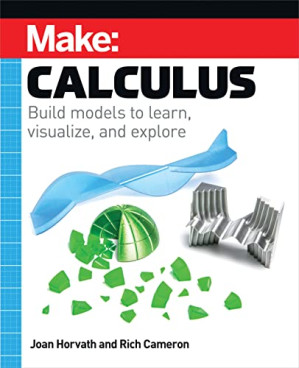
Make: Calculus: Build models to learn, visualize, and explore 🔍
Joan Horvath, Rich Cameron
O'Reilly Media, Incorporated; Make Community, LLC, 1, Revised, PS, 2022
英语 [en] · EPUB · 20.9MB · 2022 · 📘 非小说类图书 · 🚀/lgli/lgrs/nexusstc/zlib · Save
描述
"When Isaac Newton developed calculus in the 1600s, he was trying to tie together math and physics in an intuitive, geometrical way. But over time math and physics teaching became heavily weighted toward algebra, and less toward geometrical problem solving. However, many practicing mathematicians and physicists will get their intuition geometrically first and do the algebra later. Make: Calculus imagines how Newton might have used 3D printed models, construction toys, programming, craft materials, and an Arduino or two to teach calculus concepts in an intuitive way. The book uses as little reliance on algebra as possible while still retaining enough to allow comparison with a traditional curriculum. This book is not a traditional Calculus I textbook. Rather, it will take the reader on a tour of key concepts in calculus that lend themselves to hands-on projects. This book also defines terms and common symbols for them so that self-learners can learn more on their own"-- Provided by publisher
备用文件名
lgli/Make Calculus.epub
备用文件名
lgrsnf/Make Calculus.epub
备用文件名
zlib/Mathematics/Analysis/Joan Horvath, Rich Cameron/Make: Calculus: Build models to learn, visualize, and explore_23121172.epub
备选标题
Calculus : learn with 3d prints, lego, coding, and electronics
备选作者
Horvath, Joan, Cameron, Rich
备用出版商
Maker Media, Incorported
备用版本
Mathematics/Calculus, First edition, Santa Rosa, CA, 2022
备用版本
Maker Media, Inc (O'Reilly), Sebastopol, CA, 2022
备用版本
United States, United States of America
元数据中的注释
It's says it's "True EPUB", whatever that means.
元数据中的注释
{"edition":"1","isbns":["168045739X","9781680457391"],"last_page":327,"publisher":"Make Community"}
备用描述
PREFACE
Who This Book Is For
WHAT WE ASSUME YOU KNOW ALREADY
TEACHING AND LEARNING WITH THIS BOOK
Developing a Hands-on Calculus Course
3D Printable Models
Chapter Layout
ACKNOWLEDGMENTS
ABOUT THE AUTHORS
CHAPTER 1: THE FUNDAMENTAL THEOREM
BUILDING CALCULUS
The Steadily-Increasing Wall
The Curved Wall
Negative Changes
Examples to Try
MEASURING REAL-WORLD CHANGE
Instantaneous Slope
Looking Ahead
SECOND FUNDAMENTAL THEOREM
CHAPTER KEY POINTS
TERMINOLOGY AND SYMBOLS
SOLUTIONS
CHAPTER 2: CALCULUS AND ITS LIMITS
WHAT IS CALCULUS?
FUNCTIONS
WHEN OUR BRICK MODELS FAIL
Limits
DERIVATIVES AND CURVES
Fundamental Theorem Model
DIMENSIONAL ANALYSIS
EQUAL, BUT NOT THE SAME
CHAPTER KEY POINTS
TERMINOLOGY AND SYMBOLS
REFERENCES
CHAPTER 3: 3D PRINTED MODELS
OPENSCAD
OpenSCAD Workflow
Idiosyncrasies of OpenSCAD
Navigating on the Screen
Comments
THE MODELS
Example 1: Changing a Parameter
Example 2: Changing a Model With the Customizer
Some Models Have Small Parts
Downloading the Models: Github
3D PRINTING
3D Printing Workflow
MATERIALS
Printing Tips
IF YOU DO NOT HAVE A 3D PRINTER
CHAPTER KEY POINTS
TERMINOLOGY AND SYMBOLS
LEARNING MORE
CHAPTER 4: DERIVATIVES: THE BASICS
THE DERIVATIVE-INTEGRAL MODEL
Model Parameters
Using Other LEGO Bricks
Testing Your Derivatives
Customizer Workarounds
Plotting Curves and Derivatives Not in the Customizer
Paper Models
INSTANTANEOUS SLOPE
Tangent Lines
The Mean Value Theorem
EXAMPLES
Derivatives of Other Powers of x
Sines and Cosines
Degrees, Radians, and Pi
Exponential Growth
Offset Calculation
Euler’s Number, e
Logarithms
Exponential Curve Offset
Experiments to Try
CHAPTER KEY POINTS
TERMINOLOGY AND SYMBOLS
REFERENCES
CHAPTER 5: USING AND CALCULATING DERIVATIVES
MAXIMA, MINIMA, INFLECTION POINTS
Second Derivatives
Inflection Points
Other Inflection Point Situations
Sketching a Curve From Its Derivatives
CALCULATING DERIVATIVES
The Chain Rule
Derivatives of Products and Quotients
Derivative of a Product
Derivative of a Quotient
L’Hôpital’s Rule
OTHER WAYS OF WRITING DERIVATIVES
PARTIAL DERIVATIVES
Modeling the Surface
Modeling the Partial Derivatives
Higher-Order Partial Derivatives
CHAPTER KEY POINTS
TERMINOLOGY AND SYMBOLS
EXERCISE ANSWERS
REFERENCES
CHAPTER 6: INTEGRALS: THE BASICS
WHAT IS AN INTEGRAL?
ASSEMBLING AN INTEGRAL
THE SECOND PART OF THE FUNDAMENTAL THEOREM OF CALCULUS
COMPUTING INTEGRALS
Indefinite Integrals (Antiderivatives)
Area Under a Curve
Area of a Region
Computing an Average
THE MEAN VALUE THEOREM, REPRISED
3D PRINTING INTEGRALS
INTEGRALS OF POWERS OF X
INTEGRALS OF SINE AND COSINE
INTEGRALS OF EXPONENTIALS
APPLICATION: PID CONTROLLERS
EXPERIMENTS TO TRY
CHAPTER KEY POINTS
TERMINOLOGY AND SYMBOLS
REFERENCES
CHAPTER 7: INTEGRALS AND VOLUME
3D Coordinates
VOLUMES OF REVOLUTION
Volume of a Cone
Method of Disks
Cavalieri’s Principle
Calculating With Method of Disks
Volumes of Other Solids of Revolution
Revolution Models
Surfaces of Revolution
COMPUTING VOLUME OF MORE GENERAL SOLIDS
Calculating Volume
Checking Our Results
Printing This Model
INTEGRAL OF A PRODUCT OR QUOTIENT
Integral of a Quotient
Doing the Algebra
Printing and Experimenting With the Model
VOLUME UNDER A SURFACE
CHAPTER KEY POINTS
TERMINOLOGY AND SYMBOLS
REFERENCES
CHAPTER 8: MODELING EXPONENTIAL GROWTH AND DECAY
ORDINARY DIFFERENTIAL EQUATIONS
Exponential Growth or Decay Equation
Radioactive Decay
Other Exponentials
The Logistic Equation
Math of Epidemics
DIFFERENCE EQUATIONS
Brick Model Reprise
Numerical Models of Derivatives
Numerical Models of Higher Derivatives
Error in Numerical Solutions
Error, Exponential Equation
Error, Logistic Equation
NUMERICAL MODELS OF INTEGRALS
WORKING WITH REAL DATA
CHAPTER KEY POINTS
TERMINOLOGY AND SYMBOLS
REFERENCES
CHAPTER 9: MODELING PERIODIC SYSTEMS
GOING AROUND IN CIRCLES
Phase Shifts
Sine and Cosine Derivative Relationships
Approximating Sine and Cosine
SIMPLE HARMONIC MOTION
Second Order Ordinary Differential Equations
Spring Experiment
Pendulum Experiment
SYSTEMS OF DIFFERENTIAL EQUATIONS
Reprising the Logistic Equation
The Lotka-Volterra Equations
Population Behavior Over Time
Exploring the Lotka-Volterra Equations
Creating the Models
Phase Space
Phase-Space Model
Slope Fields
Stable Point
Changing Population Ratios
Attofox Problem
SEPARATION OF VARIABLES
CHAPTER KEY POINTS
TERMINOLOGY AND SYMBOLS
REFERENCES
CHAPTER 10: CALCULUS, CIRCUITS, AND CODE
CALCULUS MODELS OF CIRCUITS
Simulating Circuits
DEFINITIONS AND UNITS OF ELECTRICAL COMPONENTS
RESISTOR, CAPACITOR, AND INDUCTOR CIRCUITS
RC Circuits
Capacitive Touch Sensing
LC Circuits
RL and RLC Circuits
Filters
ACCELEROMETERS AND GYROSCOPES
ACCELEROMETER MOUSE
Setting up a Circuit Playground Classic or Express
Arduino Sketch Structure
Algorithm for the Accelerometer Mouse
Circuit Playground Sketch for Accelerometer Mouse
Setting up the Mouse
Testing Out the Mouse
LIGHT-UP PENDULUM
Making the LED Pendulum
LED Pendulum Sketch
OTHER CIRCUIT PLAYGROUND ACCELEROMETER PROJECT IDEAS
PID CONTROLLERS
Temperature Control
Ball and Beam
Inverted Pendulums
CHAPTER KEY POINTS
TERMINOLOGY AND SYMBOLS
REFERENCES
CHAPTER 11: COORDINATE SYSTEMS AND VECTORS
CARTESIAN, POLAR, CYLINDRICAL, AND SPHERICAL COORDINATES
Creating the Models
Integrals and Derivatives in Polar Coordinates
VECTOR BASICS
Vector Addition
Method of Shells
Multiplying a Vector by a Scalar
COMPLEX NUMBERS
The Complex Plane
Raising Complex Numbers to a Power
VECTORS MEET CALCULUS
Vector Multiplication: Dot Product
Applying the Dot Product: Work
Vector Multiplication: Cross Product
Applying the Cross Product: Torque
Vector Fields
Grad, Div, and Curl
CHAPTER KEY POINTS
TERMINOLOGY AND SYMBOLS
REFERENCES
CHAPTER 12: SERIES
SEQUENCES VS. SERIES
SERIES
INFINITE SERIES
SERIES EXPANSIONS OF FUNCTIONS
Power Series
Taylor and Maclaurin Series
Maclaurin Series of Sine, Cosine, and Exponential
MODELING CONVERGENCE
Sinusoid Models
Exponential Model
Printing the Models
Broader Applications
Euler’s Equation
de Moivre’s Theorem
Proving Euler’s Equation
LIMITS AND SERIES
CHAPTER KEY POINTS
TERMINOLOGY AND SYMBOLS
REFERENCES
CHAPTER 13: YOUR TOOLBOX
CALCULATING INTEGRALS AND DERIVATIVES
INTEGRATION BY PARTS
TRIGONOMETRIC IDENTITIES
Cofunctions
Double Angles and Sums of Angles
Squared Functions
TRIGONOMETRIC SUBSTITUTION
MATH MODELING IN REAL LIFE
CHAPTER KEY POINTS
TERMINOLOGY AND SYMBOLS
RESOURCES FOR FURTHER STUDY
Useful Websites and Search Suggestions
CALCULATION RESOURCES
BOOKS
Who This Book Is For
WHAT WE ASSUME YOU KNOW ALREADY
TEACHING AND LEARNING WITH THIS BOOK
Developing a Hands-on Calculus Course
3D Printable Models
Chapter Layout
ACKNOWLEDGMENTS
ABOUT THE AUTHORS
CHAPTER 1: THE FUNDAMENTAL THEOREM
BUILDING CALCULUS
The Steadily-Increasing Wall
The Curved Wall
Negative Changes
Examples to Try
MEASURING REAL-WORLD CHANGE
Instantaneous Slope
Looking Ahead
SECOND FUNDAMENTAL THEOREM
CHAPTER KEY POINTS
TERMINOLOGY AND SYMBOLS
SOLUTIONS
CHAPTER 2: CALCULUS AND ITS LIMITS
WHAT IS CALCULUS?
FUNCTIONS
WHEN OUR BRICK MODELS FAIL
Limits
DERIVATIVES AND CURVES
Fundamental Theorem Model
DIMENSIONAL ANALYSIS
EQUAL, BUT NOT THE SAME
CHAPTER KEY POINTS
TERMINOLOGY AND SYMBOLS
REFERENCES
CHAPTER 3: 3D PRINTED MODELS
OPENSCAD
OpenSCAD Workflow
Idiosyncrasies of OpenSCAD
Navigating on the Screen
Comments
THE MODELS
Example 1: Changing a Parameter
Example 2: Changing a Model With the Customizer
Some Models Have Small Parts
Downloading the Models: Github
3D PRINTING
3D Printing Workflow
MATERIALS
Printing Tips
IF YOU DO NOT HAVE A 3D PRINTER
CHAPTER KEY POINTS
TERMINOLOGY AND SYMBOLS
LEARNING MORE
CHAPTER 4: DERIVATIVES: THE BASICS
THE DERIVATIVE-INTEGRAL MODEL
Model Parameters
Using Other LEGO Bricks
Testing Your Derivatives
Customizer Workarounds
Plotting Curves and Derivatives Not in the Customizer
Paper Models
INSTANTANEOUS SLOPE
Tangent Lines
The Mean Value Theorem
EXAMPLES
Derivatives of Other Powers of x
Sines and Cosines
Degrees, Radians, and Pi
Exponential Growth
Offset Calculation
Euler’s Number, e
Logarithms
Exponential Curve Offset
Experiments to Try
CHAPTER KEY POINTS
TERMINOLOGY AND SYMBOLS
REFERENCES
CHAPTER 5: USING AND CALCULATING DERIVATIVES
MAXIMA, MINIMA, INFLECTION POINTS
Second Derivatives
Inflection Points
Other Inflection Point Situations
Sketching a Curve From Its Derivatives
CALCULATING DERIVATIVES
The Chain Rule
Derivatives of Products and Quotients
Derivative of a Product
Derivative of a Quotient
L’Hôpital’s Rule
OTHER WAYS OF WRITING DERIVATIVES
PARTIAL DERIVATIVES
Modeling the Surface
Modeling the Partial Derivatives
Higher-Order Partial Derivatives
CHAPTER KEY POINTS
TERMINOLOGY AND SYMBOLS
EXERCISE ANSWERS
REFERENCES
CHAPTER 6: INTEGRALS: THE BASICS
WHAT IS AN INTEGRAL?
ASSEMBLING AN INTEGRAL
THE SECOND PART OF THE FUNDAMENTAL THEOREM OF CALCULUS
COMPUTING INTEGRALS
Indefinite Integrals (Antiderivatives)
Area Under a Curve
Area of a Region
Computing an Average
THE MEAN VALUE THEOREM, REPRISED
3D PRINTING INTEGRALS
INTEGRALS OF POWERS OF X
INTEGRALS OF SINE AND COSINE
INTEGRALS OF EXPONENTIALS
APPLICATION: PID CONTROLLERS
EXPERIMENTS TO TRY
CHAPTER KEY POINTS
TERMINOLOGY AND SYMBOLS
REFERENCES
CHAPTER 7: INTEGRALS AND VOLUME
3D Coordinates
VOLUMES OF REVOLUTION
Volume of a Cone
Method of Disks
Cavalieri’s Principle
Calculating With Method of Disks
Volumes of Other Solids of Revolution
Revolution Models
Surfaces of Revolution
COMPUTING VOLUME OF MORE GENERAL SOLIDS
Calculating Volume
Checking Our Results
Printing This Model
INTEGRAL OF A PRODUCT OR QUOTIENT
Integral of a Quotient
Doing the Algebra
Printing and Experimenting With the Model
VOLUME UNDER A SURFACE
CHAPTER KEY POINTS
TERMINOLOGY AND SYMBOLS
REFERENCES
CHAPTER 8: MODELING EXPONENTIAL GROWTH AND DECAY
ORDINARY DIFFERENTIAL EQUATIONS
Exponential Growth or Decay Equation
Radioactive Decay
Other Exponentials
The Logistic Equation
Math of Epidemics
DIFFERENCE EQUATIONS
Brick Model Reprise
Numerical Models of Derivatives
Numerical Models of Higher Derivatives
Error in Numerical Solutions
Error, Exponential Equation
Error, Logistic Equation
NUMERICAL MODELS OF INTEGRALS
WORKING WITH REAL DATA
CHAPTER KEY POINTS
TERMINOLOGY AND SYMBOLS
REFERENCES
CHAPTER 9: MODELING PERIODIC SYSTEMS
GOING AROUND IN CIRCLES
Phase Shifts
Sine and Cosine Derivative Relationships
Approximating Sine and Cosine
SIMPLE HARMONIC MOTION
Second Order Ordinary Differential Equations
Spring Experiment
Pendulum Experiment
SYSTEMS OF DIFFERENTIAL EQUATIONS
Reprising the Logistic Equation
The Lotka-Volterra Equations
Population Behavior Over Time
Exploring the Lotka-Volterra Equations
Creating the Models
Phase Space
Phase-Space Model
Slope Fields
Stable Point
Changing Population Ratios
Attofox Problem
SEPARATION OF VARIABLES
CHAPTER KEY POINTS
TERMINOLOGY AND SYMBOLS
REFERENCES
CHAPTER 10: CALCULUS, CIRCUITS, AND CODE
CALCULUS MODELS OF CIRCUITS
Simulating Circuits
DEFINITIONS AND UNITS OF ELECTRICAL COMPONENTS
RESISTOR, CAPACITOR, AND INDUCTOR CIRCUITS
RC Circuits
Capacitive Touch Sensing
LC Circuits
RL and RLC Circuits
Filters
ACCELEROMETERS AND GYROSCOPES
ACCELEROMETER MOUSE
Setting up a Circuit Playground Classic or Express
Arduino Sketch Structure
Algorithm for the Accelerometer Mouse
Circuit Playground Sketch for Accelerometer Mouse
Setting up the Mouse
Testing Out the Mouse
LIGHT-UP PENDULUM
Making the LED Pendulum
LED Pendulum Sketch
OTHER CIRCUIT PLAYGROUND ACCELEROMETER PROJECT IDEAS
PID CONTROLLERS
Temperature Control
Ball and Beam
Inverted Pendulums
CHAPTER KEY POINTS
TERMINOLOGY AND SYMBOLS
REFERENCES
CHAPTER 11: COORDINATE SYSTEMS AND VECTORS
CARTESIAN, POLAR, CYLINDRICAL, AND SPHERICAL COORDINATES
Creating the Models
Integrals and Derivatives in Polar Coordinates
VECTOR BASICS
Vector Addition
Method of Shells
Multiplying a Vector by a Scalar
COMPLEX NUMBERS
The Complex Plane
Raising Complex Numbers to a Power
VECTORS MEET CALCULUS
Vector Multiplication: Dot Product
Applying the Dot Product: Work
Vector Multiplication: Cross Product
Applying the Cross Product: Torque
Vector Fields
Grad, Div, and Curl
CHAPTER KEY POINTS
TERMINOLOGY AND SYMBOLS
REFERENCES
CHAPTER 12: SERIES
SEQUENCES VS. SERIES
SERIES
INFINITE SERIES
SERIES EXPANSIONS OF FUNCTIONS
Power Series
Taylor and Maclaurin Series
Maclaurin Series of Sine, Cosine, and Exponential
MODELING CONVERGENCE
Sinusoid Models
Exponential Model
Printing the Models
Broader Applications
Euler’s Equation
de Moivre’s Theorem
Proving Euler’s Equation
LIMITS AND SERIES
CHAPTER KEY POINTS
TERMINOLOGY AND SYMBOLS
REFERENCES
CHAPTER 13: YOUR TOOLBOX
CALCULATING INTEGRALS AND DERIVATIVES
INTEGRATION BY PARTS
TRIGONOMETRIC IDENTITIES
Cofunctions
Double Angles and Sums of Angles
Squared Functions
TRIGONOMETRIC SUBSTITUTION
MATH MODELING IN REAL LIFE
CHAPTER KEY POINTS
TERMINOLOGY AND SYMBOLS
RESOURCES FOR FURTHER STUDY
Useful Websites and Search Suggestions
CALCULATION RESOURCES
BOOKS
开源日期
2022-09-24
We strongly recommend that you support the author by buying or donating on their personal website, or borrowing in your local library.
🚀 快速下载
成为会员以支持书籍、论文等的长期保存。为了感谢您对我们的支持,您将获得高速下载权益。❤️
🐢 低速下载
由可信的合作方提供。 更多信息请参见常见问题解答。 (可能需要验证浏览器——无限次下载!)
- 低速服务器(合作方提供) #1 (稍快但需要排队)
- 低速服务器(合作方提供) #2 (稍快但需要排队)
- 低速服务器(合作方提供) #3 (稍快但需要排队)
- 低速服务器(合作方提供) #4 (稍快但需要排队)
- 低速服务器(合作方提供) #5 (无需排队,但可能非常慢)
- 低速服务器(合作方提供) #6 (无需排队,但可能非常慢)
- 低速服务器(合作方提供) #7 (无需排队,但可能非常慢)
- 低速服务器(合作方提供) #8 (无需排队,但可能非常慢)
- 低速服务器(合作方提供) #9 (无需排队,但可能非常慢)
- 下载后: 在我们的查看器中打开
所有选项下载的文件都相同,应该可以安全使用。即使这样,从互联网下载文件时始终要小心。例如,确保您的设备更新及时。
外部下载
-
对于大文件,我们建议使用下载管理器以防止中断。
推荐的下载管理器:JDownloader -
您将需要一个电子书或 PDF 阅读器来打开文件,具体取决于文件格式。
推荐的电子书阅读器:Anna的档案在线查看器、ReadEra和Calibre -
使用在线工具进行格式转换。
推荐的转换工具:CloudConvert和PrintFriendly -
您可以将 PDF 和 EPUB 文件发送到您的 Kindle 或 Kobo 电子阅读器。
推荐的工具:亚马逊的“发送到 Kindle”和djazz 的“发送到 Kobo/Kindle” -
支持作者和图书馆
✍️ 如果您喜欢这个并且能够负担得起,请考虑购买原版,或直接支持作者。
📚 如果您当地的图书馆有这本书,请考虑在那里免费借阅。
下面的文字仅以英文继续。
总下载量:
“文件的MD5”是根据文件内容计算出的哈希值,并且基于该内容具有相当的唯一性。我们这里索引的所有影子图书馆都主要使用MD5来标识文件。
一个文件可能会出现在多个影子图书馆中。有关我们编译的各种数据集的信息,请参见数据集页面。
有关此文件的详细信息,请查看其JSON 文件。 Live/debug JSON version. Live/debug page.