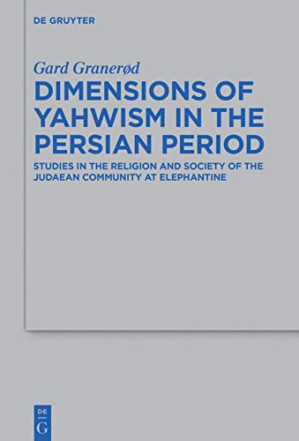
upload/cgiym_more/PBooks Collection 2023/Classics Archive/De Gruyter Edition/Beihefte zur Zeitschrift für die alttestamentliche Wissenschaft (C)/488. Gard Granerød - Dimensions of Yahwism in the Persian Period. Studies in the Religion and Society of the Judaean Community at Elephantine (Beihefte zur Zeitschrift für die alttestamentliche Wissenschaft)[Retail].pdf
Dimensions of Yahwism in the Persian Period: Studies in the Religion and Society of the Judaean Community at Elephantine (Beihefte Zur Zeitschrift Fur ... fur die Alttestamentliche Wissenschaft, 488) 🔍
Gard Granerød; Walter de Gruyter GmbH & Co. KG
de Gruyter GmbH, Walter, Beihefte zur Zeitschrift fur die Alttestamentliche Wissenschaft; 488, 488, 1, 2016
英语 [en] · PDF · 2.9MB · 2016 · 📘 非小说类图书 · 🚀/lgli/lgrs/nexusstc/upload/zlib · Save
描述
What was Judaean religion in the Persian period like? Is it necessary to use the Bible to give an answer to the question? Among other things the study argues that • the religion practiced in the 5th c. BCE Elephantine community and which is reflected in the so-called Elephantine documents represent a well-attested manifestation of lived Persian period Yahwism,• as religio-historical sources, the Elephantine documents reveal more about the actual religious practice of the Elephantine Judaeans than what the highly edited and canonised texts of the Bible reveal about the religious practice of the contemporary Yahwistic coreligionists in Judah, and• the image of the Elephantine Judaism emerging from the Elephantine documents can revise the canonised image of Judaean religion in the Persian period (cf. A. Assmann). The Elephantine Yahwism should not be interpreted within a framework dependent upon theological, conceptual and spatial concepts alien to it, such as biblical ones. The study proposes an alternative framework by approaching the Elephantine documents on the basis of N. Smart’s multidimensional model of religion. Elephantine should not be exotified but brought to the very centre of any discussion of the history of Judaism.
Erscheinungsdatum: 25.07.2016
Erscheinungsdatum: 25.07.2016
备用文件名
upload/degruyter/Degruyter Imprints v2 [09-06-23]/bzaw-b/10.1515_9783110454314.pdf
备用文件名
nexusstc/Dimensions of Yahwism in the Persian Period: Studies in the Religion and Society of the Judaean Community at Elephantine/3917f61926cd22724bac8d52c2531d6b.pdf
备用文件名
lgli/488. Gard Granerød - Dimensions of Yahwism in the Persian Period. Studies in the Religion and Society of the Judaean Community at Elephantine (Beihefte zur Zeitschrift für die alttestamentliche Wissenschaft)[Retail].pdf
备用文件名
lgrsnf/488. Gard Granerød - Dimensions of Yahwism in the Persian Period. Studies in the Religion and Society of the Judaean Community at Elephantine (Beihefte zur Zeitschrift für die alttestamentliche Wissenschaft)[Retail].pdf
备用文件名
zlib/Religion & Spirituality/Bible/Gard Granerød/Dimensions of Yahwism in the Persian Period: Studies in the Religion and Society of the Judaean Community at Elephantine_24520417.pdf
备选作者
Adobe Acrobat Pro 10.1.16
备选作者
Granerød, Gard
备用出版商
Saur, K. G., Verlag. ein Imprint der Walter de Gruyter GmbH
备用出版商
düsseldorf university press. in Walter de Gruyter GmbH
备用出版商
de Gruyter, Walter, GmbH
备用版本
Beihefte zur Zeitschrift für die alttestamentliche Wissenschaft, volume 488, Berlin ; Boston, 2016
备用版本
Zeitschrift für die alttestamentliche Wissenschaft / Beihefte, Berlin, 2016
备用版本
De Gruyter, Berlin, 2016
备用版本
Digital original, 2016
备用版本
Germany, Germany
元数据中的注释
producers:
Adobe Acrobat Pro 10.1.16
Adobe Acrobat Pro 10.1.16
元数据中的注释
{"isbns":["3110452111","3110454319","9783110452112","9783110454314"],"last_page":406,"publisher":"De Gruyter"}
备用描述
Contents 11
Abbreviations 19
1. Introduction 23
1.1 Problem and Hypotheses 23
1.1.1 Excursus: The Distance between Elephantine and Jerusalem 28
1.2 “Religion,” “Dimensions of Religion,” and “Religion Here, There, and Anywhere” 31
1.3 The Present Study in the Context of Positions in the History of Research 40
1.3.1 A Relic from the Preexilic Period? 40
1.3.2 Typical or Contemporary Judaean Religion? 42
1.3.3 Elephantine As an Archive Challenging the Canon 43
1.4 Outline of the Book 45
2. The Social Dimension 46
2.1 “The Judaean Garrison” 46
2.2 Judaean Identity in Elephantine 51
2.3 The Leaders of the Judaean Community 54
2.3.1 Jedaniah and the Priests of YHW 55
2.3.2 Hananiah 56
2.3.3 The Group of Five Syenians Who Were “Hereditary Property Holders” (mh?snn) in Elephantine 60
2.3.4 The Political and Religious Leaders of Judah and Samaria 63
2.4 Law 67
2.4.1 Oath Procedures, Courts, and Judges 67
2.4.2 Marriage and Inheritance 71
2.5 Judaean and Non-Judaean Religious Specialists 73
2.5.1 “Priest” (khn) and “Priest” (kmr) 73
2.5.1.1 Who Became Priests of YHW in Elephantine, and How? 76
2.5.2 “Servitor” (l?n), “Servant” (?bd), and “Gardener” (gnn) 79
2.6 The Economy of the Temple of YHW 80
2.6.1 Direct and Indirect Economic Support of Cults: A Survey 81
2.6.1.1 Concession Lands 81
2.6.1.2 Direct Payments from the Royal/Satrapal Treasuries 84
2.6.1.2.1 The Persepolis Tablets and the Persepolis Pantheon 84
2.6.1.2.2 Ezra–Nehemiah and the Jerusalem Temple 85
2.6.1.3 Indirect Economic Support 85
2.6.1.3.1 Tax Exemption 85
2.6.1.3.2 Privilege to Levy Taxes and the Exemption from Corvée Labour 86
2.6.2 Aspects of the Economic Structures in Achaemenid Egypt 87
2.6.3 The Temple of YHW 89
2.6.3.1 Arguments from (Loud) Silence 89
2.6.3.2 Positive Arguments 91
2.6.4 The Economy: Conclusion 95
2.6.5 Where Did the Elephantine Judaeans Get Their Means? 96
2.7 The Organisation of Time 97
2.8 Chapter Summary 101
3. The Material Dimension 103
3.1 The Temple of YHW in the Textual Sources 103
3.1.1 Legal Documents 104
3.1.2 Private Correspondence 105
3.1.3 Official Correspondence 107
3.1.3.1 A4.5 108
3.1.3.2 A4.7 and A4.8 108
3.1.3.3 A4.9 and A4.10 109
3.1.4 Milestones in the History of the Temple 110
3.1.4.1 The Origin: Before 525 BCE 110
3.1.4.2 The Destruction: Ca. 410 BCE 111
3.1.4.3 Still in Ruins: 407 BCE 112
3.1.4.4 Rebuilt around 402 BCE? 112
3.1.5 The Textual Evidence for the Inventory and the Architecture 114
3.2 The Temple of YHW and the Archaeology of Elephantine 117
3.2.1 The Continuity of the Urban Fabric 117
3.2.2 The Second Temple of YHW 120
3.2.3 The First Temple of YHW 123
3.2.4 Stephen G. Rosenberg’s Reconstruction 124
3.3 Aspects of a “Elephantine Temple Theology” in Light of the Material Dimension 126
3.3.1 A Real Temple? 126
3.3.2 “The Pillars of Stone” (?mwdy? zy ?bn?): ma???bôt or Entry Pillars? 131
3.3.3 Concentric Circles of Sanctity 135
3.3.4 “The Five Great Gateways,” the Proximity to the Residential Areas and the Possible Participation of the Laity in the Cult 136
3.3.5 (Sacred) Orientation toward Jerusalem? 138
3.3.5.1 The Concept of Sacred Direction in Yahwistic Textual Sources 141
3.3.5.2 The Longitudinal Orientation of the Temple in the Light of the General Orientation of the Ancient Town 144
3.3.5.3 Conclusion 145
3.3.6 Rival, Succeeding, or Complementary? 146
3.4 Chapter Summary 148
4. The Ritual Dimension 150
4.1 Rituals: Repeatable, Interpersonal and Purpose-Driven 150
4.2 Sacrifices 151
4.2.1 The Agents and Beneficiaries of the Sacrifices 154
4.2.1.1 Excursus: Sacrifice as Atonement? 156
4.2.2 Sacrifices as Measurable and Assessable Commodities 158
4.2.3 Resumption of Cereal Offerings, Cessation of Burnt Offerings 162
4.2.3.1 A Veto Out of Consideration for Persian Theological Concepts? 164
4.2.3.2 A Veto out of Consideration for the Priests of Khnum? 164
4.2.3.3 A Veto out of Consideration for the Privileges of the Jerusalem Temple? 165
4.2.3.4 Suggestion: A Veto out of Consideration for the Satrap Arshama 167
4.2.4 Why and How Could the Elephantine Community Theologically Legitimate the Veto on Burnt Offerings? 169
4.3 Communal Rites of Mourning 172
4.4 Communal and Individual Prayers 176
4.4.1 A Communal Prayer of Intercession 176
4.4.2 A Communal Prayer of Curse 177
4.4.3 Individual Prayers 182
4.4.3.1 Epistolary Salutations 183
4.4.3.2 Proper Names 184
4.4.3.3 Profane Swearing 186
4.4.4 Summary 187
4.5 The Passover and the Festival of Unleavened Bread 187
4.5.1 A Potential Terminological Pitfall 187
4.5.2 D7.24 “On the Passover” and D7.6 “Inform Me When You Will Make the Passover!” 188
4.5.3 The Festival(s) According to A4.1 (the So-Called Passover Letter) 190
4.5.3.1 Rather a Letter on the Festival of Unleavened Bread? 192
4.5.3.2 Should a Restoration Be Made on the Basis of the Bible? 194
4.5.3.3 Any References to the Passover and the Passover Sacrifice? 197
4.5.3.4 Did the Letter Signal a Change of the Social Sphere of the Festival(s)? 198
4.5.3.5 The Purpose of Hananiah’s Letter: Not to Introduce but to Fix the Date 199
4.5.3.6 The Purpose of Hananiah’s Letter: To Regulate out of Consideration for the Economy and the Stability? 200
4.6 The Sabbath in Elephantine 204
4.6.1 The Sabbath as an Identity Marker in the Last Half of the First Millennium BCE in Biblical and Intertestamental Literature 204
4.6.2 What Kind of Sabbath: A Lunar Sabbath or the Seventh Day of a Seven-Day Week? 207
4.6.3 The Terminology: Hebrew šabbat and Egyptian Aramaic šbh 209
4.6.4 šbh: The Sources 213
4.6.4.1 The Fragmentary Reference to šbh in D7.10; D7.12; D7.28; D7.35; and D7.48 214
4.6.4.2 D7.16 215
4.6.4.3 D7.8 and Clermont-Ganneau 204 217
4.6.5 The Personal Names šbty and šbtyt 218
4.6.5.1 A2.1 (Late Sixth/Early Fifth Century BCE): “Greetings (to) Shabbethai Son of Shug” 218
4.6.5.2 B4.4 (483 BCE): The Witness Shabbethai son of Kibda/ Kibra 219
4.6.5.3 B3.9 (416 BCE): The Witness Sinkishir Son of Shabbethai 220
4.6.5.4 D18.18 (Elephantine Museum 2605): A Sarcophagus from Aswan with Aramaic Inscription 220
4.6.5.5 The Remaining Occurrences 222
4.6.5.6 Is the Name Shabbethai a Relevant Source? 222
4.6.6 The Sabbath: Summary and Conclusion 226
4.7 Chapter Summary 228
5. The Mythic and Narrative Dimension 231
5.1 Introduction 231
5.2 Judaean Myths of Creation in Elephantine? 234
5.3 The Elephantine Judaean Temple Foundation Narrative 236
5.3.1 Outline of the History of the Temple 238
5.3.2 Traditum in the Petition to the Governor of the Persian Province of Judah 239
5.3.3 Traditio and Tradentes According to the Petition to Bahavahya and the Subsequent Correspondence 241
5.3.4 Alteration of the Traditum (A4.9 and A4.10) 242
5.3.5 Summary and Perspectives 245
5.4 Myths about Sacral Kingship 249
5.4.1 The Egyptian and Ancient Near Eastern Context 250
5.4.1.1 Egyptian Royal Myths 250
5.4.1.2 Israelite–Judaean Royal Myths 251
5.4.1.3 Mesopotamian Legendary Tales about Ancient Kings 252
5.4.2 Sacral Kingship and the Official Royal Achaemenid Ideology 255
5.4.3 Achaemenid Propaganda and Judaean Myths about Sacral Kingship 262
5.5 Traces of Judaean and Other Pantheons 266
5.5.1 The Egyptian Pantheon 267
5.5.2 The Pantheons of the Garrisons in Syene and Elephantine 267
5.5.3 The Relationship between YHW and the Other Gods 274
5.5.3.1 YHW and Ahuramazda 275
5.5.3.2 YHW and the Other Gods 277
5.5.3.3 An Operational Theology of Religion 278
5.6 Chapter Summary 278
6. The Ethical Dimension 281
6.1 Introduction 281
6.1.1 The Relevant Sources 281
6.1.1.1 The Native Judaean Sources from Elephantine 282
6.1.1.2 The Non-Native Sources 282
6.1.2 The Taxonomy 284
6.2 The Human and the Deities in the Native Sources 285
6.2.1 The Ethical Aspects of the Oath Practice 286
6.2.2 Ethical Aspects of the So-Called Vidranga Section 290
6.3 The Human and the Humans in the Native Sources 292
6.3.1 The View on Animals as Backdrop of the Anthropology 292
6.3.2 The View on Work 294
6.3.3 The View on Slaves 301
6.3.3.1 The Status of Children Borne by a Slave 304
6.3.3.2 Manumission and Adoption 308
6.3.3.3 The Background of the Emancipation Formularies 310
6.3.3.4 The Function of the Emancipation Formularies 312
6.3.4 The View on Gender and Family Matters 314
6.3.4.1 The Marriage 314
6.3.4.1.1 Some Observations Concerning the Marriage 322
6.3.4.2 More on Women’s Legal Status 323
6.3.4.3 The Household as the Basic Unit of Society 325
6.4 The Human and the Authorities of Society in the Native Sources 326
6.5 The Ethical Instruction of the Non-Native Sources (DB Aram and A?iqar) 329
6.5.1 The Words of A?iqar (C1.1) 330
6.5.1.1 Outline 330
6.5.1.2 Provenance 331
6.5.1.3 The Human and the Deities 333
6.5.1.3.1 The Gods and Wisdom 333
6.5.1.3.2 The Gods and Determinism 335
6.5.1.3.3 The Gods and Retribution 337
6.5.1.4 The Human and the Other Humans 339
6.5.1.5 The Human and the Authorities of Society 340
6.5.2 The Aramaic Version of the Bisitun Inscription (C2.1) 342
6.5.3 The Relevance of the Non-Native Sources 343
6.6 Chapter Summary 344
7. Conclusion and Outlook 346
7.1 The Dimensions of Yahwism in General and in Elephantine in Particular 346
7.2 Contributions and Findings 347
7.2.1 Yahwistic Diversity 347
7.2.2 The Ordinariness of the Yahwism in Elephantine 348
7.2.3 The Suitability (and Limitations) of Smart’s Multi-Dimensional Model of Religion 349
7.2.4 Selected Original Particular Findings 352
7.2.5 YHWH, a God Also Dwelling in Africa: Yahwism in Elephantine as a Challenge for Biblical Scholarship 353
7.3 Recommendations for Future Research: Elephantine in a Comparative Perspective 355
7.3.1 The Judaean Diaspora in Babylonia in Neo-Babylonian and Achaemenid Periods 356
7.3.2 The Israelite (“Samaritan”) Diaspora in the Aegean in the Second Century BCE 358
7.3.3 Preliminary Outcomes and Prospects of a Comparison 359
7.4 End: Elephantine As an Archive Challenging the Canon 361
Bibliography 363
Index of Ancient Sources 378
Index of Aramaic, Hebrew, Old Persian and Greek Words 391
Index of Ancient Names, Deities and Epithets 395
Index of Modern Authors 401
Abbreviations 19
1. Introduction 23
1.1 Problem and Hypotheses 23
1.1.1 Excursus: The Distance between Elephantine and Jerusalem 28
1.2 “Religion,” “Dimensions of Religion,” and “Religion Here, There, and Anywhere” 31
1.3 The Present Study in the Context of Positions in the History of Research 40
1.3.1 A Relic from the Preexilic Period? 40
1.3.2 Typical or Contemporary Judaean Religion? 42
1.3.3 Elephantine As an Archive Challenging the Canon 43
1.4 Outline of the Book 45
2. The Social Dimension 46
2.1 “The Judaean Garrison” 46
2.2 Judaean Identity in Elephantine 51
2.3 The Leaders of the Judaean Community 54
2.3.1 Jedaniah and the Priests of YHW 55
2.3.2 Hananiah 56
2.3.3 The Group of Five Syenians Who Were “Hereditary Property Holders” (mh?snn) in Elephantine 60
2.3.4 The Political and Religious Leaders of Judah and Samaria 63
2.4 Law 67
2.4.1 Oath Procedures, Courts, and Judges 67
2.4.2 Marriage and Inheritance 71
2.5 Judaean and Non-Judaean Religious Specialists 73
2.5.1 “Priest” (khn) and “Priest” (kmr) 73
2.5.1.1 Who Became Priests of YHW in Elephantine, and How? 76
2.5.2 “Servitor” (l?n), “Servant” (?bd), and “Gardener” (gnn) 79
2.6 The Economy of the Temple of YHW 80
2.6.1 Direct and Indirect Economic Support of Cults: A Survey 81
2.6.1.1 Concession Lands 81
2.6.1.2 Direct Payments from the Royal/Satrapal Treasuries 84
2.6.1.2.1 The Persepolis Tablets and the Persepolis Pantheon 84
2.6.1.2.2 Ezra–Nehemiah and the Jerusalem Temple 85
2.6.1.3 Indirect Economic Support 85
2.6.1.3.1 Tax Exemption 85
2.6.1.3.2 Privilege to Levy Taxes and the Exemption from Corvée Labour 86
2.6.2 Aspects of the Economic Structures in Achaemenid Egypt 87
2.6.3 The Temple of YHW 89
2.6.3.1 Arguments from (Loud) Silence 89
2.6.3.2 Positive Arguments 91
2.6.4 The Economy: Conclusion 95
2.6.5 Where Did the Elephantine Judaeans Get Their Means? 96
2.7 The Organisation of Time 97
2.8 Chapter Summary 101
3. The Material Dimension 103
3.1 The Temple of YHW in the Textual Sources 103
3.1.1 Legal Documents 104
3.1.2 Private Correspondence 105
3.1.3 Official Correspondence 107
3.1.3.1 A4.5 108
3.1.3.2 A4.7 and A4.8 108
3.1.3.3 A4.9 and A4.10 109
3.1.4 Milestones in the History of the Temple 110
3.1.4.1 The Origin: Before 525 BCE 110
3.1.4.2 The Destruction: Ca. 410 BCE 111
3.1.4.3 Still in Ruins: 407 BCE 112
3.1.4.4 Rebuilt around 402 BCE? 112
3.1.5 The Textual Evidence for the Inventory and the Architecture 114
3.2 The Temple of YHW and the Archaeology of Elephantine 117
3.2.1 The Continuity of the Urban Fabric 117
3.2.2 The Second Temple of YHW 120
3.2.3 The First Temple of YHW 123
3.2.4 Stephen G. Rosenberg’s Reconstruction 124
3.3 Aspects of a “Elephantine Temple Theology” in Light of the Material Dimension 126
3.3.1 A Real Temple? 126
3.3.2 “The Pillars of Stone” (?mwdy? zy ?bn?): ma???bôt or Entry Pillars? 131
3.3.3 Concentric Circles of Sanctity 135
3.3.4 “The Five Great Gateways,” the Proximity to the Residential Areas and the Possible Participation of the Laity in the Cult 136
3.3.5 (Sacred) Orientation toward Jerusalem? 138
3.3.5.1 The Concept of Sacred Direction in Yahwistic Textual Sources 141
3.3.5.2 The Longitudinal Orientation of the Temple in the Light of the General Orientation of the Ancient Town 144
3.3.5.3 Conclusion 145
3.3.6 Rival, Succeeding, or Complementary? 146
3.4 Chapter Summary 148
4. The Ritual Dimension 150
4.1 Rituals: Repeatable, Interpersonal and Purpose-Driven 150
4.2 Sacrifices 151
4.2.1 The Agents and Beneficiaries of the Sacrifices 154
4.2.1.1 Excursus: Sacrifice as Atonement? 156
4.2.2 Sacrifices as Measurable and Assessable Commodities 158
4.2.3 Resumption of Cereal Offerings, Cessation of Burnt Offerings 162
4.2.3.1 A Veto Out of Consideration for Persian Theological Concepts? 164
4.2.3.2 A Veto out of Consideration for the Priests of Khnum? 164
4.2.3.3 A Veto out of Consideration for the Privileges of the Jerusalem Temple? 165
4.2.3.4 Suggestion: A Veto out of Consideration for the Satrap Arshama 167
4.2.4 Why and How Could the Elephantine Community Theologically Legitimate the Veto on Burnt Offerings? 169
4.3 Communal Rites of Mourning 172
4.4 Communal and Individual Prayers 176
4.4.1 A Communal Prayer of Intercession 176
4.4.2 A Communal Prayer of Curse 177
4.4.3 Individual Prayers 182
4.4.3.1 Epistolary Salutations 183
4.4.3.2 Proper Names 184
4.4.3.3 Profane Swearing 186
4.4.4 Summary 187
4.5 The Passover and the Festival of Unleavened Bread 187
4.5.1 A Potential Terminological Pitfall 187
4.5.2 D7.24 “On the Passover” and D7.6 “Inform Me When You Will Make the Passover!” 188
4.5.3 The Festival(s) According to A4.1 (the So-Called Passover Letter) 190
4.5.3.1 Rather a Letter on the Festival of Unleavened Bread? 192
4.5.3.2 Should a Restoration Be Made on the Basis of the Bible? 194
4.5.3.3 Any References to the Passover and the Passover Sacrifice? 197
4.5.3.4 Did the Letter Signal a Change of the Social Sphere of the Festival(s)? 198
4.5.3.5 The Purpose of Hananiah’s Letter: Not to Introduce but to Fix the Date 199
4.5.3.6 The Purpose of Hananiah’s Letter: To Regulate out of Consideration for the Economy and the Stability? 200
4.6 The Sabbath in Elephantine 204
4.6.1 The Sabbath as an Identity Marker in the Last Half of the First Millennium BCE in Biblical and Intertestamental Literature 204
4.6.2 What Kind of Sabbath: A Lunar Sabbath or the Seventh Day of a Seven-Day Week? 207
4.6.3 The Terminology: Hebrew šabbat and Egyptian Aramaic šbh 209
4.6.4 šbh: The Sources 213
4.6.4.1 The Fragmentary Reference to šbh in D7.10; D7.12; D7.28; D7.35; and D7.48 214
4.6.4.2 D7.16 215
4.6.4.3 D7.8 and Clermont-Ganneau 204 217
4.6.5 The Personal Names šbty and šbtyt 218
4.6.5.1 A2.1 (Late Sixth/Early Fifth Century BCE): “Greetings (to) Shabbethai Son of Shug” 218
4.6.5.2 B4.4 (483 BCE): The Witness Shabbethai son of Kibda/ Kibra 219
4.6.5.3 B3.9 (416 BCE): The Witness Sinkishir Son of Shabbethai 220
4.6.5.4 D18.18 (Elephantine Museum 2605): A Sarcophagus from Aswan with Aramaic Inscription 220
4.6.5.5 The Remaining Occurrences 222
4.6.5.6 Is the Name Shabbethai a Relevant Source? 222
4.6.6 The Sabbath: Summary and Conclusion 226
4.7 Chapter Summary 228
5. The Mythic and Narrative Dimension 231
5.1 Introduction 231
5.2 Judaean Myths of Creation in Elephantine? 234
5.3 The Elephantine Judaean Temple Foundation Narrative 236
5.3.1 Outline of the History of the Temple 238
5.3.2 Traditum in the Petition to the Governor of the Persian Province of Judah 239
5.3.3 Traditio and Tradentes According to the Petition to Bahavahya and the Subsequent Correspondence 241
5.3.4 Alteration of the Traditum (A4.9 and A4.10) 242
5.3.5 Summary and Perspectives 245
5.4 Myths about Sacral Kingship 249
5.4.1 The Egyptian and Ancient Near Eastern Context 250
5.4.1.1 Egyptian Royal Myths 250
5.4.1.2 Israelite–Judaean Royal Myths 251
5.4.1.3 Mesopotamian Legendary Tales about Ancient Kings 252
5.4.2 Sacral Kingship and the Official Royal Achaemenid Ideology 255
5.4.3 Achaemenid Propaganda and Judaean Myths about Sacral Kingship 262
5.5 Traces of Judaean and Other Pantheons 266
5.5.1 The Egyptian Pantheon 267
5.5.2 The Pantheons of the Garrisons in Syene and Elephantine 267
5.5.3 The Relationship between YHW and the Other Gods 274
5.5.3.1 YHW and Ahuramazda 275
5.5.3.2 YHW and the Other Gods 277
5.5.3.3 An Operational Theology of Religion 278
5.6 Chapter Summary 278
6. The Ethical Dimension 281
6.1 Introduction 281
6.1.1 The Relevant Sources 281
6.1.1.1 The Native Judaean Sources from Elephantine 282
6.1.1.2 The Non-Native Sources 282
6.1.2 The Taxonomy 284
6.2 The Human and the Deities in the Native Sources 285
6.2.1 The Ethical Aspects of the Oath Practice 286
6.2.2 Ethical Aspects of the So-Called Vidranga Section 290
6.3 The Human and the Humans in the Native Sources 292
6.3.1 The View on Animals as Backdrop of the Anthropology 292
6.3.2 The View on Work 294
6.3.3 The View on Slaves 301
6.3.3.1 The Status of Children Borne by a Slave 304
6.3.3.2 Manumission and Adoption 308
6.3.3.3 The Background of the Emancipation Formularies 310
6.3.3.4 The Function of the Emancipation Formularies 312
6.3.4 The View on Gender and Family Matters 314
6.3.4.1 The Marriage 314
6.3.4.1.1 Some Observations Concerning the Marriage 322
6.3.4.2 More on Women’s Legal Status 323
6.3.4.3 The Household as the Basic Unit of Society 325
6.4 The Human and the Authorities of Society in the Native Sources 326
6.5 The Ethical Instruction of the Non-Native Sources (DB Aram and A?iqar) 329
6.5.1 The Words of A?iqar (C1.1) 330
6.5.1.1 Outline 330
6.5.1.2 Provenance 331
6.5.1.3 The Human and the Deities 333
6.5.1.3.1 The Gods and Wisdom 333
6.5.1.3.2 The Gods and Determinism 335
6.5.1.3.3 The Gods and Retribution 337
6.5.1.4 The Human and the Other Humans 339
6.5.1.5 The Human and the Authorities of Society 340
6.5.2 The Aramaic Version of the Bisitun Inscription (C2.1) 342
6.5.3 The Relevance of the Non-Native Sources 343
6.6 Chapter Summary 344
7. Conclusion and Outlook 346
7.1 The Dimensions of Yahwism in General and in Elephantine in Particular 346
7.2 Contributions and Findings 347
7.2.1 Yahwistic Diversity 347
7.2.2 The Ordinariness of the Yahwism in Elephantine 348
7.2.3 The Suitability (and Limitations) of Smart’s Multi-Dimensional Model of Religion 349
7.2.4 Selected Original Particular Findings 352
7.2.5 YHWH, a God Also Dwelling in Africa: Yahwism in Elephantine as a Challenge for Biblical Scholarship 353
7.3 Recommendations for Future Research: Elephantine in a Comparative Perspective 355
7.3.1 The Judaean Diaspora in Babylonia in Neo-Babylonian and Achaemenid Periods 356
7.3.2 The Israelite (“Samaritan”) Diaspora in the Aegean in the Second Century BCE 358
7.3.3 Preliminary Outcomes and Prospects of a Comparison 359
7.4 End: Elephantine As an Archive Challenging the Canon 361
Bibliography 363
Index of Ancient Sources 378
Index of Aramaic, Hebrew, Old Persian and Greek Words 391
Index of Ancient Names, Deities and Epithets 395
Index of Modern Authors 401
备用描述
The Book Argues That The Aramaic Documents From Elephantine Dating To The Achaemenid Period Offer Not Only Important Glimpses Of Judaean Religion In The Persian Period But That The Religion Of The Judaeans In Elephantine Is Among The Best Historically Verifiable Cases Of Persian Period Yahwism. From This Perspective, The Documents Function As An Archive That Enhances Our Understanding Of The Judaean Religion In The Persian Period.-- Introduction -- The Social Dimension -- The Material Dimension -- The Ritual Dimension -- The Mythic And Narrative Dimension -- The Ethical Dimension -- Conclusion And Outlook. Gard Granerød. Includes Bibliographical References (unnumbered Page 341-355) And Indexes.
备用描述
"The book argues that the Aramaic documents from Elephantine dating to the Achaemenid period offer not only important glimpses of Judaean religion in the Persian period but that the religion of the Judaeans in Elephantine is among the best historically verifiable cases of Persian period Yahwism. From this perspective, the documents function as an archive that enhances our understanding of the Judaean religion in the Persian period."-- Provided by publisher
备用描述
The book argues that the Aramaic documents from Elephantine dating to the Achaemenid period offer not only important glimpses of Judaean religion in the Persian period but that the religion of the Judaeans in Elephantine is among the best historically verifiable cases of Persian period Yahwism. The documents have the potential of functioning as an archive that can revise the canonised image of the Judaean religion in the Persian period
开源日期
2023-01-30
🚀 快速下载
成为会员以支持书籍、论文等的长期保存。为了感谢您对我们的支持,您将获得高速下载权益。❤️
🐢 低速下载
由可信的合作方提供。 更多信息请参见常见问题解答。 (可能需要验证浏览器——无限次下载!)
- 低速服务器(合作方提供) #1 (稍快但需要排队)
- 低速服务器(合作方提供) #2 (稍快但需要排队)
- 低速服务器(合作方提供) #3 (稍快但需要排队)
- 低速服务器(合作方提供) #4 (稍快但需要排队)
- 低速服务器(合作方提供) #5 (无需排队,但可能非常慢)
- 低速服务器(合作方提供) #6 (无需排队,但可能非常慢)
- 低速服务器(合作方提供) #7 (无需排队,但可能非常慢)
- 低速服务器(合作方提供) #8 (无需排队,但可能非常慢)
- 低速服务器(合作方提供) #9 (无需排队,但可能非常慢)
- 下载后: 在我们的查看器中打开
所有选项下载的文件都相同,应该可以安全使用。即使这样,从互联网下载文件时始终要小心。例如,确保您的设备更新及时。
外部下载
-
对于大文件,我们建议使用下载管理器以防止中断。
推荐的下载管理器:JDownloader -
您将需要一个电子书或 PDF 阅读器来打开文件,具体取决于文件格式。
推荐的电子书阅读器:Anna的档案在线查看器、ReadEra和Calibre -
使用在线工具进行格式转换。
推荐的转换工具:CloudConvert和PrintFriendly -
您可以将 PDF 和 EPUB 文件发送到您的 Kindle 或 Kobo 电子阅读器。
推荐的工具:亚马逊的“发送到 Kindle”和djazz 的“发送到 Kobo/Kindle” -
支持作者和图书馆
✍️ 如果您喜欢这个并且能够负担得起,请考虑购买原版,或直接支持作者。
📚 如果您当地的图书馆有这本书,请考虑在那里免费借阅。
下面的文字仅以英文继续。
总下载量:
“文件的MD5”是根据文件内容计算出的哈希值,并且基于该内容具有相当的唯一性。我们这里索引的所有影子图书馆都主要使用MD5来标识文件。
一个文件可能会出现在多个影子图书馆中。有关我们编译的各种数据集的信息,请参见数据集页面。
有关此文件的详细信息,请查看其JSON 文件。 Live/debug JSON version. Live/debug page.