lgli/A:\usenetabtechnical\SOURCES OF WEAPON SYSTEMS INNOVATION IN THE DEPARTMENT OF DEFENSE - THE ROLE OF IN-HOUSE RESEARCH AND DEVELOPMENT, 1945-2000.pdf
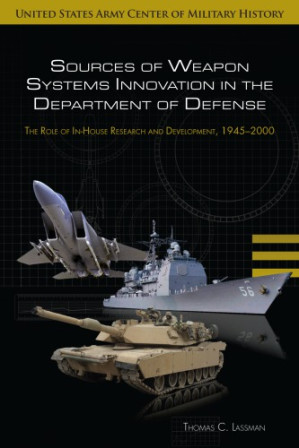
Sources of weapon systems innovation in the Department of Defense : the role of in-house research and development, 1945-2000 🔍
Thomas Charles Lassman; Center of Military History
Center of Military History, U.S. Army : For sale by the Supt. of Docs., U.S. G.P.O, CMH pub, 51-2-1, Washington, D.C, 2008
英语 [en] · PDF · 4.9MB · 2008 · 📘 非小说类图书 · 🚀/lgli/lgrs/nexusstc/zlib · Save
描述
Since the end of World War II, civilian and military policymakers have sought to understand and improve the institutional processes involved in the development of modern weapons systems. The persistent calls for institutional, managerial, and organizational reform suggest that such tasks have not always been easy nor clearly defined. This study is intended to bring some historical clarity to that problem by identifying and examining the patterns of organizational and institutional change that guided in-house weapons research and development (R'D) over the course of the past six decades. Specifically, it details the history of weapons R'D in the major laboratories owned and operated by the Army, the Navy, and the Air Force between 1945 and 2000. At the same time, the monograph complements a larger multivolume historical effort that is currently analyzing the policies, procedures, and institutions that guided the development, production, and procurement of major weapon systems during the same period. Together they constitute the on-going Defense Acquisition History Project. The Department of Defense spends hundreds of billions of dollars every year to keep U.S. forces equipped with state-of-the-art weapon systems. Research and development is an essential component of this process. It is the foundation upon which all weapon systems are built once requirements have been set. Although they outsourced a significant share of their research requirements during the Cold War, the Army, the Navy, and the Air Force also maintained extensive in-house R'D establishments whose laboratories turned out many products, ranging from fundamental knowledge in physics, chemistry, and other scientific disciplines to complete prototype weapon systems. What set the services apart from one another, however, was the extent to which they managed and organized their respective R'D programs. In the Army, research, development, and production proceeded alongside one another in the manufacturing arsenals that had been in continuous operation since the beginning of the nineteenth century, despite actions taken by some Army leaders to separate these functions organizationally as a necessary prerequisite to the development of technologically advanced weapon systems. The Navy, by contrast, maintained a sharper organizational division of labor between R'D and production. Established in 1923, the Naval Research Laboratory operated independently of the Navy’s material bureaus, where, like the Army’s arsenals, technological innovation had historically depended on the close coordination of research, development, and production. Created in 1947, the Air Force relied more heavily than the Army and the Navy on the private sector for new knowledge and skills. But it also operated an extensive network of in-house laboratories, the management and organization of which periodically shifted between the extremes of independence from and subordination to the Air Force’s production and procurement functions. Throughout all three services, a disjunction sometimes existed between the formulation of R'D policies at the management level and the implementation of those policies in the laboratory. These relationships and other patterns of organizational change are highlighted in the study and should help DoD acquisition managers to understand the current acquisition environment and successfully navigate their way through it as they seek to make informed decisions about future weapons development across an increasingly broad spectrum of activities
备用文件名
lgrsnf/A:\usenetabtechnical\SOURCES OF WEAPON SYSTEMS INNOVATION IN THE DEPARTMENT OF DEFENSE - THE ROLE OF IN-HOUSE RESEARCH AND DEVELOPMENT, 1945-2000.pdf
备用文件名
nexusstc/Sources of weapon systems innovation in the Department of Defense : the role of in-house research and development, 1945-2000/41cc0aff2ce229601d43a82415cd2f6b.pdf
备用文件名
zlib/History/Military History/Thomas Charles Lassman; Center of Military History/Sources of weapon systems innovation in the Department of Defense : the role of in-house research and development, 1945-2000_2060686.pdf
备选标题
Sources of Weapon Systems Innovation in the Department of Defense: Role of Research and Development 1945-2000: The Role of Research and Development 1945-2000 (Center of Military History Publication)
备选作者
Lassman, Thomas C.
备用出版商
Center of Military History, United States Army
备用出版商
United States Government Printing Office
备用出版商
Superintendent of Documents
备用出版商
Department of the Army
备用出版商
Justice Department
备用版本
United States, United States of America
备用版本
Nov 15, 2008
元数据中的注释
usenet tech -- 2012-06
元数据中的注释
lg906424
元数据中的注释
{"isbns":["0160794188","9780160794186"],"last_page":170,"series":"CMH pub., 51-2-1"}
备用描述
After World War II, the military services did not possess the requisite in-house expertise to develop nuclear submarines, jet aircraft, intercontinental ballistic missiles, and other state-of-the-art weapon systems incorporating the latest advances in science and technology. Because of this deficiency, the Department of Defense increasingly acquired new knowledge and technical skills through contracts with industrial firms and colleges and universities. At the same time, however, the services continued to expand and diversify their own internal R & D programs to complement the growth of weapons research and development in the private sector. Sources of Weapon Systems Innovation in the Department of Defense explores the historical evolution of this process during the Cold War, focusing specifically on the content, scope, organizational structure, and management of in-house R & D in the Army, the Navy, and the Air Force. This monograph is not a comprehensive history of military R & D, but rather a broad historical overview of changing institutional patterns of technological innovation within the Defense Department's major weapons laboratories. It examines many types of research and development including fundamental studies of the physics of metals in the Army's primary manufacturing arsenals, rocket and missile development at the Naval Ordnance Test Station in California, testing and evaluation of aircraft engines and rocket motors at the Air Force's Arnold Engineering Development Center in Tennessee, and a host of other R & D activities at laboratories located throughout the United States. How the military services accommodated changes in management policy and balanced the corresponding growth of R & D outsourcing at the expense of maintaining a viable in-house capability is the central theme of this book. Academia and industry played a crucial role in the development and production of military hardware. Significantly, however, the extant historical literature has paid far less attention to weapons research and development in the Defense Department's own laboratories. Any understanding of how the Army, the Navy, and the Air Force developed and acquired new weapon systems after World War II must include a more thorough examination of the historical evolution of the institutions of science and technology within the Department of Defense. While this monograph only scratches the surface of such an ambitious endeavor, it does attempt to provide a general interpretive framework that historians will hopefully find useful as a guide to further research. -- Publisher's Description
备用描述
By Thomas C. Lassman. Shipping List No.: 2009-0104-p. Includes Bibliographical References And Index.
开源日期
2013-03-30
🚀 快速下载
成为会员以支持书籍、论文等的长期保存。为了感谢您对我们的支持,您将获得高速下载权益。❤️
如果您在本月捐款,您将获得双倍的快速下载次数。
🐢 低速下载
由可信的合作方提供。 更多信息请参见常见问题解答。 (可能需要验证浏览器——无限次下载!)
- 低速服务器(合作方提供) #1 (稍快但需要排队)
- 低速服务器(合作方提供) #2 (稍快但需要排队)
- 低速服务器(合作方提供) #3 (稍快但需要排队)
- 低速服务器(合作方提供) #4 (稍快但需要排队)
- 低速服务器(合作方提供) #5 (无需排队,但可能非常慢)
- 低速服务器(合作方提供) #6 (无需排队,但可能非常慢)
- 低速服务器(合作方提供) #7 (无需排队,但可能非常慢)
- 低速服务器(合作方提供) #8 (无需排队,但可能非常慢)
- 低速服务器(合作方提供) #9 (无需排队,但可能非常慢)
- 下载后: 在我们的查看器中打开
所有选项下载的文件都相同,应该可以安全使用。即使这样,从互联网下载文件时始终要小心。例如,确保您的设备更新及时。
外部下载
-
对于大文件,我们建议使用下载管理器以防止中断。
推荐的下载管理器:JDownloader -
您将需要一个电子书或 PDF 阅读器来打开文件,具体取决于文件格式。
推荐的电子书阅读器:Anna的档案在线查看器、ReadEra和Calibre -
使用在线工具进行格式转换。
推荐的转换工具:CloudConvert和PrintFriendly -
您可以将 PDF 和 EPUB 文件发送到您的 Kindle 或 Kobo 电子阅读器。
推荐的工具:亚马逊的“发送到 Kindle”和djazz 的“发送到 Kobo/Kindle” -
支持作者和图书馆
✍️ 如果您喜欢这个并且能够负担得起,请考虑购买原版,或直接支持作者。
📚 如果您当地的图书馆有这本书,请考虑在那里免费借阅。
下面的文字仅以英文继续。
总下载量:
“文件的MD5”是根据文件内容计算出的哈希值,并且基于该内容具有相当的唯一性。我们这里索引的所有影子图书馆都主要使用MD5来标识文件。
一个文件可能会出现在多个影子图书馆中。有关我们编译的各种数据集的信息,请参见数据集页面。
有关此文件的详细信息,请查看其JSON 文件。 Live/debug JSON version. Live/debug page.