nexusstc/The Counselor-at-Law: A Collaborative Approach to Client Interviewing and Counseling/5cd2a79d5e912808cddb7ae3d942f5f0.pdf
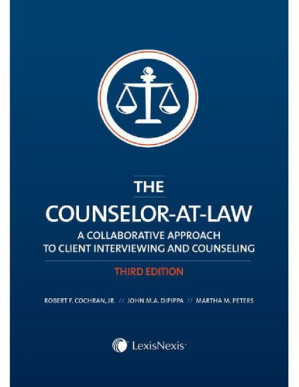
The Counselor-at-Law: A Collaborative Approach to Client Interviewing and Counseling (2014) 🔍
Robert F. Cochran, Jr., Director, the Herbert and Elinor Nootbaar Institute on Law, Religion, and Ethics and Louis D. Brandeis Professor of Law, Pepperdine University School of Law; John M.A. DiPippa, Dean Emeritus and Distinguished Professor of Law and Public Policy, University of Arkansas at Little Rock William H. Bowen School of Law; Martha M. Peters, Professor of Legal Education, Elon University School of Law
Carolina Academic Press, 3. ed, New Providence, NJ, cop. 2014
英语 [en] · PDF · 3.2MB · 2014 · 📘 非小说类图书 · 🚀/lgli/lgrs/nexusstc/zlib · Save
描述
This book takes a collaborative approach to legal interviewing and counseling. It suggests that clients will be best served when lawyers and clients work together to resolve problems. Under a collaborative decision-making model, the client controls most decisions, but the lawyer structures the process and provides advice in a manner that is likely to yield wise decisions.
The Counselor-at-Law explores the major approaches to legal interviewing and counseling and outlines the available research on the psychology and the sociology of clients and lawyers. This book explores communication and decision-making theory, memory and recall, power and submission, personality types, and ethics. From this base, the authors construct a model of interviewing and counseling based on the techniques that are effective in real-life encounters. They also include psychological type theory and explain how it can be used to improve a lawyer's communication, interviewing, and counseling skills.
This innovative casebook provides students with a template for effective legal interviewing and counseling. The most effective legal counselors are the ones instilled with respect for the client, cognizant of building rapport, aware of the psychological dynamics of the lawyer-client relationship, and equipped with technical communication skills to gather information without sacrificing rapport.
The Counselor-at-Law explores the major approaches to legal interviewing and counseling and outlines the available research on the psychology and the sociology of clients and lawyers. This book explores communication and decision-making theory, memory and recall, power and submission, personality types, and ethics. From this base, the authors construct a model of interviewing and counseling based on the techniques that are effective in real-life encounters. They also include psychological type theory and explain how it can be used to improve a lawyer's communication, interviewing, and counseling skills.
This innovative casebook provides students with a template for effective legal interviewing and counseling. The most effective legal counselors are the ones instilled with respect for the client, cognizant of building rapport, aware of the psychological dynamics of the lawyer-client relationship, and equipped with technical communication skills to gather information without sacrificing rapport.
备用文件名
lgli/The Counselor-at-Law_ A Collabo - Jr. Robert F. Cochran.pdf
备用文件名
lgrsnf/The Counselor-at-Law_ A Collabo - Jr. Robert F. Cochran.pdf
备用文件名
zlib/no-category/Robert Cochran, John DiPippa, Martha Peters/The Counselor-at-Law: A Collaborative Approach to Client Interviewing and Counseling_24569837.pdf
备选作者
Jr. Robert F. Cochran, John M.A. DiPippa, Martha M. Peters
备用出版商
LexisNexis
备用版本
Third edition., New Providence, NJ, New Jersey, April 2006
备用版本
Third edition, New Providence, NJ, 2014
备用版本
United States, United States of America
元数据中的注释
{"edition":"3","isbns":["1630430668","9781630430665"],"last_page":246,"publisher":"Carolina Academic Press"}
元数据中的注释
Includes bibliographical references and index.
备用描述
Cover Page
Prefatory Material
LexisNexis Law School Publishing Advisory Board
Title Page
Copyright Page
Terms Of Use
Dedication
Acknowledgment
Table of Contents
Chapter 1 — THREE MODELS OF LEGAL COUNSELING
§ 1-1. INTRODUCTION
§ 1-2. THE AUTHORITARIAN MODEL
§ 1-3. THE CLIENT-CENTERED COUNSELING MODEL
§ 1-4. THE COLLABORATIVE DECISION-MAKING MODEL
Chapter 2 — HOW LAWYERS CONTROL CLIENTS
§ 2-1. INTRODUCTION
§ 2-2. TRANSFORMING THE CLIENT’S CASE
§ 2-3. CONTROLLING THE CONVERSATION
§ 2-4. INSIDER STATUS FOR SALE
§ 2-5. STRUGGLING FOR POWER
§ 2-6. TRANSLATING THE CLIENT’S STORY
§ 2-7. CRAFTING THE LAWYER-CLIENT RELATIONSHIP THROUGH COLLABORATIVE NEGOTIATION
§ 2-8. CONCLUSION
Chapter 3 — COMMUNICATION SKILLS
§ 3-1. INTRODUCTION
§ 3-2. LISTENING
§ 3-2(a) Paying Attention
§ 3-2(a)(1) Paying Attention Physically
§ 3-2(a)(2) Paying Attention Mentally by Active Listening
§ 3-2(b) Actively Listening to the Client’s Nonverbal Messages
§ 3-2(b)(1) Body Language
§ 3-2(b)(2) Eyes
§ 3-2(b)(3) Facial Expressions
§ 3-2(b)(4) Using Knowledge of Body Language
§ 3-2 (c) Using Knowledge of Psychological Type
§ 3-3. BUILDING RAPPORT
§ 3-3(a) Mirroring
§ 3-3(a)(1) Mirroring the Client
§ 3-3(a)(2) Mirroring the Client’s Language
§ 3-4. WHAT TO AVOID
§ 3-4(a) Professional Blindness
§ 3-4(b) Hardening of the Categories
§ 3-5. VERBALLY RESPONDING TO THE CLIENT
§ 3-5(a) Responsive Statements
§ 3-5(a)(1) Clarification Responses
§ 3-5(a)(2) Reflective Statements
§ 3-5(b) Kinds of Reflective Statements
§ 3-5(b)(1) Paraphrasing
§ 3-5(b)(2) Reflecting Content Alone
§ 3-5(b)(3) Reflecting Emotion Alone
§ 3-5(b)(4) Reflecting Both Content and Emotion
§ 3-5(c) Summarizing
§ 3-5(d) Silence
§ 3-6. ASKING QUESTIONS
§ 3-6(a) Closed-Ended Questions
§ 3-6(b) Open-Ended Questions
§ 3-6(c) General Guidelines for Using Open and Closed Questions
§ 3-6(c)(1) The Advantages and Disadvantages of Each Type of Question
§ 3-6(c)(2) Asking These Questions in Context
§ 3-6(c)(3) Summary
§ 3-6(d) Leading Questions
§ 3-7. FINAL WORDS
Chapter 4 — BEGINNING THE LEGAL INTERVIEW
§ 4-1. INTRODUCTION
§ 4-2. EFFECTIVE LEGAL INTERVIEWING: BUILDING RAPPORT AND GATHERING INFORMATION
§ 4-3. THE GENERAL ELEMENTS OF AN EFFECTIVE LEGAL INTERVIEW
§ 4-4. THE STRUCTURE OF AN EFFECTIVE LEGAL INTERVIEW
§ 4-4(a) Overall Goals
§ 4-4(b) Structure
§ 4-5. THE OPENING STAGE OF THE CLIENT INTERVIEW
§ 4-5(a) Physical Surroundings
§ 4-5(a)(1) The Office Building
§ 4-5(a)(2) The Lawyer’s Office
§ 4-5(b) Opening the Interview
§ 4-5(b)(1) General Guidelines
§ 4-5(b)(2) Building Rapport: Conveying Acceptance
§ 4-5(c) Opening the Interview: Meeting and Greeting the Client
§ 4-5(c)(1) Introductions
§ 4-5(c)(2) Ice Breaking
Gay Gellhorn, Law and Language: An Empirically Based Model for the Opening Moments of Client Interviews
Gay Gellhorn, Law and Language: An Empirically Based Model for the Opening Moments of Client Interviews
§ 4-5(c)(3) Time Constraints and Purposes of the Interview
§ 4-6. EXPLANATIONS
§ 4-6(a) Confidentiality
§ 4-6(a)(1) Discussing Confidentiality
§ 4-6(a)(2) Talking About Confidentiality at the Initial Interview
§ 4-6(b) Fees
§ 4-6(b)(1) Talking About Fees
§ 4-6(b)(2) Talking About Fees at the Initial Interview
§ 4-7. SAMPLE DIALOGUE TO OPEN A CLIENT INTERVIEW
§ 4-8. CONCLUSION
Chapter 5 — HEARING THE CLIENT’S STORY
§ 5-1. THE FRAMING STATEMENT
§ 5-2. GETTING THE CLIENT’S STORY
§ 5-2(a) Opening Questions
§ 5-2(b) Avoiding Narrow Frames
§ 5-2(c) Providing Context
Gay Gellhorn, Law and Language: An Empirically Based Model for the Opening Moments of Client Interviews
§ 5-3. HEARING THE CLIENT’S STORY
§ 5-3(a) Getting Past Framing Statements
Gay Gellhorn, Law and Language: An Empirically Based Model for the Opening Moments of Client Interviews
§ 5-3(b) Identifying the Client’s Goals and Interests
§ 5-4. LAWYER DISTORTIONS
§ 5-4(a) Interruptions
Linda F. Smith, Interviewing Clients: A Linguistic Comparison of the “Traditional” Interview and the “Client-Centered” Interview
§ 5-4(b) Narrow Questions and Premature Diagnosis
§ 5-4(c) Cross-Examination
§ 5-5. CLIENT DISTORTIONS
§ 5-6. SUMMARY
Chapter 6 — DEVELOPING THE CLIENT’S STORY
§ 6-1. FRAMING STATEMENT: REPEATING THE HIGH POINTS
§ 6-2. CLARIFYING AND EXPLORING THE CLIENT’S STORY
§ 6-2(a) Funnel Sequences
§ 6-2(b) Helping Clients Explore Their Memories
§ 6-2(c) Statements of Understanding
§ 6-3. AN EXAMPLE OF SUCCESSFULLY EXPLORING A CLIENT’S CASE
Gay Gellhorn, Law and Language: An Empirically Based Model for the Opening Moments of Client Interviews
§ 6-4. ENDING THE INITIAL INTERVIEW
§ 6-4(a) Defining the Role of the Attorney
§ 6-4(b) Things to Do at the End of Every Interview
§ 6-4(c) Things to Do When No Decision About the Case is Made at the End of the Initial Interview
§ 6-4(d) Things to Do When a Decision About the Case is Made at the Initial Interview
§ 6-5. CONCLUSION
Chapter 7 — DECISION-MAKING
§ 7-1. LEGAL AND THERAPEUTIC COUNSELING: SIMILARITIES AND DIFFERENCES
§ 7-2. APPROACHES TO LEGAL COUNSELING
§ 7-2(a) The Client-Centered Approach
§ 7-2(b) The Authoritarian Approach
§ 7-2(c) The Decision-Counselor Approach
§ 7-2(d) Collaborative Legal Counseling
§ 7-3. COMMON ELEMENTS OF EFFECTIVE LEGAL COUNSELING
§ 7-3(a) Relationship Building Practices
§ 7-3(b) Decision Process Practices
§ 7-4. FACTORS THAT INTERFERE WITH EFFECTIVE DECISION-MAKING
§ 7-4(a) Satisficing
§ 7-4(b) Elimination by Aspects
§ 7-4(c) Information Processing Flaws: Heuristics and Biases
§ 7-4(c)(1) Heuristics
§ 7-4(c)(2) Biases
§ 7-4(c)(2)(i) Availability Biases
§ 7-4(c)(2)(ii) Representative Biases
§ 7-4(c)(2)(iii) Anchoring and Adjustment Biases
§ 7-5. DEALING WITH UNCERTAINTY
§ 7-5(a) Risk
§ 7-5(b) Framing Gains or Losses
§ 7-5(c) Guidelines for Accurately Framing Risk
§ 7-6. CONCLUSION
Chapter 8 — CLIENT COUNSELING
§ 8-1. THE LAWYER’S RESPONSIBILITIES IN COUNSELING CLIENTS
§ 8-2. THE RHYTHM OF COUNSELING
§ 8-3. DESCRIPTION
§ 8-3(a) Accuracy, Objectivity, and Completeness
§ 8-3(a)(1) Assess the Client’s Case
§ 8-3(a)(2) Identify the Alternatives
§ 8-3(a)(2)(i) Minimal Acceptance Criteria
§ 8-3(a)(2)(ii) Cover a Wide Range of Options
§ 8-3(a)(2)(iii) Generality of Options
§ 8-4. DISCUSSION
§ 8-4(a) Client/Lawyer Collaborative Deliberation
§ 8-4(b) Structuring the Discussion
§ 8-4(b)(1) Agree on the Options Under Discussion
§ 8-4(b)(2) Agree on the Criteria Used to Evaluate the Options
§ 8-4(b)(3) Apply the Criteria in a Rigorous and Systematic Fashion
§ 8-4(c) The Decision Sheet
§ 8-4(c)(1) The Consequences to the Client
§ 8-4(c)(2) The Consequences to Others
§ 8-4(c)(3) Consequences for the Client’s Self-Image
§ 8-4(c)(4) Consequences for the Client’s Reputation
§ 8-4(c)(5) Reviewing the Decision Sheet
§ 8-5. DECISION
§ 8-5(a) Choosing the Option that Best Meets the Client’s Values and Goals
§ 8-5(a)(1) Making an Optimal Choice
§ 8-5(a)(2) Making Comparative Judgements
§ 8-5(a)(3) Making the Decision
§ 8-5(a)(4) Reviewing the Decision
§ 8-5(b) How to Structure the Decision Phase
§ 8-6. GIVING CLIENTS BAD NEWS
§ 8-7. CONCLUSION
Chapter 9 — MORAL CHOICES IN THE LAW OFFICE: WHO GETS HURT? AND WHO DECIDES?
§ 9-1. INTRODUCTION
§ 9-2. AUTHORITARIAN LAWYERS: THE GURU AND THE GODFATHER
§ 9-2(a) The Lawyer as Guru
Harrop Freeman, The Rabbi and the Horse-whip Lawyer
§ 9-2(b) The Lawyer as Godfather
§ 9-3. CLIENT-CENTERED COUNSELORS: THE LAWYER AS HIRED GUN
§ 9-4. COLLABORATIVE LAWYERS: THE LAWYER AS FRIEND
Anthony T. Kronman, The Lost Lawyer
§ 9-5. AVOIDING LAWYER DOMINATION
§ 9-6. MORAL DISCOURSE WITH CORPORATE CLIENTS
§ 9-7. CONCLUSION
Chapter 10 — TO SUE OR SETTLE?: COUNSELING ABOUT DISPUTE RESOLUTION
§ 10-1. INTRODUCTION
§ 10-2. COUNSELING CLIENTS ABOUT NEGOTIATION
§ 10-3. COUNSELING CONCERNING ALTERNATIVE DISPUTE RESOLUTION
Chapter 11 — DEALING WITH CLIENT-LAWYER DIFFERENCE
§ 11-1. INTRODUCTION
§ 11-2. THE IMPACT OF DIFFERENCES ON THE LAWYER-CLIENT RELATIONSHIP
§ 11-2(a) Cultural Encapsulation
§ 11-2(b) Sensitivity to Different Cultural Rapport-Building Rituals and Patterns
§ 11-3. STEPS TO BECOMING MORE AWARE OF CULTURAL ENCAPSULATION
§ 11-3(a) Expectations
§ 11-3(b) Empathy
§ 11-4. CAUTION NOT TO STEREOTYPE BY ATTRIBUTING GROUP PREFERENCES TO INDIVIDUALS
§ 11-5. DO’S AND DON’TS
§ 11-6. SUMMARY
Chapter 12 — LAWYERS, CLIENTS, AND PSYCHOLOGICAL TYPE THEORY
§ 12-1. INTRODUCTION
§ 12-2. AN OVERVIEW OF PSYCHOLOGICAL TYPE THEORY
§ 12-2(a) Two Mental Functions, Perception and Judgment, Influence Communication Between Lawyers and Clients
§ 12-2(b) Two Directions of Energy: Extraverting or Introverting
§ 12-2(c) Two Lifestyles
§ 12-3. REFLECTING ON YOUR TYPE PREFERENCES
§ 12-4. VALUE OF TYPE KNOWLEDGE
§ 12-5. TYPE AND SKILL DEVELOPMENT
§ 12-6. THE FOUR PREFERENCE SCALES APPLIED TO LEGAL INTERVIEWING AND COUNSELING
§ 12-6(a) The Perception Functions: Sensing or Intuition
§ 12-6(b) The Judgment Functions: Thinking or Feeling
§ 12-6(c) Direction of Energy: Extraversion or Introversion
§ 12-6(d) Lifestyles: Judgment or Perception
§ 12-7. TYPE DYNAMICS
§ 12-8. USING TYPE IN PROBLEM SOLVING
§ 12-9. CONCLUSION
Prefatory Material
LexisNexis Law School Publishing Advisory Board
Title Page
Copyright Page
Terms Of Use
Dedication
Acknowledgment
Table of Contents
Chapter 1 — THREE MODELS OF LEGAL COUNSELING
§ 1-1. INTRODUCTION
§ 1-2. THE AUTHORITARIAN MODEL
§ 1-3. THE CLIENT-CENTERED COUNSELING MODEL
§ 1-4. THE COLLABORATIVE DECISION-MAKING MODEL
Chapter 2 — HOW LAWYERS CONTROL CLIENTS
§ 2-1. INTRODUCTION
§ 2-2. TRANSFORMING THE CLIENT’S CASE
§ 2-3. CONTROLLING THE CONVERSATION
§ 2-4. INSIDER STATUS FOR SALE
§ 2-5. STRUGGLING FOR POWER
§ 2-6. TRANSLATING THE CLIENT’S STORY
§ 2-7. CRAFTING THE LAWYER-CLIENT RELATIONSHIP THROUGH COLLABORATIVE NEGOTIATION
§ 2-8. CONCLUSION
Chapter 3 — COMMUNICATION SKILLS
§ 3-1. INTRODUCTION
§ 3-2. LISTENING
§ 3-2(a) Paying Attention
§ 3-2(a)(1) Paying Attention Physically
§ 3-2(a)(2) Paying Attention Mentally by Active Listening
§ 3-2(b) Actively Listening to the Client’s Nonverbal Messages
§ 3-2(b)(1) Body Language
§ 3-2(b)(2) Eyes
§ 3-2(b)(3) Facial Expressions
§ 3-2(b)(4) Using Knowledge of Body Language
§ 3-2 (c) Using Knowledge of Psychological Type
§ 3-3. BUILDING RAPPORT
§ 3-3(a) Mirroring
§ 3-3(a)(1) Mirroring the Client
§ 3-3(a)(2) Mirroring the Client’s Language
§ 3-4. WHAT TO AVOID
§ 3-4(a) Professional Blindness
§ 3-4(b) Hardening of the Categories
§ 3-5. VERBALLY RESPONDING TO THE CLIENT
§ 3-5(a) Responsive Statements
§ 3-5(a)(1) Clarification Responses
§ 3-5(a)(2) Reflective Statements
§ 3-5(b) Kinds of Reflective Statements
§ 3-5(b)(1) Paraphrasing
§ 3-5(b)(2) Reflecting Content Alone
§ 3-5(b)(3) Reflecting Emotion Alone
§ 3-5(b)(4) Reflecting Both Content and Emotion
§ 3-5(c) Summarizing
§ 3-5(d) Silence
§ 3-6. ASKING QUESTIONS
§ 3-6(a) Closed-Ended Questions
§ 3-6(b) Open-Ended Questions
§ 3-6(c) General Guidelines for Using Open and Closed Questions
§ 3-6(c)(1) The Advantages and Disadvantages of Each Type of Question
§ 3-6(c)(2) Asking These Questions in Context
§ 3-6(c)(3) Summary
§ 3-6(d) Leading Questions
§ 3-7. FINAL WORDS
Chapter 4 — BEGINNING THE LEGAL INTERVIEW
§ 4-1. INTRODUCTION
§ 4-2. EFFECTIVE LEGAL INTERVIEWING: BUILDING RAPPORT AND GATHERING INFORMATION
§ 4-3. THE GENERAL ELEMENTS OF AN EFFECTIVE LEGAL INTERVIEW
§ 4-4. THE STRUCTURE OF AN EFFECTIVE LEGAL INTERVIEW
§ 4-4(a) Overall Goals
§ 4-4(b) Structure
§ 4-5. THE OPENING STAGE OF THE CLIENT INTERVIEW
§ 4-5(a) Physical Surroundings
§ 4-5(a)(1) The Office Building
§ 4-5(a)(2) The Lawyer’s Office
§ 4-5(b) Opening the Interview
§ 4-5(b)(1) General Guidelines
§ 4-5(b)(2) Building Rapport: Conveying Acceptance
§ 4-5(c) Opening the Interview: Meeting and Greeting the Client
§ 4-5(c)(1) Introductions
§ 4-5(c)(2) Ice Breaking
Gay Gellhorn, Law and Language: An Empirically Based Model for the Opening Moments of Client Interviews
Gay Gellhorn, Law and Language: An Empirically Based Model for the Opening Moments of Client Interviews
§ 4-5(c)(3) Time Constraints and Purposes of the Interview
§ 4-6. EXPLANATIONS
§ 4-6(a) Confidentiality
§ 4-6(a)(1) Discussing Confidentiality
§ 4-6(a)(2) Talking About Confidentiality at the Initial Interview
§ 4-6(b) Fees
§ 4-6(b)(1) Talking About Fees
§ 4-6(b)(2) Talking About Fees at the Initial Interview
§ 4-7. SAMPLE DIALOGUE TO OPEN A CLIENT INTERVIEW
§ 4-8. CONCLUSION
Chapter 5 — HEARING THE CLIENT’S STORY
§ 5-1. THE FRAMING STATEMENT
§ 5-2. GETTING THE CLIENT’S STORY
§ 5-2(a) Opening Questions
§ 5-2(b) Avoiding Narrow Frames
§ 5-2(c) Providing Context
Gay Gellhorn, Law and Language: An Empirically Based Model for the Opening Moments of Client Interviews
§ 5-3. HEARING THE CLIENT’S STORY
§ 5-3(a) Getting Past Framing Statements
Gay Gellhorn, Law and Language: An Empirically Based Model for the Opening Moments of Client Interviews
§ 5-3(b) Identifying the Client’s Goals and Interests
§ 5-4. LAWYER DISTORTIONS
§ 5-4(a) Interruptions
Linda F. Smith, Interviewing Clients: A Linguistic Comparison of the “Traditional” Interview and the “Client-Centered” Interview
§ 5-4(b) Narrow Questions and Premature Diagnosis
§ 5-4(c) Cross-Examination
§ 5-5. CLIENT DISTORTIONS
§ 5-6. SUMMARY
Chapter 6 — DEVELOPING THE CLIENT’S STORY
§ 6-1. FRAMING STATEMENT: REPEATING THE HIGH POINTS
§ 6-2. CLARIFYING AND EXPLORING THE CLIENT’S STORY
§ 6-2(a) Funnel Sequences
§ 6-2(b) Helping Clients Explore Their Memories
§ 6-2(c) Statements of Understanding
§ 6-3. AN EXAMPLE OF SUCCESSFULLY EXPLORING A CLIENT’S CASE
Gay Gellhorn, Law and Language: An Empirically Based Model for the Opening Moments of Client Interviews
§ 6-4. ENDING THE INITIAL INTERVIEW
§ 6-4(a) Defining the Role of the Attorney
§ 6-4(b) Things to Do at the End of Every Interview
§ 6-4(c) Things to Do When No Decision About the Case is Made at the End of the Initial Interview
§ 6-4(d) Things to Do When a Decision About the Case is Made at the Initial Interview
§ 6-5. CONCLUSION
Chapter 7 — DECISION-MAKING
§ 7-1. LEGAL AND THERAPEUTIC COUNSELING: SIMILARITIES AND DIFFERENCES
§ 7-2. APPROACHES TO LEGAL COUNSELING
§ 7-2(a) The Client-Centered Approach
§ 7-2(b) The Authoritarian Approach
§ 7-2(c) The Decision-Counselor Approach
§ 7-2(d) Collaborative Legal Counseling
§ 7-3. COMMON ELEMENTS OF EFFECTIVE LEGAL COUNSELING
§ 7-3(a) Relationship Building Practices
§ 7-3(b) Decision Process Practices
§ 7-4. FACTORS THAT INTERFERE WITH EFFECTIVE DECISION-MAKING
§ 7-4(a) Satisficing
§ 7-4(b) Elimination by Aspects
§ 7-4(c) Information Processing Flaws: Heuristics and Biases
§ 7-4(c)(1) Heuristics
§ 7-4(c)(2) Biases
§ 7-4(c)(2)(i) Availability Biases
§ 7-4(c)(2)(ii) Representative Biases
§ 7-4(c)(2)(iii) Anchoring and Adjustment Biases
§ 7-5. DEALING WITH UNCERTAINTY
§ 7-5(a) Risk
§ 7-5(b) Framing Gains or Losses
§ 7-5(c) Guidelines for Accurately Framing Risk
§ 7-6. CONCLUSION
Chapter 8 — CLIENT COUNSELING
§ 8-1. THE LAWYER’S RESPONSIBILITIES IN COUNSELING CLIENTS
§ 8-2. THE RHYTHM OF COUNSELING
§ 8-3. DESCRIPTION
§ 8-3(a) Accuracy, Objectivity, and Completeness
§ 8-3(a)(1) Assess the Client’s Case
§ 8-3(a)(2) Identify the Alternatives
§ 8-3(a)(2)(i) Minimal Acceptance Criteria
§ 8-3(a)(2)(ii) Cover a Wide Range of Options
§ 8-3(a)(2)(iii) Generality of Options
§ 8-4. DISCUSSION
§ 8-4(a) Client/Lawyer Collaborative Deliberation
§ 8-4(b) Structuring the Discussion
§ 8-4(b)(1) Agree on the Options Under Discussion
§ 8-4(b)(2) Agree on the Criteria Used to Evaluate the Options
§ 8-4(b)(3) Apply the Criteria in a Rigorous and Systematic Fashion
§ 8-4(c) The Decision Sheet
§ 8-4(c)(1) The Consequences to the Client
§ 8-4(c)(2) The Consequences to Others
§ 8-4(c)(3) Consequences for the Client’s Self-Image
§ 8-4(c)(4) Consequences for the Client’s Reputation
§ 8-4(c)(5) Reviewing the Decision Sheet
§ 8-5. DECISION
§ 8-5(a) Choosing the Option that Best Meets the Client’s Values and Goals
§ 8-5(a)(1) Making an Optimal Choice
§ 8-5(a)(2) Making Comparative Judgements
§ 8-5(a)(3) Making the Decision
§ 8-5(a)(4) Reviewing the Decision
§ 8-5(b) How to Structure the Decision Phase
§ 8-6. GIVING CLIENTS BAD NEWS
§ 8-7. CONCLUSION
Chapter 9 — MORAL CHOICES IN THE LAW OFFICE: WHO GETS HURT? AND WHO DECIDES?
§ 9-1. INTRODUCTION
§ 9-2. AUTHORITARIAN LAWYERS: THE GURU AND THE GODFATHER
§ 9-2(a) The Lawyer as Guru
Harrop Freeman, The Rabbi and the Horse-whip Lawyer
§ 9-2(b) The Lawyer as Godfather
§ 9-3. CLIENT-CENTERED COUNSELORS: THE LAWYER AS HIRED GUN
§ 9-4. COLLABORATIVE LAWYERS: THE LAWYER AS FRIEND
Anthony T. Kronman, The Lost Lawyer
§ 9-5. AVOIDING LAWYER DOMINATION
§ 9-6. MORAL DISCOURSE WITH CORPORATE CLIENTS
§ 9-7. CONCLUSION
Chapter 10 — TO SUE OR SETTLE?: COUNSELING ABOUT DISPUTE RESOLUTION
§ 10-1. INTRODUCTION
§ 10-2. COUNSELING CLIENTS ABOUT NEGOTIATION
§ 10-3. COUNSELING CONCERNING ALTERNATIVE DISPUTE RESOLUTION
Chapter 11 — DEALING WITH CLIENT-LAWYER DIFFERENCE
§ 11-1. INTRODUCTION
§ 11-2. THE IMPACT OF DIFFERENCES ON THE LAWYER-CLIENT RELATIONSHIP
§ 11-2(a) Cultural Encapsulation
§ 11-2(b) Sensitivity to Different Cultural Rapport-Building Rituals and Patterns
§ 11-3. STEPS TO BECOMING MORE AWARE OF CULTURAL ENCAPSULATION
§ 11-3(a) Expectations
§ 11-3(b) Empathy
§ 11-4. CAUTION NOT TO STEREOTYPE BY ATTRIBUTING GROUP PREFERENCES TO INDIVIDUALS
§ 11-5. DO’S AND DON’TS
§ 11-6. SUMMARY
Chapter 12 — LAWYERS, CLIENTS, AND PSYCHOLOGICAL TYPE THEORY
§ 12-1. INTRODUCTION
§ 12-2. AN OVERVIEW OF PSYCHOLOGICAL TYPE THEORY
§ 12-2(a) Two Mental Functions, Perception and Judgment, Influence Communication Between Lawyers and Clients
§ 12-2(b) Two Directions of Energy: Extraverting or Introverting
§ 12-2(c) Two Lifestyles
§ 12-3. REFLECTING ON YOUR TYPE PREFERENCES
§ 12-4. VALUE OF TYPE KNOWLEDGE
§ 12-5. TYPE AND SKILL DEVELOPMENT
§ 12-6. THE FOUR PREFERENCE SCALES APPLIED TO LEGAL INTERVIEWING AND COUNSELING
§ 12-6(a) The Perception Functions: Sensing or Intuition
§ 12-6(b) The Judgment Functions: Thinking or Feeling
§ 12-6(c) Direction of Energy: Extraversion or Introversion
§ 12-6(d) Lifestyles: Judgment or Perception
§ 12-7. TYPE DYNAMICS
§ 12-8. USING TYPE IN PROBLEM SOLVING
§ 12-9. CONCLUSION
备用描述
Models Of Legal Counseling -- How Lawyers Control Clients -- Communication Skills -- Beginning The Legal Interview -- Hearing The Client's Story -- Developing The Client's Story -- Decision Making -- Client Counseling -- Moral Choices In The Law Office : Who Gets Hurt? And Who Decides? -- To Sue Or Settle? : Counseling About Dispute Resolution -- Dealing With Client-lawyer Difference -- Lawyers, Clients, And Psychological Type Theory. Robert F. Cochran, Jr., Director, The Herbert And Elinor Nootbaar Institute On Law, Religion, And Ethics And Louis D. Brandeis Professor Of Law, Pepperdine University School Of Law; John M.a. Dipippa, Dean Emeritus And Distinguished Professor Of Law And Public Policy, University Of Arkansas At Little Rock William H. Bowen School Of Law; Martha M. Peters, Professor Of Legal Education, Elon University School Of Law. Includes Bibliographical References.
开源日期
2023-02-15
🚀 快速下载
成为会员以支持书籍、论文等的长期保存。为了感谢您对我们的支持,您将获得高速下载权益。❤️
如果您在本月捐款,您将获得双倍的快速下载次数。
🐢 低速下载
由可信的合作方提供。 更多信息请参见常见问题解答。 (可能需要验证浏览器——无限次下载!)
- 低速服务器(合作方提供) #1 (稍快但需要排队)
- 低速服务器(合作方提供) #2 (稍快但需要排队)
- 低速服务器(合作方提供) #3 (稍快但需要排队)
- 低速服务器(合作方提供) #4 (稍快但需要排队)
- 低速服务器(合作方提供) #5 (无需排队,但可能非常慢)
- 低速服务器(合作方提供) #6 (无需排队,但可能非常慢)
- 低速服务器(合作方提供) #7 (无需排队,但可能非常慢)
- 低速服务器(合作方提供) #8 (无需排队,但可能非常慢)
- 低速服务器(合作方提供) #9 (无需排队,但可能非常慢)
- 下载后: 在我们的查看器中打开
所有选项下载的文件都相同,应该可以安全使用。即使这样,从互联网下载文件时始终要小心。例如,确保您的设备更新及时。
外部下载
-
对于大文件,我们建议使用下载管理器以防止中断。
推荐的下载管理器:JDownloader -
您将需要一个电子书或 PDF 阅读器来打开文件,具体取决于文件格式。
推荐的电子书阅读器:Anna的档案在线查看器、ReadEra和Calibre -
使用在线工具进行格式转换。
推荐的转换工具:CloudConvert和PrintFriendly -
您可以将 PDF 和 EPUB 文件发送到您的 Kindle 或 Kobo 电子阅读器。
推荐的工具:亚马逊的“发送到 Kindle”和djazz 的“发送到 Kobo/Kindle” -
支持作者和图书馆
✍️ 如果您喜欢这个并且能够负担得起,请考虑购买原版,或直接支持作者。
📚 如果您当地的图书馆有这本书,请考虑在那里免费借阅。
下面的文字仅以英文继续。
总下载量:
“文件的MD5”是根据文件内容计算出的哈希值,并且基于该内容具有相当的唯一性。我们这里索引的所有影子图书馆都主要使用MD5来标识文件。
一个文件可能会出现在多个影子图书馆中。有关我们编译的各种数据集的信息,请参见数据集页面。
有关此文件的详细信息,请查看其JSON 文件。 Live/debug JSON version. Live/debug page.