lgli/N:\!genesis_files_for_add\_add\kolxo3\94\M_Mathematics\MC_Calculus\MCde_Differential equations/Bagchi B.K. Partial differential equations for mathematical physicists (CRC, 2020)(ISBN 9780367227029)(O)(239s)_MCde_.pdf
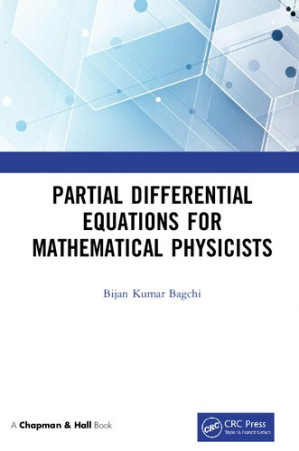
Partial Differential Equations for Mathematical Physicists 🔍
Bagchi, Bijan Kumar
Chapman and Hall/CRC, 1, 2019-07-08
英语 [en] · PDF · 1.1MB · 2019 · 📘 非小说类图书 · 🚀/lgli/lgrs/nexusstc/zlib · Save
描述
Partial Differential Equations for Mathematical Physicistsis intended for graduate students, researchers of theoretical physics and applied mathematics, and professionals who want to take a course in partial differential equations. This book offers the essentials of the subject with theprerequisite being only an elementary knowledge of introductory calculus, ordinary differential equations, and certain aspects of Read more... Abstract: Partial Differential Equations for Mathematical Physicistsis intended for graduate students, researchers of theoretical physics and applied mathematics, and professionals who want to take a course in partial differential equations. This book offers the essentials of the subject with theprerequisite being only an elementary knowledge of introductory calculus, ordinary differential equations, and certain aspects of classical mechanics. We have stressed more the methodologies of partial differential equations and how they can be implemented as tools for extracting their solutions rather thandwelling on the foundational aspects. After covering some basic material, the book proceeds to focus mostly on the three main types of second order linear equations, namely those belonging to the elliptic, hyperbolic, and parabolic classes. For such equations a detailed treatment is given of the derivation of Green's functions, and of the roles of characteristics and techniques required in handling the solutions with the expected amount of rigor. In this regard we have discussed at length the method of separation variables, application of Green's function technique, and employment of Fourier and Laplace's transforms. Also collected in the appendices are some useful results from the Dirac delta function, Fourier transform, and Laplace transform meant to be used as supplementary materials to the text. A good number of problems is worked out andan equallylarge number of exercises has been appended at the end of each chapter keeping in mind the needs of the students. It is expected that this book will provide a systematic and unitary coverage of the basics of partial differential equations. Key Features An adequate and substantive exposition of the subject. Covers a wide range of important topics. Maintainsmathematical rigor throughout. Organizes materials in a self-contained way with each chapter ending with a summary. Contains a large number of worked out problems
备用文件名
lgli/M_Mathematics/MC_Calculus/MCde_Differential equations/Bagchi B.K. Partial differential equations for mathematical physicists (CRC, 2020)(ISBN 9780367227029)(O)(239s)_MCde_.pdf
备用文件名
nexusstc/Partial Differential Equations for Mathematical Physicists/6195191749ecc8e77622f4ddc69e1d23.pdf
备用文件名
lgrsnf/Bagchi B.K. Partial differential equations for mathematical physicists (CRC, 2020)(ISBN 9780367227029)(O)(239s)_MCde_.pdf
备用文件名
zlib/Mathematics/Differential Equations/Bijan Kumar Bagchi/Partial Differential Equations for Mathematical Physicists_5652538.pdf
备选作者
Bijan Kumar Bagchi
备用出版商
Taylor & Francis Group
备用出版商
Taylor & Francis Ltd
备用出版商
Psychology Press Ltd
备用出版商
CRC Press
备用版本
United Kingdom and Ireland, United Kingdom
备用版本
CRC Press (Unlimited), Boca Raton, 2020
备用版本
Boca Raton, FL, 2020
元数据中的注释
lg2711903
元数据中的注释
{"edition":"1","isbns":["0367227029","9780367227029"],"last_page":238,"publisher":"Chapman and Hall/CRC"}
备用描述
Cover
Half Title
Title Page
Copyright Page
Dedication
Contents
Preface
Acknowledgments
Author
1. Preliminary concepts and background material
1.1 Notations and definitions
1.2 Generating a PDE
(a) Eliminating arbitrary constants from a given relation
(b) Elimination of an arbitrary function
1.3 First order PDE and the concept of characteristics
1.4 Quasi-linear first order equation: Method of characteristics
(a) Lagrange's method of seeking a general solution
(b) Integral lines and integral surfaces
1.5 Second order PDEs
1.6 Higher order PDEs
1.7 Cauchy problem for second order linear PDEs
1.8 Hamilton-Jacobi equation
1.9 Canonical transformation
1.10 Concept of generating function
1.11 Types of time-dependent canonical transformations
1.11.1 Type I Canonical transformation
1.11.2 Type II Canonical transformation
1.11.3 Type III Canonical transformation
1.11.4 Type IV Canonical transformation
1.12 Derivation of Hamilton-Jacobi equation
1.13 Summary
2. Basic properties of second order linear PDEs
2.1 Preliminaries
2.2 Reduction to normal or canonical form
2.3 Boundary and initial value problems
(a) Different types of boundary and initial value problems
(b) Applications
Dirichlet problem on a rectangular domain: 0 ≤ x ≤ a, 0 ≤ y ≤ b
Neumann problem on a rectangular domain: 0 ≤ x ≤ a, 0 ≤ y ≤ b
Cauchy initial value problem on an interval: 0 ≤ x ≤ l, t > 0
(c) Well-posedness
Hadamard example
2.4 Insights from classical mechanics
2.5 Adjoint and self-adjoint operators
Two-dimensional case
2.6 Classification of PDE in terms of eigenvalues
2.7 Summary
3. PDE: Elliptic form
3.1 Solving through separation of variables
(a) Two dimensions: plane polar coordinates (r, θ)
(b) Three dimensions: spherical polar coordinates (r, θ, φ)
(c) Cylindrical polar coordinates (r, θ, z)
3.2 Harmonic functions
Gauss' mean value theorem
3.3 Maximum-minimum principle for Poisson's and Laplace's equations
3.4 Existence and uniqueness of solutions
Theorem
3.5 Normally directed distribution of doublets
3.6 Generating Green's function for Laplacian operator
3.7 Dirichlet problem for circle, sphere and half-space
(a) Circle
(b) Sphere
(c) Half-space
3.8 Summary
4. PDE: Hyperbolic form
4.1 D'Alembert's solution
4.2 Solving by Riemann method
4.3 Method of separation of variables
(a) Three dimensions: spherical polar coordinates (r, θ, φ)
(b) Cylindrical polar coordinates (r, θ, z)
4.4 Initial value problems
(a) Three dimensional wave equation
(b) Two dimensional wave equation
4.5 Summary
5. PDE: Parabolic form
5.1 Reaction-diffusion and heat equations
5.2 Cauchy problem: Uniqueness of solution
5.3 Maximum-minimum principle
5.4 Method of separation of variables
(a) Cartesian coordinates (x; y; z)
(b) Three dimensions: spherical polar coordinates (r, θ, φ)
(c) Cylindrical polar coordinates (r, θ, z)
5.5 Fundamental solution
5.6 Green's function
5.7 Summary
6. Solving PDEs by integral transform method
6.1 Solving by Fourier transform method
6.2 Solving by Laplace transform method
6.3 Summary
Appendix A: Dirac delta function
Dirac delta function δ(x)
Other results using delta function
Test function
Green's function
Appendix B: Fourier transform
Fourier transform
Convolution theorem and Parseval relation
Appendix C: Laplace transform
Laplace transform
Inversion theorem for Laplace transform
Asymptotic form for Laplace's inversion integral
Bibliography
Index
Half Title
Title Page
Copyright Page
Dedication
Contents
Preface
Acknowledgments
Author
1. Preliminary concepts and background material
1.1 Notations and definitions
1.2 Generating a PDE
(a) Eliminating arbitrary constants from a given relation
(b) Elimination of an arbitrary function
1.3 First order PDE and the concept of characteristics
1.4 Quasi-linear first order equation: Method of characteristics
(a) Lagrange's method of seeking a general solution
(b) Integral lines and integral surfaces
1.5 Second order PDEs
1.6 Higher order PDEs
1.7 Cauchy problem for second order linear PDEs
1.8 Hamilton-Jacobi equation
1.9 Canonical transformation
1.10 Concept of generating function
1.11 Types of time-dependent canonical transformations
1.11.1 Type I Canonical transformation
1.11.2 Type II Canonical transformation
1.11.3 Type III Canonical transformation
1.11.4 Type IV Canonical transformation
1.12 Derivation of Hamilton-Jacobi equation
1.13 Summary
2. Basic properties of second order linear PDEs
2.1 Preliminaries
2.2 Reduction to normal or canonical form
2.3 Boundary and initial value problems
(a) Different types of boundary and initial value problems
(b) Applications
Dirichlet problem on a rectangular domain: 0 ≤ x ≤ a, 0 ≤ y ≤ b
Neumann problem on a rectangular domain: 0 ≤ x ≤ a, 0 ≤ y ≤ b
Cauchy initial value problem on an interval: 0 ≤ x ≤ l, t > 0
(c) Well-posedness
Hadamard example
2.4 Insights from classical mechanics
2.5 Adjoint and self-adjoint operators
Two-dimensional case
2.6 Classification of PDE in terms of eigenvalues
2.7 Summary
3. PDE: Elliptic form
3.1 Solving through separation of variables
(a) Two dimensions: plane polar coordinates (r, θ)
(b) Three dimensions: spherical polar coordinates (r, θ, φ)
(c) Cylindrical polar coordinates (r, θ, z)
3.2 Harmonic functions
Gauss' mean value theorem
3.3 Maximum-minimum principle for Poisson's and Laplace's equations
3.4 Existence and uniqueness of solutions
Theorem
3.5 Normally directed distribution of doublets
3.6 Generating Green's function for Laplacian operator
3.7 Dirichlet problem for circle, sphere and half-space
(a) Circle
(b) Sphere
(c) Half-space
3.8 Summary
4. PDE: Hyperbolic form
4.1 D'Alembert's solution
4.2 Solving by Riemann method
4.3 Method of separation of variables
(a) Three dimensions: spherical polar coordinates (r, θ, φ)
(b) Cylindrical polar coordinates (r, θ, z)
4.4 Initial value problems
(a) Three dimensional wave equation
(b) Two dimensional wave equation
4.5 Summary
5. PDE: Parabolic form
5.1 Reaction-diffusion and heat equations
5.2 Cauchy problem: Uniqueness of solution
5.3 Maximum-minimum principle
5.4 Method of separation of variables
(a) Cartesian coordinates (x; y; z)
(b) Three dimensions: spherical polar coordinates (r, θ, φ)
(c) Cylindrical polar coordinates (r, θ, z)
5.5 Fundamental solution
5.6 Green's function
5.7 Summary
6. Solving PDEs by integral transform method
6.1 Solving by Fourier transform method
6.2 Solving by Laplace transform method
6.3 Summary
Appendix A: Dirac delta function
Dirac delta function δ(x)
Other results using delta function
Test function
Green's function
Appendix B: Fourier transform
Fourier transform
Convolution theorem and Parseval relation
Appendix C: Laplace transform
Laplace transform
Inversion theorem for Laplace transform
Asymptotic form for Laplace's inversion integral
Bibliography
Index
备用描述
Partial Differential Equations for Mathematical Physicists is intended for graduate students, researchers of theoretical physics and applied mathematics, and professionals who want to take a course in partial differential equations. This book offers the essentials of the subject with the prerequisite being only an elementary knowledge of introductory calculus, ordinary differential equations, and certain aspects of classical mechanics. We have stressed more the methodologies of partial differential equations and how they can be implemented as tools for extracting their solutions rather than dwelling on the foundational aspects. After covering some basic material, the book proceeds to focus mostly on the three main types of second order linear equations, namely those belonging to the elliptic, hyperbolic, and parabolic classes. For such equations a detailed treatment is given of the derivation of Green's functions, and of the roles of characteristics and techniques required in handling the solutions with the expected amount of rigor. In this regard we have discussed at length the method of separation variables, application of Green's function technique, and employment of Fourier and Laplace's transforms. Also collected in the appendices are some useful results from the Dirac delta function, Fourier transform, and Laplace transform meant to be used as supplementary materials to the text. A good number of problems is worked out and an equally large number of exercises has been appended at the end of each chapter keeping in mind the needs of the students. It is expected that this book will provide a systematic and unitary coverage of the basics of partial differential equations.
Key Features
An adequate and substantive exposition of the subject. Covers a wide range of important topics. Maintains mathematical rigor throughout. Organizes materials in a self-contained way with each chapter ending with a summary. Contains a large number of worked out problems.
Key Features
An adequate and substantive exposition of the subject. Covers a wide range of important topics. Maintains mathematical rigor throughout. Organizes materials in a self-contained way with each chapter ending with a summary. Contains a large number of worked out problems.
开源日期
2020-07-28
🚀 快速下载
成为会员以支持书籍、论文等的长期保存。为了感谢您对我们的支持,您将获得高速下载权益。❤️
如果您在本月捐款,您将获得双倍的快速下载次数。
🐢 低速下载
由可信的合作方提供。 更多信息请参见常见问题解答。 (可能需要验证浏览器——无限次下载!)
- 低速服务器(合作方提供) #1 (稍快但需要排队)
- 低速服务器(合作方提供) #2 (稍快但需要排队)
- 低速服务器(合作方提供) #3 (稍快但需要排队)
- 低速服务器(合作方提供) #4 (稍快但需要排队)
- 低速服务器(合作方提供) #5 (无需排队,但可能非常慢)
- 低速服务器(合作方提供) #6 (无需排队,但可能非常慢)
- 低速服务器(合作方提供) #7 (无需排队,但可能非常慢)
- 低速服务器(合作方提供) #8 (无需排队,但可能非常慢)
- 低速服务器(合作方提供) #9 (无需排队,但可能非常慢)
- 下载后: 在我们的查看器中打开
所有选项下载的文件都相同,应该可以安全使用。即使这样,从互联网下载文件时始终要小心。例如,确保您的设备更新及时。
外部下载
-
对于大文件,我们建议使用下载管理器以防止中断。
推荐的下载管理器:JDownloader -
您将需要一个电子书或 PDF 阅读器来打开文件,具体取决于文件格式。
推荐的电子书阅读器:Anna的档案在线查看器、ReadEra和Calibre -
使用在线工具进行格式转换。
推荐的转换工具:CloudConvert和PrintFriendly -
您可以将 PDF 和 EPUB 文件发送到您的 Kindle 或 Kobo 电子阅读器。
推荐的工具:亚马逊的“发送到 Kindle”和djazz 的“发送到 Kobo/Kindle” -
支持作者和图书馆
✍️ 如果您喜欢这个并且能够负担得起,请考虑购买原版,或直接支持作者。
📚 如果您当地的图书馆有这本书,请考虑在那里免费借阅。
下面的文字仅以英文继续。
总下载量:
“文件的MD5”是根据文件内容计算出的哈希值,并且基于该内容具有相当的唯一性。我们这里索引的所有影子图书馆都主要使用MD5来标识文件。
一个文件可能会出现在多个影子图书馆中。有关我们编译的各种数据集的信息,请参见数据集页面。
有关此文件的详细信息,请查看其JSON 文件。 Live/debug JSON version. Live/debug page.