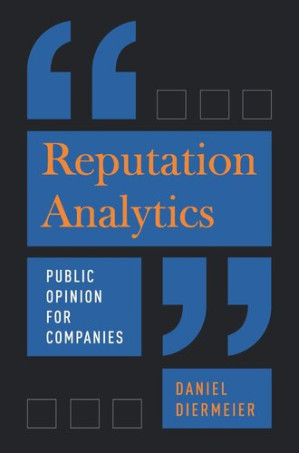
Reputation Analytics : Public Opinion for Companies 🔍
Daniel Diermeier
The University of Chicago Press, 1, 2023
英语 [en] · PDF · 2.0MB · 2023 · 📘 非小说类图书 · 🚀/lgli/lgrs/nexusstc/zlib · Save
描述
"An analytical approach to corporate reputations from its leading scholar. Public perception, especially in the time of social media, is a core determinant of any organization's success and longevity. It is also fickle: organizations can fall astray of public approval through crisis, mismanagement, or sudden shifts in the public sensibility. In Reputation Analytics, Daniel Diermeier offers the first scientific framework for understanding and managing the vagaries of corporate reputation and public opinion. Drawing on a political scientist's understanding of the formation and dynamics of public opinion, Diermeier infuses his approach with lessons from game theory, psychology, and text analytics to produce a rigorous, altogether original approach that will have immediate application in both scholarship and practice. A milestone work from one of social science's most eminent scholars, Reputation Analytics ushers a new and advanced understanding on a topic that has long eluded such treatment-and an essential work for readers across industry and academics"-- Provided by publisher
备用文件名
lgli/10.7208_chicago_9780226029764.pdf
备用文件名
lgrsnf/10.7208_chicago_9780226029764.pdf
备用文件名
zlib/no-category/Daniel Diermeier/Reputation Analytics: Public Opinion for Companies_25721499.pdf
备用版本
University of Chicago Press, Chicago, 2023
备用版本
United States, United States of America
元数据中的注释
degruyter.com
元数据中的注释
{"edition":"1","isbns":["022602962X","022602976X","9780226029627","9780226029764"],"last_page":496,"publisher":"University of Chicago Press","source":"crossref"}
备用描述
Contents
Preface
Chapter one. Overview
Part I Reputation and Public Opinion
Chapter two. Principles of Public Opinion
Part II Perception, Attitudes, and Behavior
Chapter three. Evaluations, Attitudes, and the Role of Values
Chapter four. Affective Primacy and Dual-Process Theories of Cognition
Chapter five. Beliefs: Risk, Trust, and Apologies
Chapter six. Open Questions and Future Directions
Part III Salience and Attention
Chapter seven. Framing
Chapter eight. Models of the Media: Bias and Influence
Chapter nine. Social Media—Social Networks
Chapter ten. Media Influence: An Assessment
Part IV Stakeholders and Strategies: Firms, Activists, and Corporate Campaigns
Chapter eleven. The Rise of Strategic Activism
Chapter twelve. The Boycott Game
Chapter thirteen. The Logic of Campaigns
Chapter fourteen. The Strategic Interaction between Activists and Firms
Part V Beyond Surveys: Measurement and Metrics
Chapter fifteen. Surveys and Their Limitations
Chapter sixteen. Measuring Opinion
Chapter seventeen. Agendas, Topics, and Issues
Chapter eighteen. Frames
Chapter nineteen. Text-Analytic Methods: Promise and Pitfalls
Part VI Conclusion: Toward a Reputation Management Capability
Chapter twenty. The Right Mindset: Corporate Reputation as Public Opinion
Chapter twenty-one. Developing a Reputation Management System
Acknowledgments
Notes
Bibliography
Index
Preface
Chapter one. Overview
Part I Reputation and Public Opinion
Chapter two. Principles of Public Opinion
Part II Perception, Attitudes, and Behavior
Chapter three. Evaluations, Attitudes, and the Role of Values
Chapter four. Affective Primacy and Dual-Process Theories of Cognition
Chapter five. Beliefs: Risk, Trust, and Apologies
Chapter six. Open Questions and Future Directions
Part III Salience and Attention
Chapter seven. Framing
Chapter eight. Models of the Media: Bias and Influence
Chapter nine. Social Media—Social Networks
Chapter ten. Media Influence: An Assessment
Part IV Stakeholders and Strategies: Firms, Activists, and Corporate Campaigns
Chapter eleven. The Rise of Strategic Activism
Chapter twelve. The Boycott Game
Chapter thirteen. The Logic of Campaigns
Chapter fourteen. The Strategic Interaction between Activists and Firms
Part V Beyond Surveys: Measurement and Metrics
Chapter fifteen. Surveys and Their Limitations
Chapter sixteen. Measuring Opinion
Chapter seventeen. Agendas, Topics, and Issues
Chapter eighteen. Frames
Chapter nineteen. Text-Analytic Methods: Promise and Pitfalls
Part VI Conclusion: Toward a Reputation Management Capability
Chapter twenty. The Right Mindset: Corporate Reputation as Public Opinion
Chapter twenty-one. Developing a Reputation Management System
Acknowledgments
Notes
Bibliography
Index
备用描述
A scientific approach to corporate reputation from the field’s leading scholar.
Public opinion is a core factor of any organization’s success—and sometimes its failings. Whether through crisis, mismanagement, or sudden shifts in public sensibility, an organization can run afoul in the span of a Tweet.
In Reputation Analytics , Daniel Diermeier offers the first rigorous analytical framework for understanding and managing corporate reputation and public perception. Drawing on his expertise as a political scientist and management scholar, Diermeier incorporates lessons from game theory, psychology, and text analytics to create a methodology that has immediate application in both scholarship and practice.
A milestone work from one of social science’s most eminent scholars, Reputation Analytics unveils an advanced understanding of an elusive topic, resulting in an essential guide for academics and readers across industries.
Public opinion is a core factor of any organization’s success—and sometimes its failings. Whether through crisis, mismanagement, or sudden shifts in public sensibility, an organization can run afoul in the span of a Tweet.
In Reputation Analytics , Daniel Diermeier offers the first rigorous analytical framework for understanding and managing corporate reputation and public perception. Drawing on his expertise as a political scientist and management scholar, Diermeier incorporates lessons from game theory, psychology, and text analytics to create a methodology that has immediate application in both scholarship and practice.
A milestone work from one of social science’s most eminent scholars, Reputation Analytics unveils an advanced understanding of an elusive topic, resulting in an essential guide for academics and readers across industries.
开源日期
2023-08-15
We strongly recommend that you support the author by buying or donating on their personal website, or borrowing in your local library.
🚀 快速下载
成为会员以支持书籍、论文等的长期保存。为了感谢您对我们的支持,您将获得高速下载权益。❤️
如果您在本月捐款,您将获得双倍的快速下载次数。
🐢 低速下载
由可信的合作方提供。 更多信息请参见常见问题解答。 (可能需要验证浏览器——无限次下载!)
- 低速服务器(合作方提供) #1 (稍快但需要排队)
- 低速服务器(合作方提供) #2 (稍快但需要排队)
- 低速服务器(合作方提供) #3 (稍快但需要排队)
- 低速服务器(合作方提供) #4 (稍快但需要排队)
- 低速服务器(合作方提供) #5 (无需排队,但可能非常慢)
- 低速服务器(合作方提供) #6 (无需排队,但可能非常慢)
- 低速服务器(合作方提供) #7 (无需排队,但可能非常慢)
- 低速服务器(合作方提供) #8 (无需排队,但可能非常慢)
- 低速服务器(合作方提供) #9 (无需排队,但可能非常慢)
- 下载后: 在我们的查看器中打开
所有选项下载的文件都相同,应该可以安全使用。即使这样,从互联网下载文件时始终要小心。例如,确保您的设备更新及时。
外部下载
-
对于大文件,我们建议使用下载管理器以防止中断。
推荐的下载管理器:JDownloader -
您将需要一个电子书或 PDF 阅读器来打开文件,具体取决于文件格式。
推荐的电子书阅读器:Anna的档案在线查看器、ReadEra和Calibre -
使用在线工具进行格式转换。
推荐的转换工具:CloudConvert和PrintFriendly -
您可以将 PDF 和 EPUB 文件发送到您的 Kindle 或 Kobo 电子阅读器。
推荐的工具:亚马逊的“发送到 Kindle”和djazz 的“发送到 Kobo/Kindle” -
支持作者和图书馆
✍️ 如果您喜欢这个并且能够负担得起,请考虑购买原版,或直接支持作者。
📚 如果您当地的图书馆有这本书,请考虑在那里免费借阅。
下面的文字仅以英文继续。
总下载量:
“文件的MD5”是根据文件内容计算出的哈希值,并且基于该内容具有相当的唯一性。我们这里索引的所有影子图书馆都主要使用MD5来标识文件。
一个文件可能会出现在多个影子图书馆中。有关我们编译的各种数据集的信息,请参见数据集页面。
有关此文件的详细信息,请查看其JSON 文件。 Live/debug JSON version. Live/debug page.