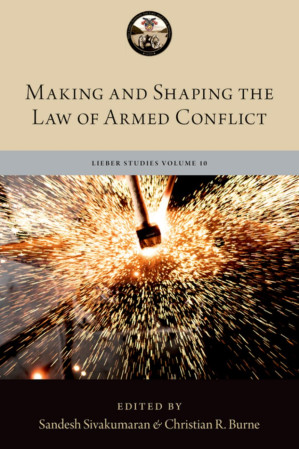
Making and Shaping the Law of Armed Conflict (The Lieber Studies Series) 🔍
Sandesh Sivakumaran, Captain Christian R. Burne
Oxford University Press, Incorporated, The Lieber Studies, 2024
英语 [en] · PDF · 28.5MB · 2024 · 📘 非小说类图书 · 🚀/lgli/lgrs/zlib · Save
描述
How laws are created, shaped, and applied is a significant but often overlooked component of studies on armed conflict. Almost every contentious legal question involves aspects of law-making and shaping, be it the determination of a rule's scope of application, whether and how to regulate a “new” situation, or determining which sources and materials to take into account. As such, all who operate in this space - whether academic, practitioner, policy-maker, or legal advisor - must appreciate and understand the forces, factors, and actors which converge to make and shape the ever-developing law of armed conflict.
This volume brings together several key contributors to explore this making and shaping in depth. A variety of aspects of law-making and shaping are analyzed, from the methodology behind identifying principles and rules of law, to what weight should be given to the views of particular actors, to the various forums where the law is made and shaped. It examines foundational materials of the law of armed conflict including the 1949 Geneva Conventions and considers the influence of a wide scope of actors, ranging from States, the International Committee of the Red Cross, and international courts and tribunals through to expert groups, commissions of inquiry, and non-state armed groups. This volume also asks us to broaden our gaze beyond spaces where the law is traditionally created to uncover different types of making and unmaking
This volume brings together several key contributors to explore this making and shaping in depth. A variety of aspects of law-making and shaping are analyzed, from the methodology behind identifying principles and rules of law, to what weight should be given to the views of particular actors, to the various forums where the law is made and shaped. It examines foundational materials of the law of armed conflict including the 1949 Geneva Conventions and considers the influence of a wide scope of actors, ranging from States, the International Committee of the Red Cross, and international courts and tribunals through to expert groups, commissions of inquiry, and non-state armed groups. This volume also asks us to broaden our gaze beyond spaces where the law is traditionally created to uncover different types of making and unmaking
备用文件名
lgrsnf/Making and Shaping the Law of Armed Conflict (The Lieber Studies Series) [3904914].pdf
备用文件名
zlib/Society, Politics & Philosophy/Warfare & Defence/Sandesh Sivakumaran;Captain Christian R. Burne;/Making and Shaping the Law of Armed Conflict_29222671.pdf
备用出版商
IRL Press at Oxford University Press
备用出版商
Oxford Institute for Energy Studies
备用出版商
German Historical Institute London
备用版本
United Kingdom and Ireland, United Kingdom
备用版本
Oxford University Press USA, [N.p.], 2024
备用版本
PT, 2024
备用描述
Cover
Series
Lieber Institute for Law and Warfare
Copyright
CONTENTS
Table of Cases
Table of Treaties
Contributors
PART ONEIntroduction
1. Making and Shaping the Law of Armed Conflict: An Overview
PART TWO Foundational Materials
2. Where Vienna and Geneva Meet: Treaty Interpretation and the Geneva Conventions
3. Customary International Law: A Transformative Force in the Landscape of IHL
4. Principles of International Humanitarian Law: A New Framework
5. Soft Law: What Is It Good For?
PART THREE Actors and Influences
6. Expert Manuals: An Insider’s Account
7. The Development of International Humanitarian Law by the International Committee of the Red Cross
8. Applying the Law of Armed Conflict in Domestic Courts: The Fusion of Domestic and International Law and the Question of IHL Expertise
9. The Development of the Law of Armed Conflict by International Criminal Tribunals
10. The Role of Human Rights Mechanisms in Shaping International Humanitarian Law
11. Applying and Interpreting the Law of Armed Conflict: Contributions by the UN Commissions on the Syrian Arab Republic and the Republic of South Sudan
12. Non-State Armed Groups, Law-Making, and the Shaping of International Law in Armed Conflict
PART FOUR Spaces
13. The Role of Regionalism in the Making and Shaping of the Law of Armed Conflict
14. Between War and the Text: The Pedagogical Life of International Humanitarian Law
PART FIVEUnmaking
15. A Prologue to Law of War Unmaking
Index
Series
Lieber Institute for Law and Warfare
Copyright
CONTENTS
Table of Cases
Table of Treaties
Contributors
PART ONEIntroduction
1. Making and Shaping the Law of Armed Conflict: An Overview
PART TWO Foundational Materials
2. Where Vienna and Geneva Meet: Treaty Interpretation and the Geneva Conventions
3. Customary International Law: A Transformative Force in the Landscape of IHL
4. Principles of International Humanitarian Law: A New Framework
5. Soft Law: What Is It Good For?
PART THREE Actors and Influences
6. Expert Manuals: An Insider’s Account
7. The Development of International Humanitarian Law by the International Committee of the Red Cross
8. Applying the Law of Armed Conflict in Domestic Courts: The Fusion of Domestic and International Law and the Question of IHL Expertise
9. The Development of the Law of Armed Conflict by International Criminal Tribunals
10. The Role of Human Rights Mechanisms in Shaping International Humanitarian Law
11. Applying and Interpreting the Law of Armed Conflict: Contributions by the UN Commissions on the Syrian Arab Republic and the Republic of South Sudan
12. Non-State Armed Groups, Law-Making, and the Shaping of International Law in Armed Conflict
PART FOUR Spaces
13. The Role of Regionalism in the Making and Shaping of the Law of Armed Conflict
14. Between War and the Text: The Pedagogical Life of International Humanitarian Law
PART FIVEUnmaking
15. A Prologue to Law of War Unmaking
Index
开源日期
2024-07-09
We strongly recommend that you support the author by buying or donating on their personal website, or borrowing in your local library.
🚀 快速下载
成为会员以支持书籍、论文等的长期保存。为了感谢您对我们的支持,您将获得高速下载权益。❤️
- 高速服务器(合作方提供) #1 (推荐)
- 高速服务器(合作方提供) #2 (推荐)
- 高速服务器(合作方提供) #3 (推荐)
- 高速服务器(合作方提供) #4 (推荐)
- 高速服务器(合作方提供) #5 (推荐)
- 高速服务器(合作方提供) #6 (推荐)
- 高速服务器(合作方提供) #7
- 高速服务器(合作方提供) #8
- 高速服务器(合作方提供) #9
- 高速服务器(合作方提供) #10
- 高速服务器(合作方提供) #11
- 高速服务器(合作方提供) #12
- 高速服务器(合作方提供) #13
- 高速服务器(合作方提供) #14
- 高速服务器(合作方提供) #15
- 高速服务器(合作方提供) #16
- 高速服务器(合作方提供) #17
- 高速服务器(合作方提供) #18
- 高速服务器(合作方提供) #19
- 高速服务器(合作方提供) #20
- 高速服务器(合作方提供) #21
- 高速服务器(合作方提供) #22
🐢 低速下载
由可信的合作方提供。 更多信息请参见常见问题解答。 (可能需要验证浏览器——无限次下载!)
- 低速服务器(合作方提供) #1 (稍快但需要排队)
- 低速服务器(合作方提供) #2 (稍快但需要排队)
- 低速服务器(合作方提供) #3 (稍快但需要排队)
- 低速服务器(合作方提供) #4 (稍快但需要排队)
- 低速服务器(合作方提供) #5 (无需排队,但可能非常慢)
- 低速服务器(合作方提供) #6 (无需排队,但可能非常慢)
- 低速服务器(合作方提供) #7 (无需排队,但可能非常慢)
- 低速服务器(合作方提供) #8 (无需排队,但可能非常慢)
- 低速服务器(合作方提供) #9 (无需排队,但可能非常慢)
- 低速服务器(合作方提供) #10 (稍快但需要排队)
- 低速服务器(合作方提供) #11 (稍快但需要排队)
- 低速服务器(合作方提供) #12 (稍快但需要排队)
- 低速服务器(合作方提供) #13 (稍快但需要排队)
- 低速服务器(合作方提供) #14 (无需排队,但可能非常慢)
- 低速服务器(合作方提供) #15 (无需排队,但可能非常慢)
- 低速服务器(合作方提供) #16 (无需排队,但可能非常慢)
- 低速服务器(合作方提供) #17 (无需排队,但可能非常慢)
- 低速服务器(合作方提供) #18 (无需排队,但可能非常慢)
- 下载后: 在我们的查看器中打开
所有选项下载的文件都相同,应该可以安全使用。即使这样,从互联网下载文件时始终要小心。例如,确保您的设备更新及时。
外部下载
-
对于大文件,我们建议使用下载管理器以防止中断。
推荐的下载管理器:JDownloader -
您将需要一个电子书或 PDF 阅读器来打开文件,具体取决于文件格式。
推荐的电子书阅读器:Anna的档案在线查看器、ReadEra和Calibre -
使用在线工具进行格式转换。
推荐的转换工具:CloudConvert和PrintFriendly -
您可以将 PDF 和 EPUB 文件发送到您的 Kindle 或 Kobo 电子阅读器。
推荐的工具:亚马逊的“发送到 Kindle”和djazz 的“发送到 Kobo/Kindle” -
支持作者和图书馆
✍️ 如果您喜欢这个并且能够负担得起,请考虑购买原版,或直接支持作者。
📚 如果您当地的图书馆有这本书,请考虑在那里免费借阅。
下面的文字仅以英文继续。
总下载量:
“文件的MD5”是根据文件内容计算出的哈希值,并且基于该内容具有相当的唯一性。我们这里索引的所有影子图书馆都主要使用MD5来标识文件。
一个文件可能会出现在多个影子图书馆中。有关我们编译的各种数据集的信息,请参见数据集页面。
有关此文件的详细信息,请查看其JSON 文件。 Live/debug JSON version. Live/debug page.