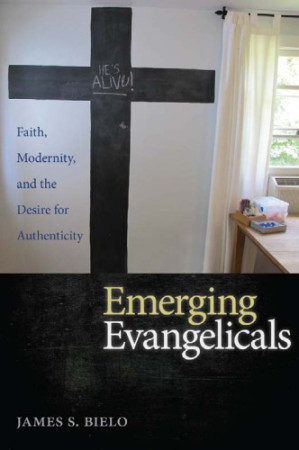
lgli/K:\_add\!woodhead\!\!!\slow\(NYU Press) Emerging Evangelicals_ Faith, Modernity, and the Desire for Authenticity - James S. Bielo.pdf
Emerging Evangelicals Faith, Modernity, and the Desire for Authenticity 🔍
James S. Bielo
NYU Press, 2006
英语 [en] · PDF · 2.5MB · 2006 · 📘 非小说类图书 · 🚀/lgli/lgrs/nexusstc/zlib · Save
描述
The Emerging Church movement developed in the mid-1990s among primarily white, urban, middle-class pastors and laity who were disenchanted with America's conservative Evangelical sub-culture. It is a response to the increasing divide between conservative Evangelicals and concerned critics who strongly oppose what they consider overly slick, corporate, and consumerist versions of faith. A core feature of their response is a challenge to traditional congregational models, often focusing on new church plants and creating networks of related house churches.Drawing on three years of ethnographic fieldwork, James S. Bielo explores the impact of the Emerging Church movement on American Evangelicals. He combines ethnographic analysis with discussions of the movement's history, discursive contours, defining practices, cultural logics, and contentious interactions with conservative Evangelical critics to rethink the boundaries of Evangelical as a category. Ultimately, Bielo makes a novel contribution to our understanding of the important changes at work among American Protestants, and illuminates how Emerging Evangelicals interact with the cultural conditions of modernity, late modernity, and visions of postmodern Christianity.
Read more...
Abstract: The Emerging Church movement developed in the mid-1990s among primarily white, urban, middle-class pastors and laity who were disenchanted with America's conservative Evangelical sub-culture. It is a response to the increasing divide between conservative Evangelicals and concerned critics who strongly oppose what they consider overly slick, corporate, and consumerist versions of faith. A core feature of their response is a challenge to traditional congregational models, often focusing on new church plants and creating networks of related house churches.Drawing on three years of ethnographic fieldwork, James S. Bielo explores the impact of the Emerging Church movement on American Evangelicals. He combines ethnographic analysis with discussions of the movement's history, discursive contours, defining practices, cultural logics, and contentious interactions with conservative Evangelical critics to rethink the boundaries of Evangelical as a category. Ultimately, Bielo makes a novel contribution to our understanding of the important changes at work among American Protestants, and illuminates how Emerging Evangelicals interact with the cultural conditions of modernity, late modernity, and visions of postmodern Christianity.
Read more...
Abstract: The Emerging Church movement developed in the mid-1990s among primarily white, urban, middle-class pastors and laity who were disenchanted with America's conservative Evangelical sub-culture. It is a response to the increasing divide between conservative Evangelicals and concerned critics who strongly oppose what they consider overly slick, corporate, and consumerist versions of faith. A core feature of their response is a challenge to traditional congregational models, often focusing on new church plants and creating networks of related house churches.Drawing on three years of ethnographic fieldwork, James S. Bielo explores the impact of the Emerging Church movement on American Evangelicals. He combines ethnographic analysis with discussions of the movement's history, discursive contours, defining practices, cultural logics, and contentious interactions with conservative Evangelical critics to rethink the boundaries of Evangelical as a category. Ultimately, Bielo makes a novel contribution to our understanding of the important changes at work among American Protestants, and illuminates how Emerging Evangelicals interact with the cultural conditions of modernity, late modernity, and visions of postmodern Christianity.
备用文件名
lgrsnf/K:\_add\!woodhead\!\!!\slow\(NYU Press) Emerging Evangelicals_ Faith, Modernity, and the Desire for Authenticity - James S. Bielo.pdf
备用文件名
nexusstc/Emerging Evangelicals Faith, Modernity, and the Desire for Authenticity/9324dfa27405d01251e604399db9929d.pdf
备用文件名
zlib/no-category/James S. Bielo/Emerging Evangelicals Faith, Modernity, and the Desire for Authenticity_2633292.pdf
元数据中的注释
lg1423343
元数据中的注释
{"last_page":238,"publisher":"NYU Press"}
备用描述
Content: j.ctt9qfqvv.1 Front Matter i j.ctt9qfqvv.2 Table of Contents vii j.ctt9qfqvv.3 Figures and Tables ix j.ctt9qfqvv.4 Acknowledgments xi j.ctt9qfqvv.5 Introduction: Conceptualizing Emerging Evangelicalism 1 “This is the way it’s supposed to be,” Larry averred from the top of the stairs. I turned to offer an appreciative nod. His face was beaming, framed by a neatly kept white beard.
It was 4:30 p.m., mid-June 2009, and I had just finished a three-hour interview, preceded by two hours of talk, food, and coffee. The day had started with no anticipation of anything unexpected. I was to interview Aaron, a campus pastor in his late thirties. We had arranged to meet for lunch in Newport, Kentucky, just across the state line from Cincinnati. Aaron suggested a change
j.ctt9qfqvv.6 1 Stories of Deconversion 28 I spent two hours on June 25, 2003 interviewing a man named Paul. He was in his late forties and a deacon at a rural Nazarene congregation. Paul was a conservative Evangelical, and there was nothing Emerging about him. I was doing fieldwork with three congregations, focusing on the circulation of moral discourses in local churches. Paul was an especially active member in several weekly prayer and study groups, so we arranged an interview about his experience with the church and cultural models of morality. I conducted fifteen interviews that summer, and always began by asking for a spiritual-religious life
j.ctt9qfqvv.7 2 Ironies of Faith 47 March 25, 2008: East Lansing, Michigan. Tonight I witnessed one of the oddest scenes I can recall in eight years of fieldwork with American Christians. It was ten o’clock on a weekday night. A tall, lanky man stood in front of a pulpit. His hair was short and neatly trimmed. He wore nondescript glasses, and a plaid button-up shirt tucked perfectly into iron-pressed beige khakis. He did not look the part of a celebrity, but he seemed to be playing one. A throng of preteen boys and girls with arms extended surrounded him, all waving the same book. They were
j.ctt9qfqvv.8 3 Ancient-Future I: Experiencing God 70 The December 2007 issue ofU.S. News and World Report,one of a few widely circulated news periodicals reliably perched in grocery store check-out aisles, was entitled: “A Return to Ritual: why many modern worshipers, including Catholics, Jews, and evangelicals are embracing tradition.” The cover photo hints at the story’s contents: priests in formal, brightly adorned robes blessing a sacrament in front of an altar, complete with sacred texts and a white stone, winged angel (Figure 3.1). The article suggests that Jewish, Catholic, Protestant, and Muslim communities are increasingly attracted to older expressions of faith. To illustrate the Evangelical incarnation,
j.ctt9qfqvv.9 4 Ancient-Future II: Everyday Monastics 98 In late October 2008 I waited in a coffee shop for Glenn. It was a Friday afternoon and the atmosphere was bustling, nearly frenetic. The activity was explained by the start of weekend socializing, the unseasonably warm, sunny weather and a fast approaching presidential election. Political talk filled the air alongside the permanence of coffee smells and the occasional, halting grind of an espresso machine. I had not talked with Glenn for over a month and was excited at the prospect of another follow-up interview.
Glenn is an east Tennessee native and retains a thick, Appalachian drawl. It complements the
j.ctt9qfqvv.10 5 Missional I: Everyday Missionaries 118 As a worship consultant Lilly is, relatively speaking, a success. She travels regularly as a paid speaker at conferences, churches, and workshops to help Christian communities develop ancient-future worship events. She coauthored a manual about creating sacred spaces, published by a major Christian press. Since leaving professional ministry, her consultant work has been the primary expression of her religious vocation. But in her own backyard, in Cincinnati, Lilly maintains a worry.
Events like the journaling group are not uniformly appealing. Lilly recognized this fact, describing most Thinplace events as overly “cerebral,” noting the bias toward well-educated, highly literate participants. Reading,
j.ctt9qfqvv.11 6 Missional II: Kingdom Theologies 138 I reviewed the diagram once more before holding it up to show everyone. For several minutes I had been sketching it in my field notebook. In the middle of the page was one word, in capital letters, “KINGDOM.” Curved and straight lines extended in all directions from this centerpiece. Capping the lines was a series of words: “Identity,” “Worship,” “Missional,” “Theology,” “Environment,” “Place,” “Politics.” I wanted to convey (however inartistically) the idea that so much of Evangelical thought and practice is connected to, if not derived from, kingdom theology: understandings about the nature — the what, when, where, why, how, and
j.ctt9qfqvv.12 7 Church Planting I: A New Work 157 From the audience of about fifty people, a young man who looked to be in his late twenties asked, “When you have a team ready to plant, how do you find a church willing to mentor you?” Three of the four panelists answered him. Dustin, “lead pastor” for a 2005 church plant in the eastern suburbs of Louisville, Kentucky, assured the questioner that if he had the flexibility to move anywhere he and his team would be “snapped up in a second.” Following some advice from others in the audience, Rick, lead pastor for a 2006 church plant joked that
j.ctt9qfqvv.13 8 Church Planting II: Sense of Place 178 Doing ethnography with missional church planters in Cincinnati proved to be fortuitous. Neighborhoods are the reason. Cincinnati—much like New York or Chicago—is a city defined by its collection of distinct neighborhood enclaves. When you ask Cincinnatians where they live—or for driving directions, or where an address is located, or where they would like to buy a house, or where the best place to (insert desired activity) is—they begin with a neighborhood. Rhoda Halperin, an economic anthropologist and former professor at the University of Cincinnati, used this social fact as an ethnographic starting point in her book,
j.ctt9qfqvv.14 Conclusion: Dialogic Evangelicalism 195 On Saturday, October 2, 2010, at 9 p.m. I was standing in the scene that opened this book, the neighborhood street corner in Norwood between 1801 and St. E. Looking in three directions the view repeated: silent streets, empty sidewalks, half-lit by dim street lights. Looking west, the view was much the same, save one difference: one porch, bright with candles and lighting, voices and laughter ringing, echoing against the otherwise sleepy backdrop.
The porch was that of the Vineyard Central communal house, where Kevin, who had vowed stability in this neighborhood, lives with his wife and other residents. I
j.ctt9qfqvv.15 Appendix Ethnographic Consultants 205 j.ctt9qfqvv.16 References 211 j.ctt9qfqvv.17 Index 221 j.ctt9qfqvv.18 About the Author 225
It was 4:30 p.m., mid-June 2009, and I had just finished a three-hour interview, preceded by two hours of talk, food, and coffee. The day had started with no anticipation of anything unexpected. I was to interview Aaron, a campus pastor in his late thirties. We had arranged to meet for lunch in Newport, Kentucky, just across the state line from Cincinnati. Aaron suggested a change
j.ctt9qfqvv.6 1 Stories of Deconversion 28 I spent two hours on June 25, 2003 interviewing a man named Paul. He was in his late forties and a deacon at a rural Nazarene congregation. Paul was a conservative Evangelical, and there was nothing Emerging about him. I was doing fieldwork with three congregations, focusing on the circulation of moral discourses in local churches. Paul was an especially active member in several weekly prayer and study groups, so we arranged an interview about his experience with the church and cultural models of morality. I conducted fifteen interviews that summer, and always began by asking for a spiritual-religious life
j.ctt9qfqvv.7 2 Ironies of Faith 47 March 25, 2008: East Lansing, Michigan. Tonight I witnessed one of the oddest scenes I can recall in eight years of fieldwork with American Christians. It was ten o’clock on a weekday night. A tall, lanky man stood in front of a pulpit. His hair was short and neatly trimmed. He wore nondescript glasses, and a plaid button-up shirt tucked perfectly into iron-pressed beige khakis. He did not look the part of a celebrity, but he seemed to be playing one. A throng of preteen boys and girls with arms extended surrounded him, all waving the same book. They were
j.ctt9qfqvv.8 3 Ancient-Future I: Experiencing God 70 The December 2007 issue ofU.S. News and World Report,one of a few widely circulated news periodicals reliably perched in grocery store check-out aisles, was entitled: “A Return to Ritual: why many modern worshipers, including Catholics, Jews, and evangelicals are embracing tradition.” The cover photo hints at the story’s contents: priests in formal, brightly adorned robes blessing a sacrament in front of an altar, complete with sacred texts and a white stone, winged angel (Figure 3.1). The article suggests that Jewish, Catholic, Protestant, and Muslim communities are increasingly attracted to older expressions of faith. To illustrate the Evangelical incarnation,
j.ctt9qfqvv.9 4 Ancient-Future II: Everyday Monastics 98 In late October 2008 I waited in a coffee shop for Glenn. It was a Friday afternoon and the atmosphere was bustling, nearly frenetic. The activity was explained by the start of weekend socializing, the unseasonably warm, sunny weather and a fast approaching presidential election. Political talk filled the air alongside the permanence of coffee smells and the occasional, halting grind of an espresso machine. I had not talked with Glenn for over a month and was excited at the prospect of another follow-up interview.
Glenn is an east Tennessee native and retains a thick, Appalachian drawl. It complements the
j.ctt9qfqvv.10 5 Missional I: Everyday Missionaries 118 As a worship consultant Lilly is, relatively speaking, a success. She travels regularly as a paid speaker at conferences, churches, and workshops to help Christian communities develop ancient-future worship events. She coauthored a manual about creating sacred spaces, published by a major Christian press. Since leaving professional ministry, her consultant work has been the primary expression of her religious vocation. But in her own backyard, in Cincinnati, Lilly maintains a worry.
Events like the journaling group are not uniformly appealing. Lilly recognized this fact, describing most Thinplace events as overly “cerebral,” noting the bias toward well-educated, highly literate participants. Reading,
j.ctt9qfqvv.11 6 Missional II: Kingdom Theologies 138 I reviewed the diagram once more before holding it up to show everyone. For several minutes I had been sketching it in my field notebook. In the middle of the page was one word, in capital letters, “KINGDOM.” Curved and straight lines extended in all directions from this centerpiece. Capping the lines was a series of words: “Identity,” “Worship,” “Missional,” “Theology,” “Environment,” “Place,” “Politics.” I wanted to convey (however inartistically) the idea that so much of Evangelical thought and practice is connected to, if not derived from, kingdom theology: understandings about the nature — the what, when, where, why, how, and
j.ctt9qfqvv.12 7 Church Planting I: A New Work 157 From the audience of about fifty people, a young man who looked to be in his late twenties asked, “When you have a team ready to plant, how do you find a church willing to mentor you?” Three of the four panelists answered him. Dustin, “lead pastor” for a 2005 church plant in the eastern suburbs of Louisville, Kentucky, assured the questioner that if he had the flexibility to move anywhere he and his team would be “snapped up in a second.” Following some advice from others in the audience, Rick, lead pastor for a 2006 church plant joked that
j.ctt9qfqvv.13 8 Church Planting II: Sense of Place 178 Doing ethnography with missional church planters in Cincinnati proved to be fortuitous. Neighborhoods are the reason. Cincinnati—much like New York or Chicago—is a city defined by its collection of distinct neighborhood enclaves. When you ask Cincinnatians where they live—or for driving directions, or where an address is located, or where they would like to buy a house, or where the best place to (insert desired activity) is—they begin with a neighborhood. Rhoda Halperin, an economic anthropologist and former professor at the University of Cincinnati, used this social fact as an ethnographic starting point in her book,
j.ctt9qfqvv.14 Conclusion: Dialogic Evangelicalism 195 On Saturday, October 2, 2010, at 9 p.m. I was standing in the scene that opened this book, the neighborhood street corner in Norwood between 1801 and St. E. Looking in three directions the view repeated: silent streets, empty sidewalks, half-lit by dim street lights. Looking west, the view was much the same, save one difference: one porch, bright with candles and lighting, voices and laughter ringing, echoing against the otherwise sleepy backdrop.
The porch was that of the Vineyard Central communal house, where Kevin, who had vowed stability in this neighborhood, lives with his wife and other residents. I
j.ctt9qfqvv.15 Appendix Ethnographic Consultants 205 j.ctt9qfqvv.16 References 211 j.ctt9qfqvv.17 Index 221 j.ctt9qfqvv.18 About the Author 225
开源日期
2015-12-23
🚀 快速下载
成为会员以支持书籍、论文等的长期保存。为了感谢您对我们的支持,您将获得高速下载权益。❤️
🐢 低速下载
由可信的合作方提供。 更多信息请参见常见问题解答。 (可能需要验证浏览器——无限次下载!)
- 低速服务器(合作方提供) #1 (稍快但需要排队)
- 低速服务器(合作方提供) #2 (稍快但需要排队)
- 低速服务器(合作方提供) #3 (稍快但需要排队)
- 低速服务器(合作方提供) #4 (稍快但需要排队)
- 低速服务器(合作方提供) #5 (无需排队,但可能非常慢)
- 低速服务器(合作方提供) #6 (无需排队,但可能非常慢)
- 低速服务器(合作方提供) #7 (无需排队,但可能非常慢)
- 低速服务器(合作方提供) #8 (无需排队,但可能非常慢)
- 低速服务器(合作方提供) #9 (无需排队,但可能非常慢)
- 下载后: 在我们的查看器中打开
所有选项下载的文件都相同,应该可以安全使用。即使这样,从互联网下载文件时始终要小心。例如,确保您的设备更新及时。
外部下载
-
对于大文件,我们建议使用下载管理器以防止中断。
推荐的下载管理器:JDownloader -
您将需要一个电子书或 PDF 阅读器来打开文件,具体取决于文件格式。
推荐的电子书阅读器:Anna的档案在线查看器、ReadEra和Calibre -
使用在线工具进行格式转换。
推荐的转换工具:CloudConvert和PrintFriendly -
您可以将 PDF 和 EPUB 文件发送到您的 Kindle 或 Kobo 电子阅读器。
推荐的工具:亚马逊的“发送到 Kindle”和djazz 的“发送到 Kobo/Kindle” -
支持作者和图书馆
✍️ 如果您喜欢这个并且能够负担得起,请考虑购买原版,或直接支持作者。
📚 如果您当地的图书馆有这本书,请考虑在那里免费借阅。
下面的文字仅以英文继续。
总下载量:
“文件的MD5”是根据文件内容计算出的哈希值,并且基于该内容具有相当的唯一性。我们这里索引的所有影子图书馆都主要使用MD5来标识文件。
一个文件可能会出现在多个影子图书馆中。有关我们编译的各种数据集的信息,请参见数据集页面。
有关此文件的详细信息,请查看其JSON 文件。 Live/debug JSON version. Live/debug page.