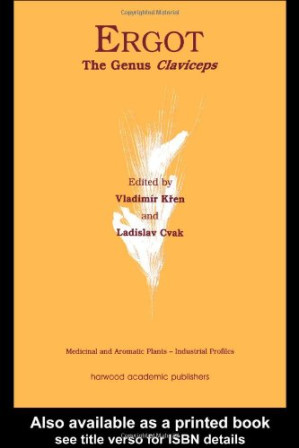
Ergot: The Genus Claviceps (Medicinal and Aromatic Plants--Industrial Profiles,) 🔍
Vladimír Křen, Ladislav Cvak
Harwood academic publ, 1, PT, 1999
英语 [en] · PDF · 7.5MB · 1999 · 📘 非小说类图书 · 🚀/lgli/lgrs/nexusstc/zlib · Save
描述
tf3168fm......Page 2
ERGOT: The Genus Claviceps......Page 4
CONTENTS......Page 6
PREFACE TO THE SERIES......Page 8
PREFACE......Page 10
NAMES OF ERGOT IN VARIOUS COUNTRIES OF THE WORLD......Page 11
CONTRIBUTORS......Page 12
TABLE OF CONTENTS......Page 0
1.1. THE EARLIER ALKALOIDS: ISOLATION AND STRUCTURES......Page 14
1.2. THE FERMENTATION ERA......Page 20
1.3. THE ERGOPEPTINES......Page 26
REFERENCES......Page 32
2.1. INTRODUCTION......Page 38
2.2. LIFE-CYCLE......Page 39
2.3.1. Host Range......Page 41
2.3.2. Organ Specificity......Page 42
2.4. HISTO- AND CYTOPATHOLOGY OF INFECTION......Page 43
Infection Site and Route......Page 44
Spore Adhesion, Infection Structures and the Infection Process......Page 46
Mechanisms of Adhesion and Penetration......Page 47
Ectotrophic Growth in the Host Ovary with Limited Endotrophism......Page 48
Mechanisms of Fungal Growth in the Host Tissue......Page 50
Direct Tapping of the Vascular Nutrition Supply......Page 53
2.4.3. Sphacelial Stromata for Secondary Propagation......Page 54
2.4.4. Ergot Sclerotia......Page 55
2.5. ERGOT VIRULENCE AND HOST SUSCEPTIBILITY......Page 56
2.6. TROPHISM AND ECOLOGY......Page 58
2.7.1. Occurrence and Spread of Ergot Disease......Page 60
2.7.2. Control Measures......Page 62
I. REFERENCES......Page 63
3.2.1. Sclerotium......Page 70
3.2.2. Stroma......Page 71
3.2.4. Chemotaxonomic Markers......Page 72
3.3.1. C. paspali......Page 73
3.3.5. C. africana......Page 74
3.3.9. Claviceps fusiformis......Page 75
3.3.10. Claviceps purpurea......Page 76
3.4.1. Variable C. purpurea......Page 79
3.4.2. Other Claviceps Species......Page 82
3.5.1. Grass Evolution......Page 83
3.5.2. Ergot Distribution......Page 84
3.5.3. Claviceps Phylogenetic Tree......Page 85
REFERENCES......Page 86
4.1.1. Mutants......Page 91
4.1.2. Heterokaryosis......Page 92
4.1.3. Sexual Cycle and Recombination......Page 93
4.2.1. Molecular Characterization of Strains......Page 94
4.2.2. Isolation of Genes......Page 99
4.2.3. Transformation......Page 100
4.3. PERSPECTIVES......Page 101
REFERENCES......Page 102
5.1.1. Historical Background and Importance of Ergot Alkaloids......Page 106
5.1.2. Development of Alkaloid Biochemistry......Page 107
5.2. STRUCTURES AND CLASSIFICATION OF ERGOT ALKALOIDS......Page 108
5.2.1. d-Lysergic Acid and its Derivatives......Page 109
5.2.2. Clavines and Secoergolines......Page 112
5.3.1. Precursors of the Ergoline Ring......Page 114
5.3.2. The Pathway of Ergoline Ring Synthesis......Page 115
5.3.3. The First Step: Isoprenylation of Tryptophan......Page 116
Mechanism of the Isoprenylation Reaction......Page 118
5.3.4. The Second Step: Methylation of Dimethylallyltryptophan......Page 120
Cis-Trans Isomerization at the Double Bond of the Isoprenoid Moiety......Page 121
Hydroxylation Reactions in the Course of Chanoclavine-I Synthesis......Page 122
Clavicipitic Acids......Page 125
The Decarboxylation Step......Page 127
Chanoclavine-I Aldehyde......Page 128
Mechanism of Cis-Trans Isomerization and Closure of Ring D......Page 129
5.4.1. The Ergoline Ring as a Substrate for Hydroxylation Reactions......Page 130
5.5.1. Dimethylallyltryptophan Synthase......Page 131
Molecular Cloning of DMAT Synthase Gene......Page 132
5.5.4. Agroclavine 17-hydroxylase......Page 133
5.5.5. Elymoclavine 17-mono-oxygenase......Page 134
5.6.1. Origin of d-Lysergic Acid......Page 135
5.6.2. Origin of the Building Blocks of Ergopeptines......Page 136
5.6.3. Early Models of Ergopeptine Biosynthesis......Page 137
5.6.4. Non-ribosomal Peptide Synthesis as Model for Ergot Peptide Alkaloid Assembly......Page 141
5.6.5. d-Lysergic Acid Activating Enzymes......Page 142
5.6.6. Enzymatic Synthesis Systems of Ergopeptines and d-Lysergyl Peptide Lactams......Page 145
5.6.7. d-Lysergyl Peptide Synthetase, the Enzyme Catalysing Assembly of d-Lysergyl Peptide Lactams......Page 148
5.6.8. Substrate Specificities of d-Lysergyl Peptide Synthetase (LPS)......Page 149
5.6.10. Reaction Mechanism of d-Lysergyl Peptide Assembly......Page 152
Initiation of d-LysergyI Peptide Synthesis......Page 153
Successive Acyl Transfers Between the d-Lysergic Acid and Amino Acid Activating Domains of LPS......Page 154
Mechanistic Regulation of LPS......Page 155
5.6.11. LPS—One Polypeptide or Two Subunits?......Page 157
5.7.1. d-Lysergyl Dipeptides—Ergosecaline......Page 158
Models of d-Lysergic Acid Alkylamide Formation Based on a Non-ribosomal Mechanism......Page 160
5.8.2. Combinatorial Biosynthesis of New d-Lysergic Acid Containing Compounds......Page 163
REFERENCES......Page 164
6.1.1. Carbon Sources and Saccharides......Page 175
6.1.4. Medium Osmolarity......Page 177
6.2. SEASONAL CYCLES IN ERGOT CULTIVATION......Page 178
6.3. BIOTECHNOLOGY OF SUBMERGED CULTIVATION OF ERGOT......Page 179
6.6. PROTOCOL......Page 180
REFERENCES......Page 181
7.2.2. Ergot Alkaloid Nomenclature......Page 183
7.2.3. Ergot Alkaloid Stereochemistry......Page 184
Ergolines......Page 187
Alkaloids with Modified Ergoline Structure......Page 188
7.2.5. Simple Derivatives of Lysergic and Paspalic Acids......Page 189
Ergopeptines......Page 195
Ergopeptams......Page 198
7.3.1. Pigments......Page 201
7.3.2. Mycotoxins......Page 203
7.4.1. Lipids......Page 204
REFERENCES......Page 205
8.2. CHEMICAL MODIFICATIONS IN THE ERGOLINE SKELETON......Page 211
N-1-Alkyl Derivatives......Page 212
N-1-Glycosides of EA......Page 213
2-Halogen Derivatives......Page 214
Electrophilic Substitution Using 2-Lithiated s......Page 215
Oxidation in Position 2......Page 216
8.2.3. Modifications in Position 3......Page 217
N-6 Oxides......Page 218
Functional Derivatives of Lysergic, Isolysergic, Paspalic and Dihydrolysergic Acids......Page 219
Modification of the Side Chain in Position 8......Page 221
8alpha-Aminoergoline Derivatives......Page 223
Electrophilic Substitution of 10-Lithiated Ergolines and increment8,9-Ergolenes......Page 224
8.2.9. Modifications in Positions 12, 13 and 14......Page 225
5, 6- and 6, 7-Secoergolines......Page 226
5(10→9)Abeo-ergolines......Page 227
Aci-Derivatives......Page 228
8.4. RADIOLABELLED DERIVATIVES......Page 229
REFERENCES......Page 231
9.1. INTRODUCTION......Page 239
9.2.1. Agroclavine......Page 240
9.2.2. Elymoclavine......Page 247
9.2.3. Lysergol, Lysergene, and Lysergine......Page 248
9.2.4. Chanoclavine......Page 252
9.2.5. Semisynthetic Clavine Alkaloids......Page 253
Ergot alkaloid fructosylation......Page 254
Ergot alkaloid glycosylations by glycosyItransferases—complex glycosides......Page 257
9.3.1. Hydrolysis of Lysergic Acid Amides......Page 258
9.3.2. Oxidation of Lysergic Acid Derivatives......Page 260
9.3.3. Biotransformations of LSD and its Homologues......Page 261
9.4. BIOCONVERSION OF ERGOT ALKALOIDS AS A TOOL FOR STUDY OF THEIR METABOLISM IN MAMMALS......Page 263
Pergolide......Page 264
Terguride and lisuride......Page 265
Cabergoline......Page 267
6-Methyl-8beta-(2, 4-dioxo-1-imidazolidinylmethyl) ergoline......Page 269
ACKNOWLEDGEMENT......Page 271
REFERENCES......Page 272
10.1. COLORIMETRY, SPECTROPHOTOMETRY, AND FLUORIMETRY......Page 277
10.2. PLANAR CHROMATOGRAPHY......Page 279
10.3. GAS CHROMATOGRAPHY......Page 281
10.4. LIQUID CHROMATOGRAPHY......Page 283
10.5. ELECTROANALYTICAL METHODS......Page 287
10.6. IMMUNOASSAYS......Page 289
10.7. COMBINED MASS SPECTROMETRIC TECHNIQUES......Page 292
10.8. STANDARD DEFINITION AND PHASE ANALYSIS......Page 293
REFERENCES......Page 296
11.2. GENOTYPES AND BREEDING FOR FIELD PRODUCTION......Page 312
11.3.1. Abiotic Factors......Page 313
11.3.2. Biotic Factors......Page 314
Male Fertile Varieties......Page 316
Male Sterile Varieties......Page 317
Male Fertile Rye Technology (Pricking Technology)......Page 318
Male Sterile Rye Technology (Cultivation Without Pricking)......Page 321
Fertile Rye Technology (Pricking Technology)......Page 324
Male Sterile Rye Technology (Cultivation Without Pricking)......Page 325
REFERENCES......Page 326
12.2.1. Sources......Page 329
12.2.2. Breeding and Selection of Production Strains......Page 330
12.2.4. Long-Term Preservation of Production Strains......Page 332
12.3. FERMENTATION TECHNOLOGY......Page 333
12.3.1. Stationary Surface Cultivation......Page 335
12.3.2. Submerged Cultivation......Page 336
12.3.3. Alternative Fermentation Processes......Page 338
12.4. MANUFACTURE OF CLAVINE ALKALOIDS......Page 339
12.4.1. Production of increment8,9-Ergolenes......Page 340
12.4.2. Production of 6, 7-secoergolenes......Page 343
12.5. LYSERGIC ACID, ITS SIMPLE DERIVATIVES AND PASPALIC ACID......Page 344
12.5.1. Production of Simple Derivatives of Lysergic Acid......Page 345
12.5.2. Production of Ergometrine......Page 347
12.5.3. Production of Paspalic Acid......Page 348
12.6.1. Production of Ergotamine Group Alkaloids......Page 349
12.6.2. Production of Alkaloids of the Ergotoxine Series......Page 350
12.7. CONTROL AND MODELLING OF ERGOT ALKALOID FERMENTATION......Page 354
12.8. PRODUCTION OF INOCULATION MATERIAL FOR PARASITIC ERGOT PRODUCTION......Page 356
12.9. PRODUCTION OF OTHER SUBSTANCES BY CLAVICEPS......Page 357
ACKNOWLEDGEMENT......Page 358
REFERENCES......Page 359
13.1. INTRODUCTION......Page 380
13.2.1. Field Ergot......Page 381
Ergot Extraction......Page 382
13.2.2. Fermentation......Page 383
Simple Ergolines......Page 384
13.2.4. Organic Synthesis......Page 385
13.3.1. Lysergic Acid......Page 387
13.3.4. Dihydrolysergol......Page 389
13.4.1 Ergotamine......Page 390
13.4.2. Ergometrine......Page 392
13.4.3. Dihydroergotamine......Page 394
13.4.4. Dihydroergotoxine......Page 396
13.4.5. Dihydroergocristine......Page 398
13.4.6. Dihydro-alpha-ergokryptine......Page 399
13.4.7. Bromokryptine......Page 400
13.4.8. Nicergoline......Page 402
13.4.10. Methylergometrine......Page 404
13.4.11. Methysergide......Page 406
13.4.12. Lisuride......Page 407
13.4.14. Pergolide......Page 408
13.4.15. Cabergoline......Page 409
REFERENCES......Page 410
14.1. INTRODUCTION......Page 417
14.2. ERGOLINES AS LIGANDS FOR 5-HT RECEPTORS......Page 418
14.2.1. Ergolines are Nonselective Ligands with High Affinity for 5-HT1A Receptors......Page 420
14.2.2. Ergolines are Partial Agonists of High Potency at 5-HT1B/1D Receptors......Page 421
14.2.4. Ergolines are Potent Antagonists/Partial Agonists at 5-HT2A Receptors......Page 424
14.2.5. The Complexity of the Interaction of the Ergolines with 5-HT2B and 5-HT2C Receptors......Page 428
14.2.7. Ergolines as Useful Tools for the Characterization of 5-ht5, 5-ht6, and 5-ht7 Receptors......Page 430
14.3. ERGOLINES AS LIGANDS FOR DOPAMINE RECEPTORS......Page 431
14.4. ERGOLINES AS LIGANDS FOR ADRENOCEPTORS......Page 435
REFERENCES......Page 437
15.2. ANTIMICROBIAL EFFECTS......Page 447
15.3. CYTOSTATIC EFFECTS OF AGROCLAVINE AND FESTUCLAVINE......Page 448
15.4. AGROCLAVINE AND FESTUCLAVINE AS LEADS FOR THE DEVELOPMENT OF ANTITUMOR DRUGS......Page 449
15.5. INFLUENCE OF DIFFERENT SUBSTITUTIONS ON THE CYTOSTATIC ACTIVITY OF CLAVINES IN VITRO......Page 450
15.6. MECHANISM OF ACTION......Page 451
REFERENCES......Page 453
16.1. INTRODUCTION......Page 456
16.2. CONTEMPORARY KNOWLEDGE OF THE TOPIC—CLINICAL CORRELATES......Page 457
16.3.2. The Regulatory Role of Biogenic Amines in Neuroendocrine Immune Axis......Page 458
NK Cells as a Sensitive Targets for Ergot Alkaloids Action......Page 459
Ergolines Action on Macrophages......Page 461
Ergolines Action on T Lymphocyte Effector Functions......Page 462
Ergolines Action on B Lymphocytes......Page 463
16.4.3. Lymphokine Production by T and NK Cells......Page 464
Involvement of Ergolines in Signaling Pathways of NK, T Cells......Page 465
16.6. CONCLUSIONS......Page 466
REFERENCES......Page 467
CHAPTER 17. TOXICOLOGY OF ERGOT ALKALOIDS IN AGRICULTURE......Page 473
17.1. ERGOT ALKALOIDS IN ANIMAL FEED......Page 474
17.2. ROUTES OF CONTAMINATION......Page 476
17.3. TESTING OF FOOD AND FEED......Page 478
17.4. THE FUTURE OF ERGOT......Page 479
REFERENCES......Page 480
18.1. INTRODUCTION......Page 482
18.2. SCREENING OF THE ERGOT ALKALOID PRODUCERS AMONG THE FILAMENTOUS FUNGI......Page 483
18.3. PHYSIOLOGY OF THE PRODUCERS AND SOME ASPECTS OF THE REGULATION OF ERGOT ALKALOID BIOSYNTHESIS......Page 490
18.5. HIGHER PLANTS AS THE PRODUCERS OF THE ERGOT ALKALOIDS......Page 494
18.6. ENVIRONMENTAL AND HAZARD PROBLEMS WITH UNTRADITIONAL PRODUCERS OF ERGOT ALKALOIDS......Page 495
18.7. OUTLOOK ON USING OF ERGOT ALKALOID PRODUCERS OUT OF THE GENUS CLAVICEPS IN PRACTICE......Page 496
REFERENCES......Page 497
ERGOT: The Genus Claviceps......Page 4
CONTENTS......Page 6
PREFACE TO THE SERIES......Page 8
PREFACE......Page 10
NAMES OF ERGOT IN VARIOUS COUNTRIES OF THE WORLD......Page 11
CONTRIBUTORS......Page 12
TABLE OF CONTENTS......Page 0
1.1. THE EARLIER ALKALOIDS: ISOLATION AND STRUCTURES......Page 14
1.2. THE FERMENTATION ERA......Page 20
1.3. THE ERGOPEPTINES......Page 26
REFERENCES......Page 32
2.1. INTRODUCTION......Page 38
2.2. LIFE-CYCLE......Page 39
2.3.1. Host Range......Page 41
2.3.2. Organ Specificity......Page 42
2.4. HISTO- AND CYTOPATHOLOGY OF INFECTION......Page 43
Infection Site and Route......Page 44
Spore Adhesion, Infection Structures and the Infection Process......Page 46
Mechanisms of Adhesion and Penetration......Page 47
Ectotrophic Growth in the Host Ovary with Limited Endotrophism......Page 48
Mechanisms of Fungal Growth in the Host Tissue......Page 50
Direct Tapping of the Vascular Nutrition Supply......Page 53
2.4.3. Sphacelial Stromata for Secondary Propagation......Page 54
2.4.4. Ergot Sclerotia......Page 55
2.5. ERGOT VIRULENCE AND HOST SUSCEPTIBILITY......Page 56
2.6. TROPHISM AND ECOLOGY......Page 58
2.7.1. Occurrence and Spread of Ergot Disease......Page 60
2.7.2. Control Measures......Page 62
I. REFERENCES......Page 63
3.2.1. Sclerotium......Page 70
3.2.2. Stroma......Page 71
3.2.4. Chemotaxonomic Markers......Page 72
3.3.1. C. paspali......Page 73
3.3.5. C. africana......Page 74
3.3.9. Claviceps fusiformis......Page 75
3.3.10. Claviceps purpurea......Page 76
3.4.1. Variable C. purpurea......Page 79
3.4.2. Other Claviceps Species......Page 82
3.5.1. Grass Evolution......Page 83
3.5.2. Ergot Distribution......Page 84
3.5.3. Claviceps Phylogenetic Tree......Page 85
REFERENCES......Page 86
4.1.1. Mutants......Page 91
4.1.2. Heterokaryosis......Page 92
4.1.3. Sexual Cycle and Recombination......Page 93
4.2.1. Molecular Characterization of Strains......Page 94
4.2.2. Isolation of Genes......Page 99
4.2.3. Transformation......Page 100
4.3. PERSPECTIVES......Page 101
REFERENCES......Page 102
5.1.1. Historical Background and Importance of Ergot Alkaloids......Page 106
5.1.2. Development of Alkaloid Biochemistry......Page 107
5.2. STRUCTURES AND CLASSIFICATION OF ERGOT ALKALOIDS......Page 108
5.2.1. d-Lysergic Acid and its Derivatives......Page 109
5.2.2. Clavines and Secoergolines......Page 112
5.3.1. Precursors of the Ergoline Ring......Page 114
5.3.2. The Pathway of Ergoline Ring Synthesis......Page 115
5.3.3. The First Step: Isoprenylation of Tryptophan......Page 116
Mechanism of the Isoprenylation Reaction......Page 118
5.3.4. The Second Step: Methylation of Dimethylallyltryptophan......Page 120
Cis-Trans Isomerization at the Double Bond of the Isoprenoid Moiety......Page 121
Hydroxylation Reactions in the Course of Chanoclavine-I Synthesis......Page 122
Clavicipitic Acids......Page 125
The Decarboxylation Step......Page 127
Chanoclavine-I Aldehyde......Page 128
Mechanism of Cis-Trans Isomerization and Closure of Ring D......Page 129
5.4.1. The Ergoline Ring as a Substrate for Hydroxylation Reactions......Page 130
5.5.1. Dimethylallyltryptophan Synthase......Page 131
Molecular Cloning of DMAT Synthase Gene......Page 132
5.5.4. Agroclavine 17-hydroxylase......Page 133
5.5.5. Elymoclavine 17-mono-oxygenase......Page 134
5.6.1. Origin of d-Lysergic Acid......Page 135
5.6.2. Origin of the Building Blocks of Ergopeptines......Page 136
5.6.3. Early Models of Ergopeptine Biosynthesis......Page 137
5.6.4. Non-ribosomal Peptide Synthesis as Model for Ergot Peptide Alkaloid Assembly......Page 141
5.6.5. d-Lysergic Acid Activating Enzymes......Page 142
5.6.6. Enzymatic Synthesis Systems of Ergopeptines and d-Lysergyl Peptide Lactams......Page 145
5.6.7. d-Lysergyl Peptide Synthetase, the Enzyme Catalysing Assembly of d-Lysergyl Peptide Lactams......Page 148
5.6.8. Substrate Specificities of d-Lysergyl Peptide Synthetase (LPS)......Page 149
5.6.10. Reaction Mechanism of d-Lysergyl Peptide Assembly......Page 152
Initiation of d-LysergyI Peptide Synthesis......Page 153
Successive Acyl Transfers Between the d-Lysergic Acid and Amino Acid Activating Domains of LPS......Page 154
Mechanistic Regulation of LPS......Page 155
5.6.11. LPS—One Polypeptide or Two Subunits?......Page 157
5.7.1. d-Lysergyl Dipeptides—Ergosecaline......Page 158
Models of d-Lysergic Acid Alkylamide Formation Based on a Non-ribosomal Mechanism......Page 160
5.8.2. Combinatorial Biosynthesis of New d-Lysergic Acid Containing Compounds......Page 163
REFERENCES......Page 164
6.1.1. Carbon Sources and Saccharides......Page 175
6.1.4. Medium Osmolarity......Page 177
6.2. SEASONAL CYCLES IN ERGOT CULTIVATION......Page 178
6.3. BIOTECHNOLOGY OF SUBMERGED CULTIVATION OF ERGOT......Page 179
6.6. PROTOCOL......Page 180
REFERENCES......Page 181
7.2.2. Ergot Alkaloid Nomenclature......Page 183
7.2.3. Ergot Alkaloid Stereochemistry......Page 184
Ergolines......Page 187
Alkaloids with Modified Ergoline Structure......Page 188
7.2.5. Simple Derivatives of Lysergic and Paspalic Acids......Page 189
Ergopeptines......Page 195
Ergopeptams......Page 198
7.3.1. Pigments......Page 201
7.3.2. Mycotoxins......Page 203
7.4.1. Lipids......Page 204
REFERENCES......Page 205
8.2. CHEMICAL MODIFICATIONS IN THE ERGOLINE SKELETON......Page 211
N-1-Alkyl Derivatives......Page 212
N-1-Glycosides of EA......Page 213
2-Halogen Derivatives......Page 214
Electrophilic Substitution Using 2-Lithiated s......Page 215
Oxidation in Position 2......Page 216
8.2.3. Modifications in Position 3......Page 217
N-6 Oxides......Page 218
Functional Derivatives of Lysergic, Isolysergic, Paspalic and Dihydrolysergic Acids......Page 219
Modification of the Side Chain in Position 8......Page 221
8alpha-Aminoergoline Derivatives......Page 223
Electrophilic Substitution of 10-Lithiated Ergolines and increment8,9-Ergolenes......Page 224
8.2.9. Modifications in Positions 12, 13 and 14......Page 225
5, 6- and 6, 7-Secoergolines......Page 226
5(10→9)Abeo-ergolines......Page 227
Aci-Derivatives......Page 228
8.4. RADIOLABELLED DERIVATIVES......Page 229
REFERENCES......Page 231
9.1. INTRODUCTION......Page 239
9.2.1. Agroclavine......Page 240
9.2.2. Elymoclavine......Page 247
9.2.3. Lysergol, Lysergene, and Lysergine......Page 248
9.2.4. Chanoclavine......Page 252
9.2.5. Semisynthetic Clavine Alkaloids......Page 253
Ergot alkaloid fructosylation......Page 254
Ergot alkaloid glycosylations by glycosyItransferases—complex glycosides......Page 257
9.3.1. Hydrolysis of Lysergic Acid Amides......Page 258
9.3.2. Oxidation of Lysergic Acid Derivatives......Page 260
9.3.3. Biotransformations of LSD and its Homologues......Page 261
9.4. BIOCONVERSION OF ERGOT ALKALOIDS AS A TOOL FOR STUDY OF THEIR METABOLISM IN MAMMALS......Page 263
Pergolide......Page 264
Terguride and lisuride......Page 265
Cabergoline......Page 267
6-Methyl-8beta-(2, 4-dioxo-1-imidazolidinylmethyl) ergoline......Page 269
ACKNOWLEDGEMENT......Page 271
REFERENCES......Page 272
10.1. COLORIMETRY, SPECTROPHOTOMETRY, AND FLUORIMETRY......Page 277
10.2. PLANAR CHROMATOGRAPHY......Page 279
10.3. GAS CHROMATOGRAPHY......Page 281
10.4. LIQUID CHROMATOGRAPHY......Page 283
10.5. ELECTROANALYTICAL METHODS......Page 287
10.6. IMMUNOASSAYS......Page 289
10.7. COMBINED MASS SPECTROMETRIC TECHNIQUES......Page 292
10.8. STANDARD DEFINITION AND PHASE ANALYSIS......Page 293
REFERENCES......Page 296
11.2. GENOTYPES AND BREEDING FOR FIELD PRODUCTION......Page 312
11.3.1. Abiotic Factors......Page 313
11.3.2. Biotic Factors......Page 314
Male Fertile Varieties......Page 316
Male Sterile Varieties......Page 317
Male Fertile Rye Technology (Pricking Technology)......Page 318
Male Sterile Rye Technology (Cultivation Without Pricking)......Page 321
Fertile Rye Technology (Pricking Technology)......Page 324
Male Sterile Rye Technology (Cultivation Without Pricking)......Page 325
REFERENCES......Page 326
12.2.1. Sources......Page 329
12.2.2. Breeding and Selection of Production Strains......Page 330
12.2.4. Long-Term Preservation of Production Strains......Page 332
12.3. FERMENTATION TECHNOLOGY......Page 333
12.3.1. Stationary Surface Cultivation......Page 335
12.3.2. Submerged Cultivation......Page 336
12.3.3. Alternative Fermentation Processes......Page 338
12.4. MANUFACTURE OF CLAVINE ALKALOIDS......Page 339
12.4.1. Production of increment8,9-Ergolenes......Page 340
12.4.2. Production of 6, 7-secoergolenes......Page 343
12.5. LYSERGIC ACID, ITS SIMPLE DERIVATIVES AND PASPALIC ACID......Page 344
12.5.1. Production of Simple Derivatives of Lysergic Acid......Page 345
12.5.2. Production of Ergometrine......Page 347
12.5.3. Production of Paspalic Acid......Page 348
12.6.1. Production of Ergotamine Group Alkaloids......Page 349
12.6.2. Production of Alkaloids of the Ergotoxine Series......Page 350
12.7. CONTROL AND MODELLING OF ERGOT ALKALOID FERMENTATION......Page 354
12.8. PRODUCTION OF INOCULATION MATERIAL FOR PARASITIC ERGOT PRODUCTION......Page 356
12.9. PRODUCTION OF OTHER SUBSTANCES BY CLAVICEPS......Page 357
ACKNOWLEDGEMENT......Page 358
REFERENCES......Page 359
13.1. INTRODUCTION......Page 380
13.2.1. Field Ergot......Page 381
Ergot Extraction......Page 382
13.2.2. Fermentation......Page 383
Simple Ergolines......Page 384
13.2.4. Organic Synthesis......Page 385
13.3.1. Lysergic Acid......Page 387
13.3.4. Dihydrolysergol......Page 389
13.4.1 Ergotamine......Page 390
13.4.2. Ergometrine......Page 392
13.4.3. Dihydroergotamine......Page 394
13.4.4. Dihydroergotoxine......Page 396
13.4.5. Dihydroergocristine......Page 398
13.4.6. Dihydro-alpha-ergokryptine......Page 399
13.4.7. Bromokryptine......Page 400
13.4.8. Nicergoline......Page 402
13.4.10. Methylergometrine......Page 404
13.4.11. Methysergide......Page 406
13.4.12. Lisuride......Page 407
13.4.14. Pergolide......Page 408
13.4.15. Cabergoline......Page 409
REFERENCES......Page 410
14.1. INTRODUCTION......Page 417
14.2. ERGOLINES AS LIGANDS FOR 5-HT RECEPTORS......Page 418
14.2.1. Ergolines are Nonselective Ligands with High Affinity for 5-HT1A Receptors......Page 420
14.2.2. Ergolines are Partial Agonists of High Potency at 5-HT1B/1D Receptors......Page 421
14.2.4. Ergolines are Potent Antagonists/Partial Agonists at 5-HT2A Receptors......Page 424
14.2.5. The Complexity of the Interaction of the Ergolines with 5-HT2B and 5-HT2C Receptors......Page 428
14.2.7. Ergolines as Useful Tools for the Characterization of 5-ht5, 5-ht6, and 5-ht7 Receptors......Page 430
14.3. ERGOLINES AS LIGANDS FOR DOPAMINE RECEPTORS......Page 431
14.4. ERGOLINES AS LIGANDS FOR ADRENOCEPTORS......Page 435
REFERENCES......Page 437
15.2. ANTIMICROBIAL EFFECTS......Page 447
15.3. CYTOSTATIC EFFECTS OF AGROCLAVINE AND FESTUCLAVINE......Page 448
15.4. AGROCLAVINE AND FESTUCLAVINE AS LEADS FOR THE DEVELOPMENT OF ANTITUMOR DRUGS......Page 449
15.5. INFLUENCE OF DIFFERENT SUBSTITUTIONS ON THE CYTOSTATIC ACTIVITY OF CLAVINES IN VITRO......Page 450
15.6. MECHANISM OF ACTION......Page 451
REFERENCES......Page 453
16.1. INTRODUCTION......Page 456
16.2. CONTEMPORARY KNOWLEDGE OF THE TOPIC—CLINICAL CORRELATES......Page 457
16.3.2. The Regulatory Role of Biogenic Amines in Neuroendocrine Immune Axis......Page 458
NK Cells as a Sensitive Targets for Ergot Alkaloids Action......Page 459
Ergolines Action on Macrophages......Page 461
Ergolines Action on T Lymphocyte Effector Functions......Page 462
Ergolines Action on B Lymphocytes......Page 463
16.4.3. Lymphokine Production by T and NK Cells......Page 464
Involvement of Ergolines in Signaling Pathways of NK, T Cells......Page 465
16.6. CONCLUSIONS......Page 466
REFERENCES......Page 467
CHAPTER 17. TOXICOLOGY OF ERGOT ALKALOIDS IN AGRICULTURE......Page 473
17.1. ERGOT ALKALOIDS IN ANIMAL FEED......Page 474
17.2. ROUTES OF CONTAMINATION......Page 476
17.3. TESTING OF FOOD AND FEED......Page 478
17.4. THE FUTURE OF ERGOT......Page 479
REFERENCES......Page 480
18.1. INTRODUCTION......Page 482
18.2. SCREENING OF THE ERGOT ALKALOID PRODUCERS AMONG THE FILAMENTOUS FUNGI......Page 483
18.3. PHYSIOLOGY OF THE PRODUCERS AND SOME ASPECTS OF THE REGULATION OF ERGOT ALKALOID BIOSYNTHESIS......Page 490
18.5. HIGHER PLANTS AS THE PRODUCERS OF THE ERGOT ALKALOIDS......Page 494
18.6. ENVIRONMENTAL AND HAZARD PROBLEMS WITH UNTRADITIONAL PRODUCERS OF ERGOT ALKALOIDS......Page 495
18.7. OUTLOOK ON USING OF ERGOT ALKALOID PRODUCERS OUT OF THE GENUS CLAVICEPS IN PRACTICE......Page 496
REFERENCES......Page 497
备用文件名
lgli/_509435.9ddf50ff7a2609ce923cb5cad3c0da58.pdf
备用文件名
lgrsnf/_509435.9ddf50ff7a2609ce923cb5cad3c0da58.pdf
备用文件名
zlib/Medicine/Vladimír Křen, Ladislav Cvak/Ergot: the genus Claviceps_1199748.pdf
备选标题
Ergot (Medicinal and Aromatic Plants - Industrial Profiles)
备选作者
edited by Vladimír Křen and Ladislav Cvak
备选作者
Vladimir Kren; Ladislav Cvak
备选作者
Ladislav Cvak; Vladimir Kren
备用出版商
CRC Press
备用版本
Medicinal and aromatic plants--industrial profiles,, v. 6, Amsterdam, Netherlands, 1999
备用版本
Medicinal and aromatic plants : industrial profiles, vol. 6, Amsterdam, ©1999
备用版本
CRC Press (Unlimited), Australia, 1999
备用版本
Netherlands, Netherlands
备用版本
April 8, 1999
元数据中的注释
2011 12 30
元数据中的注释
lg761792
元数据中的注释
{"edition":"1","isbns":["905702375X","9789057023750"],"last_page":503,"publisher":"Harwood Academic"}
元数据中的注释
Includes bibliographical references and index.
备用描述
Machine generated contents note: 1 The History of Ergot 1
Anacleto Minghetti and Nicoletta Crespi-Perellino
2 Biology and Life Strategy of the Ergot Fungi 25
Klaus B. Tenberge
3 The Taxonomy and Phylogeny of Claviceps 57
Sylvie Pazoutovi and Douglas P. Parbery
4 Genetics of Claviceps purpurea 79
Paul Tudzynski
5 Biosynthesis of Ergot Alkaloids 95
Ullrich Keller
6 Physiological Regulation of Ergot Alkaloid Production and
Special Cultivation Techniques 165
Vladimir Kren
7 Ergot Alkaloids and Other Metabolites of the Genus Claviceps 173
Martin Buchta and Ladislav Cvak
8 Chemical Modifications of Ergot Alkaloids 201
Petr Bulej and Ladislav Cvak
9 Biotransformations of Ergot Alkaloids 229
Vladimir Kren
10 Analytical Chemistry of Ergot Alkaloids 267
AlexandrJegorov
11 Parasitic Production of Ergot Alkaloids 303
Eva Nemeth
12 Saprophytic Cultivation of Claviceps 321
Zdenek Malinka
13 Industrial Production of Ergot Alkaloids 373
Ladislav Cvak
14 Ergot Alkaloids and their Derivatives as Ligands for
Serotoninergic, Dopaminergic, and Adrenergic Receptors 411
Heinz Pertz and Eckart Eich
15 Antimicrobial and Antitumor Effects of Ergot Alkaloids
and their Derivatives 441
Eckart Eich and Heinz Pertz
16 Role of Ergot Alkaloids in the Immune System 451
Auna Fiserovd and Miloslav Pospigil
17 Toxicology of Ergot Alkaloids in Agriculture 469
Richard A. Shelby
18 Producers of Ergot Alkaloids out of Claviceps Genus 479
Anato,l G. Kozlovsky
Index 501.
Anacleto Minghetti and Nicoletta Crespi-Perellino
2 Biology and Life Strategy of the Ergot Fungi 25
Klaus B. Tenberge
3 The Taxonomy and Phylogeny of Claviceps 57
Sylvie Pazoutovi and Douglas P. Parbery
4 Genetics of Claviceps purpurea 79
Paul Tudzynski
5 Biosynthesis of Ergot Alkaloids 95
Ullrich Keller
6 Physiological Regulation of Ergot Alkaloid Production and
Special Cultivation Techniques 165
Vladimir Kren
7 Ergot Alkaloids and Other Metabolites of the Genus Claviceps 173
Martin Buchta and Ladislav Cvak
8 Chemical Modifications of Ergot Alkaloids 201
Petr Bulej and Ladislav Cvak
9 Biotransformations of Ergot Alkaloids 229
Vladimir Kren
10 Analytical Chemistry of Ergot Alkaloids 267
AlexandrJegorov
11 Parasitic Production of Ergot Alkaloids 303
Eva Nemeth
12 Saprophytic Cultivation of Claviceps 321
Zdenek Malinka
13 Industrial Production of Ergot Alkaloids 373
Ladislav Cvak
14 Ergot Alkaloids and their Derivatives as Ligands for
Serotoninergic, Dopaminergic, and Adrenergic Receptors 411
Heinz Pertz and Eckart Eich
15 Antimicrobial and Antitumor Effects of Ergot Alkaloids
and their Derivatives 441
Eckart Eich and Heinz Pertz
16 Role of Ergot Alkaloids in the Immune System 451
Auna Fiserovd and Miloslav Pospigil
17 Toxicology of Ergot Alkaloids in Agriculture 469
Richard A. Shelby
18 Producers of Ergot Alkaloids out of Claviceps Genus 479
Anato,l G. Kozlovsky
Index 501.
备用描述
The sixth volume in the series Medicinal and Aromatic Plants -Industrial Profiles, written by experts working in ergot research. Ergot (claviceps purpura) is best known as a disease of rye and grasses. it is probably the most widely cultivated fungus and it has become an important field crop. Ergot alkaloids, which are extensively used in medicine, are the main reason for its importance.
开源日期
2012-02-04
🚀 快速下载
成为会员以支持书籍、论文等的长期保存。为了感谢您对我们的支持,您将获得高速下载权益。❤️
如果您在本月捐款,您将获得双倍的快速下载次数。
🐢 低速下载
由可信的合作方提供。 更多信息请参见常见问题解答。 (可能需要验证浏览器——无限次下载!)
- 低速服务器(合作方提供) #1 (稍快但需要排队)
- 低速服务器(合作方提供) #2 (稍快但需要排队)
- 低速服务器(合作方提供) #3 (稍快但需要排队)
- 低速服务器(合作方提供) #4 (稍快但需要排队)
- 低速服务器(合作方提供) #5 (无需排队,但可能非常慢)
- 低速服务器(合作方提供) #6 (无需排队,但可能非常慢)
- 低速服务器(合作方提供) #7 (无需排队,但可能非常慢)
- 低速服务器(合作方提供) #8 (无需排队,但可能非常慢)
- 低速服务器(合作方提供) #9 (无需排队,但可能非常慢)
- 下载后: 在我们的查看器中打开
所有选项下载的文件都相同,应该可以安全使用。即使这样,从互联网下载文件时始终要小心。例如,确保您的设备更新及时。
外部下载
-
对于大文件,我们建议使用下载管理器以防止中断。
推荐的下载管理器:JDownloader -
您将需要一个电子书或 PDF 阅读器来打开文件,具体取决于文件格式。
推荐的电子书阅读器:Anna的档案在线查看器、ReadEra和Calibre -
使用在线工具进行格式转换。
推荐的转换工具:CloudConvert和PrintFriendly -
您可以将 PDF 和 EPUB 文件发送到您的 Kindle 或 Kobo 电子阅读器。
推荐的工具:亚马逊的“发送到 Kindle”和djazz 的“发送到 Kobo/Kindle” -
支持作者和图书馆
✍️ 如果您喜欢这个并且能够负担得起,请考虑购买原版,或直接支持作者。
📚 如果您当地的图书馆有这本书,请考虑在那里免费借阅。
下面的文字仅以英文继续。
总下载量:
“文件的MD5”是根据文件内容计算出的哈希值,并且基于该内容具有相当的唯一性。我们这里索引的所有影子图书馆都主要使用MD5来标识文件。
一个文件可能会出现在多个影子图书馆中。有关我们编译的各种数据集的信息,请参见数据集页面。
有关此文件的详细信息,请查看其JSON 文件。 Live/debug JSON version. Live/debug page.