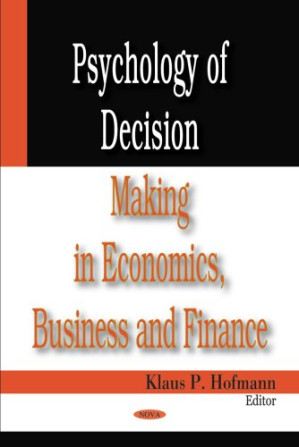
Psychology of Decision Making in Economics, Business and Finance 🔍
Klaus P Hofmann; NetLibrary, Inc
Nova Science Publishers, Incorporated, Nova Science Publishers, Inc., New York, 2007
英语 [en] · PDF · 2.3MB · 2007 · 📘 非小说类图书 · 🚀/lgli/lgrs/nexusstc/upload/zlib · Save
描述
In a fast-moving world, the necessity of making decisions, and preferably good ones, has become even more difficult. One reason is the variety and number of choices perhaps available which often are not presented or understood. Alternatives are often unclear and complex paths to them confusing and misleading. Thus the process of decision making itself requires analysis on an ongoing basis. Decision making is often made based on cultural factors whereas the best alternative might be quite different. The subject touches ethics aspects as well as psychological considerations. This book presents important research on the psychology of decision making related to economics, business and finance.
备用文件名
lgli/G_Economics/GV_Behavioral/Hofmann K.P. (ed.) Psychology of Decision Making in Economics, Business and Finance (Nova Science Pub., 2007)(ISBN 1600219179)(O)(241s)_GV_.pdf
备用文件名
lgrsnf/G_Economics/GV_Behavioral/Hofmann K.P. (ed.) Psychology of Decision Making in Economics, Business and Finance (Nova Science Pub., 2007)(ISBN 1600219179)(O)(241s)_GV_.pdf
备用文件名
nexusstc/Psychology of Decision Making in Economics, Business and Finance/ab821bd58ba532e77806cac506175dd9.pdf
备用文件名
zlib/Psychology/Klaus P. Hofmann/Psychology of Decision Making in Economics, Business and Finance_700044.pdf
备选作者
Klaus P. Hofmann, editor
备选作者
Hofmann, Klaus P.
备用出版商
Nova Science ; Gazelle Drake Academic [distributor
备用出版商
Nova Biomedical Books
备用版本
United States, United States of America
备用版本
Hauppauge, N.Y., Lancaster, 2008
备用版本
New York, New York State, 2007
备用版本
New York, NY, c 2007
备用版本
New York, 2008
元数据中的注释
65195
元数据中的注释
Kolxo3
元数据中的注释
lg269533
元数据中的注释
{"isbns":["1600219179","1606925687","9781600219177","9781606925683"],"last_page":241,"publisher":"Nova Science Publishers"}
元数据中的注释
Includes bibliographical references and index.
备用描述
PSYCHOLOGY OF DECISION MAKING INECONOMICS, BUSINESS AND FINANCE 3
NOTICE TO THE READER 6
CONTENTS 7
PREFACE 9
PSYCHOLOGICAL ASPECTS OF DECISIONMAKING AS NEW RESEARCH TOPICS IN NATURALRESOURCES MANAGEMENT 15
ABSTRACT 15
BACKGROUND 16
DISCRETION REQUIRED IN USING ELICITED PREFERENCES 17
INTRODUCING DECISION-PROBLEM SPACE 17
CONCLUSION 18
REFERENCES 19
RELATIVITY OF FINANCIAL PREFERENCES:HOW CHOICE OPTIONS INFLUENCEINVESTMENT DECISION MAKING 21
ABSTRACT 21
THEORETICAL BACKGROUND 22
PROSPECT RELATIVITY PRINCIPLE AND REALISTICFINANCIAL DECISION SCENARIOS 26
1) Representative Sample 28
2) Realistic Financial Assumptions 29
3) Financial Affordability Questionnaire 29
4) Risk Preference Tests 30
METHOD 31
RESULTS 34
GENERAL DISCUSSION AND CONCLUSIONS 41
Theoretical Accounts 41
Practical Applications 43
AUTHOR’S NOTE 44
APPENDIX AFINANCIAL AFFORDABILITY QUESTIONNAIRE 44
APPENDIX B 46
APPENDIX CMEASURES OF RISK AVERSION USED IN THE STUDY 46
REFERENCES 48
CHARTING THE COURSE OF SELF EVALUATIONS ANDSOCIAL COMPARISONS OVER TIME 51
ABSTRACT 51
SELF EVALUATION OVER TIME 52
SOLO EVALUATIONS VS. SOCIAL COMPARISONS 54
CURRENT STUDV 55
METHOD 57
Participants 57
Procedure 57
Measures 57
RESULTS 59
Overview of Analyses 59
DISCUSSION 70
Implications for Behaviour 71
Limitations of the Study 72
PROPOSED DIRECTIONS FOR RESEARCH 72
ENDNOTES 74
REFERENCES 75
INSTABILITY AND RELATIVITY OF PREFERENCES:HOW CONTEXT DETERMINES UTILITIES ANDDECISIONS 79
ABSTRACT 79
INTRODUCTION 80
MOTIVATION FROM PSYCHOPHYSICS 82
TRANSFER OF UTILITIES ACROSS SCALES AND CONTEXTS 84
THE ROLE OF CONTEXT IN DECISION MAKING 85
IMPLICATIONS FOR MODELS OF ECONOMIC BEHAVIOUR 91
THE ROLE OF CONTEXT IN COGNITION 93
CONCLUSION 95
REFERENCES 96
PRESS MEDIA INFLUENCE ON PERCEPTIONSOF GENETICALLY MODIFIED FOODIN THE UK AND SPAIN 101
ABSTRACT 101
1. INTRODUCTION 102
2. PERCEPTION AND REPRESENTATION OF GM FOOD IN THE MEDIA 103
3. METHODS 105
3.1. The Press Content Analysis 106
3.2. Empirical Analysis of Survey Data 107
4. PRESS CONTENT ANALYSIS FOR THE UK AND SPAIN 108
4.1. Description of the Media Reporting on GM Food in UK and Spain 108
4.2. Content Analysis Results 110
5. IS PUBLIC PERCEPTION OF GM FOOD AND BIOTECHNOLOGYASSOCIATED WITH THE MEDIA COVERAGE? 113
5.1. Correlation between Public Perceptions and the Press Media 113
5.2. Media Coverage Versus Perception of Risk 114
6. CONCLUSIONS 118
APPENDIX 120
REFERENCES 121
COMPARING RISKY AND INTER-TEMPORALDECISIONS: VIEWS FROM PSYCHOLOGY, ECOLOGYAND MICROECONOMICS 125
ABSTRACT 125
1. INTRODUCTION 126
2. DECISIONS WITHOUT RISK 126
3. DECISIONS UNDER RISK 127
Economic Utility Theories 128
Violations of Preference Axioms 129
Contribution from Behavioral Ecology Risk-Sensitive Foraging Theory 131
A Normative Framework for Inter-Temporal Decisions 132
Violation of Stationarity 133
Why Do We Discount the Future? 135
Preference for Delay Variability 136
Ecological Models of Inter-Temporal Decisions: Ecological Rationality 137
Ecological Models of Inter-Temporal Decisions: Feeding Ecology 141
Commonalities and Differences Between Risky and Inter-TemporalDecisions 142
CONCLUSION 144
ACKNOWLEDGEMENTS 145
REFERENCES 145
THE EFFECTS OF PERCEPTIONS ON MODE CHOICE 151
ABSTRACT 151
1. INTRODUCTION 151
2. THE SURVEY 153
2.1. The Attributes 154
2.2. Attribute Levels 154
2.3. Experimental Design 157
3. MODELLING CHOICES 159
4. ESTIMATION 161
4.1. Standard Logit 161
4.2. Random Parameters Logit 165
5. CONCLUSION 168
ACKNOWLEDGEMENTS 169
APPENDIX A:THE PERCEPTIONS AND CHOICE QUESTIONS(QUESTIONNAIRE A, QUESTIONS 19-21) 169
APPENDIX B:THE EXPERIMENTAL DESIGN 171
REFERENCES 173
THE PSYCHOLOGY OF DECISION-MAKING INECONOMICS: A REVIEW 177
ABSTRACT 177
I. INTRODUCTION 177
II. THE METHODOLOGY OF BEHAVIORAL ECONOMICS 179
III. BASIC THEMES AND RESULTS 181
Risk Preferences, Loss Aversion, the Endowment Effect and Framing Effects 181
Social Preferences: Fairness, Reciprocity, Altruism and Trust 183
IV. APPLICATIONS OF PSYCHOLOGY IN ECONOMICS 184
Money Illusion 184
The Fair Wage-Effort Hypothesis and Unemployment 185
Intertemporal Substitution 186
Seniority and Rising Consumption Profiles 186
The Equity Premium Puzzle 187
Other Asset Markets: Real Estate 188
Environmental Economics 188
V. CONCLUSION 189
REFERENCES 189
WHY DO PEOPLE CHANGE THEIR MINDS?EVIDENCE FROM THE PURCHASE OF LONG-TERMCARE INSURANCE 193
ABSTRACT 193
INTRODUCTION 194
BACKGROUND 194
METHODS 195
Data 195
Theoretical Framework 196
Explanatory Variables 197
RESULTS 201
CONCLUSION 204
ACKNOWLEDGEMENTS 205
REFERENCES 205
LEARNING, ACCEPTANCE AND THE PERCEPTIONS OFRISKS AND BENEFITS OF NEW TECHNOLOGYDEVELOPMENTS IN SPAIN 209
ABSTRACT 209
1. INTRODUCTION 209
2. TECHNOLOGY ACCEPTANCE AND THE INDEPENDENCE OFRISK AND BENEFITS PERCEPTIONS 212
2.1. The Theoretical Background 212
2.2. The Emprirical Specification 212
3. THE DATA AND PRELIMINARY EVIDENCE 213
4. RESULTS 215
4.1. Risk and Benefit Perception 215
4.2. Risk Acceptance 217
4.3. The Independence of Risk and Benefits Perceptions 219
5. CONCLUSION 219
REFERENCES 219
THE CONFLICT BETWEEN MONEY ANDSELF-ESTEEM IN INVESTMENT 221
ABSTRACT 221
SELF-ESTEEM 222
CONFLICT BETWEEN MONEY AND SELF-ESTEEM IN INVESTMENT 222
GENERAL DISCUSSION 225
Implications to Other Theories on Entrapment 226
Indications for De-Escalation 227
CONCLUSION 227
REFERENCES 227
INDEX 231
NOTICE TO THE READER 6
CONTENTS 7
PREFACE 9
PSYCHOLOGICAL ASPECTS OF DECISIONMAKING AS NEW RESEARCH TOPICS IN NATURALRESOURCES MANAGEMENT 15
ABSTRACT 15
BACKGROUND 16
DISCRETION REQUIRED IN USING ELICITED PREFERENCES 17
INTRODUCING DECISION-PROBLEM SPACE 17
CONCLUSION 18
REFERENCES 19
RELATIVITY OF FINANCIAL PREFERENCES:HOW CHOICE OPTIONS INFLUENCEINVESTMENT DECISION MAKING 21
ABSTRACT 21
THEORETICAL BACKGROUND 22
PROSPECT RELATIVITY PRINCIPLE AND REALISTICFINANCIAL DECISION SCENARIOS 26
1) Representative Sample 28
2) Realistic Financial Assumptions 29
3) Financial Affordability Questionnaire 29
4) Risk Preference Tests 30
METHOD 31
RESULTS 34
GENERAL DISCUSSION AND CONCLUSIONS 41
Theoretical Accounts 41
Practical Applications 43
AUTHOR’S NOTE 44
APPENDIX AFINANCIAL AFFORDABILITY QUESTIONNAIRE 44
APPENDIX B 46
APPENDIX CMEASURES OF RISK AVERSION USED IN THE STUDY 46
REFERENCES 48
CHARTING THE COURSE OF SELF EVALUATIONS ANDSOCIAL COMPARISONS OVER TIME 51
ABSTRACT 51
SELF EVALUATION OVER TIME 52
SOLO EVALUATIONS VS. SOCIAL COMPARISONS 54
CURRENT STUDV 55
METHOD 57
Participants 57
Procedure 57
Measures 57
RESULTS 59
Overview of Analyses 59
DISCUSSION 70
Implications for Behaviour 71
Limitations of the Study 72
PROPOSED DIRECTIONS FOR RESEARCH 72
ENDNOTES 74
REFERENCES 75
INSTABILITY AND RELATIVITY OF PREFERENCES:HOW CONTEXT DETERMINES UTILITIES ANDDECISIONS 79
ABSTRACT 79
INTRODUCTION 80
MOTIVATION FROM PSYCHOPHYSICS 82
TRANSFER OF UTILITIES ACROSS SCALES AND CONTEXTS 84
THE ROLE OF CONTEXT IN DECISION MAKING 85
IMPLICATIONS FOR MODELS OF ECONOMIC BEHAVIOUR 91
THE ROLE OF CONTEXT IN COGNITION 93
CONCLUSION 95
REFERENCES 96
PRESS MEDIA INFLUENCE ON PERCEPTIONSOF GENETICALLY MODIFIED FOODIN THE UK AND SPAIN 101
ABSTRACT 101
1. INTRODUCTION 102
2. PERCEPTION AND REPRESENTATION OF GM FOOD IN THE MEDIA 103
3. METHODS 105
3.1. The Press Content Analysis 106
3.2. Empirical Analysis of Survey Data 107
4. PRESS CONTENT ANALYSIS FOR THE UK AND SPAIN 108
4.1. Description of the Media Reporting on GM Food in UK and Spain 108
4.2. Content Analysis Results 110
5. IS PUBLIC PERCEPTION OF GM FOOD AND BIOTECHNOLOGYASSOCIATED WITH THE MEDIA COVERAGE? 113
5.1. Correlation between Public Perceptions and the Press Media 113
5.2. Media Coverage Versus Perception of Risk 114
6. CONCLUSIONS 118
APPENDIX 120
REFERENCES 121
COMPARING RISKY AND INTER-TEMPORALDECISIONS: VIEWS FROM PSYCHOLOGY, ECOLOGYAND MICROECONOMICS 125
ABSTRACT 125
1. INTRODUCTION 126
2. DECISIONS WITHOUT RISK 126
3. DECISIONS UNDER RISK 127
Economic Utility Theories 128
Violations of Preference Axioms 129
Contribution from Behavioral Ecology Risk-Sensitive Foraging Theory 131
A Normative Framework for Inter-Temporal Decisions 132
Violation of Stationarity 133
Why Do We Discount the Future? 135
Preference for Delay Variability 136
Ecological Models of Inter-Temporal Decisions: Ecological Rationality 137
Ecological Models of Inter-Temporal Decisions: Feeding Ecology 141
Commonalities and Differences Between Risky and Inter-TemporalDecisions 142
CONCLUSION 144
ACKNOWLEDGEMENTS 145
REFERENCES 145
THE EFFECTS OF PERCEPTIONS ON MODE CHOICE 151
ABSTRACT 151
1. INTRODUCTION 151
2. THE SURVEY 153
2.1. The Attributes 154
2.2. Attribute Levels 154
2.3. Experimental Design 157
3. MODELLING CHOICES 159
4. ESTIMATION 161
4.1. Standard Logit 161
4.2. Random Parameters Logit 165
5. CONCLUSION 168
ACKNOWLEDGEMENTS 169
APPENDIX A:THE PERCEPTIONS AND CHOICE QUESTIONS(QUESTIONNAIRE A, QUESTIONS 19-21) 169
APPENDIX B:THE EXPERIMENTAL DESIGN 171
REFERENCES 173
THE PSYCHOLOGY OF DECISION-MAKING INECONOMICS: A REVIEW 177
ABSTRACT 177
I. INTRODUCTION 177
II. THE METHODOLOGY OF BEHAVIORAL ECONOMICS 179
III. BASIC THEMES AND RESULTS 181
Risk Preferences, Loss Aversion, the Endowment Effect and Framing Effects 181
Social Preferences: Fairness, Reciprocity, Altruism and Trust 183
IV. APPLICATIONS OF PSYCHOLOGY IN ECONOMICS 184
Money Illusion 184
The Fair Wage-Effort Hypothesis and Unemployment 185
Intertemporal Substitution 186
Seniority and Rising Consumption Profiles 186
The Equity Premium Puzzle 187
Other Asset Markets: Real Estate 188
Environmental Economics 188
V. CONCLUSION 189
REFERENCES 189
WHY DO PEOPLE CHANGE THEIR MINDS?EVIDENCE FROM THE PURCHASE OF LONG-TERMCARE INSURANCE 193
ABSTRACT 193
INTRODUCTION 194
BACKGROUND 194
METHODS 195
Data 195
Theoretical Framework 196
Explanatory Variables 197
RESULTS 201
CONCLUSION 204
ACKNOWLEDGEMENTS 205
REFERENCES 205
LEARNING, ACCEPTANCE AND THE PERCEPTIONS OFRISKS AND BENEFITS OF NEW TECHNOLOGYDEVELOPMENTS IN SPAIN 209
ABSTRACT 209
1. INTRODUCTION 209
2. TECHNOLOGY ACCEPTANCE AND THE INDEPENDENCE OFRISK AND BENEFITS PERCEPTIONS 212
2.1. The Theoretical Background 212
2.2. The Emprirical Specification 212
3. THE DATA AND PRELIMINARY EVIDENCE 213
4. RESULTS 215
4.1. Risk and Benefit Perception 215
4.2. Risk Acceptance 217
4.3. The Independence of Risk and Benefits Perceptions 219
5. CONCLUSION 219
REFERENCES 219
THE CONFLICT BETWEEN MONEY ANDSELF-ESTEEM IN INVESTMENT 221
ABSTRACT 221
SELF-ESTEEM 222
CONFLICT BETWEEN MONEY AND SELF-ESTEEM IN INVESTMENT 222
GENERAL DISCUSSION 225
Implications to Other Theories on Entrapment 226
Indications for De-Escalation 227
CONCLUSION 227
REFERENCES 227
INDEX 231
备用描述
PSYCHOLOGY OF DECISION MAKING INECONOMICS, BUSINESS AND FINANCE......Page 3
NOTICE TO THE READER......Page 6
CONTENTS......Page 7
PREFACE......Page 9
ABSTRACT......Page 15
BACKGROUND......Page 16
INTRODUCING DECISION-PROBLEM SPACE......Page 17
CONCLUSION......Page 18
REFERENCES......Page 19
ABSTRACT......Page 21
THEORETICAL BACKGROUND......Page 22
PROSPECT RELATIVITY PRINCIPLE AND REALISTICFINANCIAL DECISION SCENARIOS......Page 26
1) Representative Sample......Page 28
3) Financial Affordability Questionnaire......Page 29
4) Risk Preference Tests......Page 30
METHOD......Page 31
RESULTS......Page 34
Theoretical Accounts......Page 41
Practical Applications......Page 43
APPENDIX AFINANCIAL AFFORDABILITY QUESTIONNAIRE......Page 44
APPENDIX CMEASURES OF RISK AVERSION USED IN THE STUDY......Page 46
REFERENCES......Page 48
ABSTRACT......Page 51
SELF EVALUATION OVER TIME......Page 52
SOLO EVALUATIONS VS. SOCIAL COMPARISONS......Page 54
CURRENT STUDV......Page 55
Measures......Page 57
Overview of Analyses......Page 59
DISCUSSION......Page 70
Implications for Behaviour......Page 71
PROPOSED DIRECTIONS FOR RESEARCH......Page 72
ENDNOTES......Page 74
REFERENCES......Page 75
ABSTRACT......Page 79
INTRODUCTION......Page 80
MOTIVATION FROM PSYCHOPHYSICS......Page 82
TRANSFER OF UTILITIES ACROSS SCALES AND CONTEXTS......Page 84
THE ROLE OF CONTEXT IN DECISION MAKING......Page 85
IMPLICATIONS FOR MODELS OF ECONOMIC BEHAVIOUR......Page 91
THE ROLE OF CONTEXT IN COGNITION......Page 93
CONCLUSION......Page 95
REFERENCES......Page 96
ABSTRACT......Page 101
1. INTRODUCTION......Page 102
2. PERCEPTION AND REPRESENTATION OF GM FOOD IN THE MEDIA......Page 103
3. METHODS......Page 105
3.1. The Press Content Analysis......Page 106
3.2. Empirical Analysis of Survey Data......Page 107
4.1. Description of the Media Reporting on GM Food in UK and Spain......Page 108
4.2. Content Analysis Results......Page 110
5.1. Correlation between Public Perceptions and the Press Media......Page 113
5.2. Media Coverage Versus Perception of Risk......Page 114
6. CONCLUSIONS......Page 118
APPENDIX......Page 120
REFERENCES......Page 121
ABSTRACT......Page 125
2. DECISIONS WITHOUT RISK......Page 126
3. DECISIONS UNDER RISK......Page 127
Economic Utility Theories......Page 128
Violations of Preference Axioms......Page 129
Contribution from Behavioral Ecology Risk-Sensitive Foraging Theory......Page 131
A Normative Framework for Inter-Temporal Decisions......Page 132
Violation of Stationarity......Page 133
Why Do We Discount the Future?......Page 135
Preference for Delay Variability......Page 136
Ecological Models of Inter-Temporal Decisions: Ecological Rationality......Page 137
Ecological Models of Inter-Temporal Decisions: Feeding Ecology......Page 141
Commonalities and Differences Between Risky and Inter-TemporalDecisions......Page 142
CONCLUSION......Page 144
REFERENCES......Page 145
1. INTRODUCTION......Page 151
2. THE SURVEY......Page 153
2.2. Attribute Levels......Page 154
2.3. Experimental Design......Page 157
3. MODELLING CHOICES......Page 159
4.1. Standard Logit......Page 161
4.2. Random Parameters Logit......Page 165
5. CONCLUSION......Page 168
APPENDIX A:THE PERCEPTIONS AND CHOICE QUESTIONS(QUESTIONNAIRE A, QUESTIONS 19-21)......Page 169
APPENDIX B:THE EXPERIMENTAL DESIGN......Page 171
REFERENCES......Page 173
I. INTRODUCTION......Page 177
II. THE METHODOLOGY OF BEHAVIORAL ECONOMICS......Page 179
Risk Preferences, Loss Aversion, the Endowment Effect and Framing Effects......Page 181
Social Preferences: Fairness, Reciprocity, Altruism and Trust......Page 183
Money Illusion......Page 184
The Fair Wage-Effort Hypothesis and Unemployment......Page 185
Seniority and Rising Consumption Profiles......Page 186
The Equity Premium Puzzle......Page 187
Environmental Economics......Page 188
REFERENCES......Page 189
ABSTRACT......Page 193
BACKGROUND......Page 194
Data......Page 195
Theoretical Framework......Page 196
Explanatory Variables......Page 197
RESULTS......Page 201
CONCLUSION......Page 204
REFERENCES......Page 205
1. INTRODUCTION......Page 209
2.2. The Emprirical Specification......Page 212
3. THE DATA AND PRELIMINARY EVIDENCE......Page 213
4.1. Risk and Benefit Perception......Page 215
4.2. Risk Acceptance......Page 217
REFERENCES......Page 219
ABSTRACT......Page 221
CONFLICT BETWEEN MONEY AND SELF-ESTEEM IN INVESTMENT......Page 222
GENERAL DISCUSSION......Page 225
Implications to Other Theories on Entrapment......Page 226
REFERENCES......Page 227
INDEX......Page 231
NOTICE TO THE READER......Page 6
CONTENTS......Page 7
PREFACE......Page 9
ABSTRACT......Page 15
BACKGROUND......Page 16
INTRODUCING DECISION-PROBLEM SPACE......Page 17
CONCLUSION......Page 18
REFERENCES......Page 19
ABSTRACT......Page 21
THEORETICAL BACKGROUND......Page 22
PROSPECT RELATIVITY PRINCIPLE AND REALISTICFINANCIAL DECISION SCENARIOS......Page 26
1) Representative Sample......Page 28
3) Financial Affordability Questionnaire......Page 29
4) Risk Preference Tests......Page 30
METHOD......Page 31
RESULTS......Page 34
Theoretical Accounts......Page 41
Practical Applications......Page 43
APPENDIX AFINANCIAL AFFORDABILITY QUESTIONNAIRE......Page 44
APPENDIX CMEASURES OF RISK AVERSION USED IN THE STUDY......Page 46
REFERENCES......Page 48
ABSTRACT......Page 51
SELF EVALUATION OVER TIME......Page 52
SOLO EVALUATIONS VS. SOCIAL COMPARISONS......Page 54
CURRENT STUDV......Page 55
Measures......Page 57
Overview of Analyses......Page 59
DISCUSSION......Page 70
Implications for Behaviour......Page 71
PROPOSED DIRECTIONS FOR RESEARCH......Page 72
ENDNOTES......Page 74
REFERENCES......Page 75
ABSTRACT......Page 79
INTRODUCTION......Page 80
MOTIVATION FROM PSYCHOPHYSICS......Page 82
TRANSFER OF UTILITIES ACROSS SCALES AND CONTEXTS......Page 84
THE ROLE OF CONTEXT IN DECISION MAKING......Page 85
IMPLICATIONS FOR MODELS OF ECONOMIC BEHAVIOUR......Page 91
THE ROLE OF CONTEXT IN COGNITION......Page 93
CONCLUSION......Page 95
REFERENCES......Page 96
ABSTRACT......Page 101
1. INTRODUCTION......Page 102
2. PERCEPTION AND REPRESENTATION OF GM FOOD IN THE MEDIA......Page 103
3. METHODS......Page 105
3.1. The Press Content Analysis......Page 106
3.2. Empirical Analysis of Survey Data......Page 107
4.1. Description of the Media Reporting on GM Food in UK and Spain......Page 108
4.2. Content Analysis Results......Page 110
5.1. Correlation between Public Perceptions and the Press Media......Page 113
5.2. Media Coverage Versus Perception of Risk......Page 114
6. CONCLUSIONS......Page 118
APPENDIX......Page 120
REFERENCES......Page 121
ABSTRACT......Page 125
2. DECISIONS WITHOUT RISK......Page 126
3. DECISIONS UNDER RISK......Page 127
Economic Utility Theories......Page 128
Violations of Preference Axioms......Page 129
Contribution from Behavioral Ecology Risk-Sensitive Foraging Theory......Page 131
A Normative Framework for Inter-Temporal Decisions......Page 132
Violation of Stationarity......Page 133
Why Do We Discount the Future?......Page 135
Preference for Delay Variability......Page 136
Ecological Models of Inter-Temporal Decisions: Ecological Rationality......Page 137
Ecological Models of Inter-Temporal Decisions: Feeding Ecology......Page 141
Commonalities and Differences Between Risky and Inter-TemporalDecisions......Page 142
CONCLUSION......Page 144
REFERENCES......Page 145
1. INTRODUCTION......Page 151
2. THE SURVEY......Page 153
2.2. Attribute Levels......Page 154
2.3. Experimental Design......Page 157
3. MODELLING CHOICES......Page 159
4.1. Standard Logit......Page 161
4.2. Random Parameters Logit......Page 165
5. CONCLUSION......Page 168
APPENDIX A:THE PERCEPTIONS AND CHOICE QUESTIONS(QUESTIONNAIRE A, QUESTIONS 19-21)......Page 169
APPENDIX B:THE EXPERIMENTAL DESIGN......Page 171
REFERENCES......Page 173
I. INTRODUCTION......Page 177
II. THE METHODOLOGY OF BEHAVIORAL ECONOMICS......Page 179
Risk Preferences, Loss Aversion, the Endowment Effect and Framing Effects......Page 181
Social Preferences: Fairness, Reciprocity, Altruism and Trust......Page 183
Money Illusion......Page 184
The Fair Wage-Effort Hypothesis and Unemployment......Page 185
Seniority and Rising Consumption Profiles......Page 186
The Equity Premium Puzzle......Page 187
Environmental Economics......Page 188
REFERENCES......Page 189
ABSTRACT......Page 193
BACKGROUND......Page 194
Data......Page 195
Theoretical Framework......Page 196
Explanatory Variables......Page 197
RESULTS......Page 201
CONCLUSION......Page 204
REFERENCES......Page 205
1. INTRODUCTION......Page 209
2.2. The Emprirical Specification......Page 212
3. THE DATA AND PRELIMINARY EVIDENCE......Page 213
4.1. Risk and Benefit Perception......Page 215
4.2. Risk Acceptance......Page 217
REFERENCES......Page 219
ABSTRACT......Page 221
CONFLICT BETWEEN MONEY AND SELF-ESTEEM IN INVESTMENT......Page 222
GENERAL DISCUSSION......Page 225
Implications to Other Theories on Entrapment......Page 226
REFERENCES......Page 227
INDEX......Page 231
备用描述
Commentary: Psychological aspects of decision making as new research topics in natural resources management / T. Hujala, T. Kainulainen and P. Leskinen
Relativity of financial preferences : how choice options influence investment decision making / Ivo Vlaev and Nick Chater
Charting the course of self evaluations and social comparisons over time / Janet A. Sniezek, Phanikiran Radhakrishnan and Tahira M. Probst
Instability and relativity of preferences : how context determines utilities and decisions / Ivo Vlaev
Press media influence on perceptions of genetically modified food in the UK and Spain / Marta Vilella-Vila and Joan Costa-Font
Comparing risky and inter-temporal decisions : views from psychology, ecology and microeconomics / Tobias Kalenscher and Philippe N. Tobler
The effects of perceptions on mode choice / Maria Vredin Johansson
The psychology of decision-making in economics : a review / Jeffrey A. Livingston and Michael A. Quinn
Why do people change their minds? evidence from the purchase of long-term care insurance / Anne Theisen Cramer and Gail A. Jensen
Learning, acceptance and the perceptions of risks and benefits of new technology developments in Spain / Montse Costa and Joan Costa-Font
The conflict between money and self-esteem in investments / Liqing Zhang.
Relativity of financial preferences : how choice options influence investment decision making / Ivo Vlaev and Nick Chater
Charting the course of self evaluations and social comparisons over time / Janet A. Sniezek, Phanikiran Radhakrishnan and Tahira M. Probst
Instability and relativity of preferences : how context determines utilities and decisions / Ivo Vlaev
Press media influence on perceptions of genetically modified food in the UK and Spain / Marta Vilella-Vila and Joan Costa-Font
Comparing risky and inter-temporal decisions : views from psychology, ecology and microeconomics / Tobias Kalenscher and Philippe N. Tobler
The effects of perceptions on mode choice / Maria Vredin Johansson
The psychology of decision-making in economics : a review / Jeffrey A. Livingston and Michael A. Quinn
Why do people change their minds? evidence from the purchase of long-term care insurance / Anne Theisen Cramer and Gail A. Jensen
Learning, acceptance and the perceptions of risks and benefits of new technology developments in Spain / Montse Costa and Joan Costa-Font
The conflict between money and self-esteem in investments / Liqing Zhang.
备用描述
In a fast-moving world, the necessity of making decisions, and preferably good ones, has become even more difficult. One reason is the variety and number of choices perhaps available which often arenot presented or understood. Alternatives are often unclear and complex paths to them confusing and misleading. Thus the process of decision making itself requires analysis on an ongoing basis. Decision making is often made based on cultural factors whereas the best alternative might be quite different. The subject touches ethics aspects as well as psychological considerations. This new book presents important research on the psychology of decision making related to economics, business and finance.
开源日期
2010-05-31
🚀 快速下载
成为会员以支持书籍、论文等的长期保存。为了感谢您对我们的支持,您将获得高速下载权益。❤️
🐢 低速下载
由可信的合作方提供。 更多信息请参见常见问题解答。 (可能需要验证浏览器——无限次下载!)
- 低速服务器(合作方提供) #1 (稍快但需要排队)
- 低速服务器(合作方提供) #2 (稍快但需要排队)
- 低速服务器(合作方提供) #3 (稍快但需要排队)
- 低速服务器(合作方提供) #4 (稍快但需要排队)
- 低速服务器(合作方提供) #5 (无需排队,但可能非常慢)
- 低速服务器(合作方提供) #6 (无需排队,但可能非常慢)
- 低速服务器(合作方提供) #7 (无需排队,但可能非常慢)
- 低速服务器(合作方提供) #8 (无需排队,但可能非常慢)
- 低速服务器(合作方提供) #9 (无需排队,但可能非常慢)
- 下载后: 在我们的查看器中打开
所有选项下载的文件都相同,应该可以安全使用。即使这样,从互联网下载文件时始终要小心。例如,确保您的设备更新及时。
外部下载
-
对于大文件,我们建议使用下载管理器以防止中断。
推荐的下载管理器:JDownloader -
您将需要一个电子书或 PDF 阅读器来打开文件,具体取决于文件格式。
推荐的电子书阅读器:Anna的档案在线查看器、ReadEra和Calibre -
使用在线工具进行格式转换。
推荐的转换工具:CloudConvert和PrintFriendly -
您可以将 PDF 和 EPUB 文件发送到您的 Kindle 或 Kobo 电子阅读器。
推荐的工具:亚马逊的“发送到 Kindle”和djazz 的“发送到 Kobo/Kindle” -
支持作者和图书馆
✍️ 如果您喜欢这个并且能够负担得起,请考虑购买原版,或直接支持作者。
📚 如果您当地的图书馆有这本书,请考虑在那里免费借阅。
下面的文字仅以英文继续。
总下载量:
“文件的MD5”是根据文件内容计算出的哈希值,并且基于该内容具有相当的唯一性。我们这里索引的所有影子图书馆都主要使用MD5来标识文件。
一个文件可能会出现在多个影子图书馆中。有关我们编译的各种数据集的信息,请参见数据集页面。
有关此文件的详细信息,请查看其JSON 文件。 Live/debug JSON version. Live/debug page.