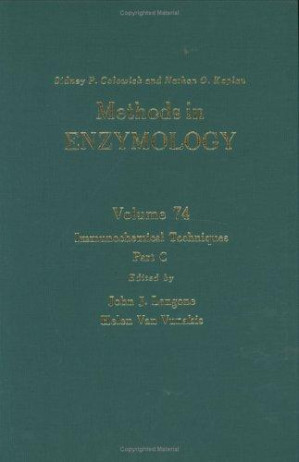
METHODS IN ENZYMOLOGY VOLUME 74 IMMUNOCHEMICAL TECHNIQUES PART C 🔍
JOHN J.LANGONE HELEN VAN VUNAKIS, Editor-in-chief Kaplan, Nathan P. Editor-in-chief Colowick -, Nathan P. Colowick, Nathan P. Kaplan, John J Langone, Helen Van Vunakis
Academic Press·New York, 1981, 1981
英语 [en] · PDF · 26.0MB · 1981 · 📗 未知类型的图书 · 🚀/duxiu/zlibzh · Save
描述
Assays utilizing the high specificities of antibodies or other receptors make it possible to detect and quantify many substances present in only minute traces in complex biological materials.
备用文件名
duxiu/initial_release/40109458_METHODS IN ENZYMOLOGY VOLUME 74 IMMUNOCHEMICAL TECHNIQUES PART C_p729.zip
备用文件名
zlibzh/no-category/JOHN J.LANGONE HELEN VAN VUNAKIS, Editor-in-chief Kaplan, Nathan P. Editor-in-chief Colowick -, Nathan P. Colowick, Nathan P. Kaplan, John J Langone, Helen Van Vunakis/METHODS IN ENZYMOLOGY VOLUME 74 IMMUNOCHEMICAL TECHNIQUES PART C_116608044.pdf
备选标题
Immunochemical Techniques, Part B, Volume 73: Volume 73: Immunochemical Techniqies Part B (Methods in Enzymology)
备选标题
Immunochemical Techniques, Part C, Volume 74: Volume 74: Immunochemical Techniques Part C (Methods in Enzymology)
备选标题
METHODS IN ENZYMOLOGY VOLUME 73 IMMUNOCHEMICAL TECHNIQUES PART B
备选作者
Nathan P. Colowick, John J. Langone, Helen Van Vunakis, Nathan P. Kaplan
备选作者
Helen Van Vunakis; John J Langone; Giovanni Di Sabato; Johannes Everse
备选作者
Sidney P. Colowick; Nathan Oram Kaplan
备选作者
Langone, John J.; Van Vunakis, Helen
备用出版商
Academic Press, Incorporated
备用出版商
Morgan Kaufmann Publishers
备用出版商
Brooks/Cole
备用版本
Methods in enzymology, v. 70, 73, 74, 84, 92, 93, 108, 116, 121, 132, 150, 162, 163, New York, 1980-<1988>
备用版本
United States, United States of America
备用版本
November 28, 1981
备用版本
August 28, 1981
备用版本
1, 1982
元数据中的注释
related_files:
filepath:40109458_METHODS IN ENZYMOLOGY VOLUME 74 IMMUNOCHEMICAL TECHNIQUES PART C_p729.zip — md5:b943ff734ab8132b432a246039938a70 — filesize:55945056
filepath:40109458_METHODS IN ENZYMOLOGY VOLUME 74 IMMUNOCHEMICAL TECHNIQUES PART C_p729.zip — md5:996a9370c600f9c5364e99fa01401f6b — filesize:55945056
filepath:40109458_METHODS IN ENZYMOLOGY VOLUME 74 IMMUNOCHEMICAL TECHNIQUES PART C_p729.zip — md5:33162ab9d37f04a19d5628db5787c280 — filesize:54604017
filepath:/读秀/读秀3.0/读秀/3.0/3.0新/其余书库等多个文件/0025/41/40109458_METHODS IN ENZYMOLOGY VOLUME 74 IMMUNOCHEMICAL TECHNIQUES PART C_p729.zip
filepath:第四部分/aaa/41/40109458_METHODS IN ENZYMOLOGY VOLUME 74 IMMUNOCHEMICAL TECHNIQUES PART C_p729.zip
filepath:40109458.zip — md5:47fa9fec9e94fab9dae6f5497585fd83 — filesize:54604017
filepath:/读秀/读秀4.0/读秀/4.0/数据库36-2/40109458.zip
filepath:40109458_METHODS IN ENZYMOLOGY VOLUME 74 IMMUNOCHEMICAL TECHNIQUES PART C_p729.zip — md5:b943ff734ab8132b432a246039938a70 — filesize:55945056
filepath:40109458_METHODS IN ENZYMOLOGY VOLUME 74 IMMUNOCHEMICAL TECHNIQUES PART C_p729.zip — md5:996a9370c600f9c5364e99fa01401f6b — filesize:55945056
filepath:40109458_METHODS IN ENZYMOLOGY VOLUME 74 IMMUNOCHEMICAL TECHNIQUES PART C_p729.zip — md5:33162ab9d37f04a19d5628db5787c280 — filesize:54604017
filepath:/读秀/读秀3.0/读秀/3.0/3.0新/其余书库等多个文件/0025/41/40109458_METHODS IN ENZYMOLOGY VOLUME 74 IMMUNOCHEMICAL TECHNIQUES PART C_p729.zip
filepath:第四部分/aaa/41/40109458_METHODS IN ENZYMOLOGY VOLUME 74 IMMUNOCHEMICAL TECHNIQUES PART C_p729.zip
filepath:40109458.zip — md5:47fa9fec9e94fab9dae6f5497585fd83 — filesize:54604017
filepath:/读秀/读秀4.0/读秀/4.0/数据库36-2/40109458.zip
元数据中的注释
topic: Immunochemistry; Immunoassay; Immunochemistry
元数据中的注释
Type: 英文图书
元数据中的注释
Bookmarks:
1. (p1) Section 1. Production of Antibodies
1.1. (p3) 1. Preparation of Monoclonal Antibodies: Strategies and Procedures
1.2. (p46) 2. Production of Antisera with Small Doses of Imnumogen: Multiple Intradermal Injections
1.3. (p52) 3. Production of Specific Antisera by Immunization with Precipitin Lines
1.4. (p57) 4. Polymers for the Sustained Release of molecules: Their Use in a Sinsle-Step Method of Immunization
2. (p78) Section 2. Labeling
2.1. (p79) 5. ~(125)Iodinated Tracers for Hapten-Specific Radioimmunoassays
2.2. (p112) 6. Radioiodinationn by Use of the Bolton-humter and Related Reagents
2.3. (p127) 7. Use of ~(125)I-Labeled Anti-2,4-Dinitrophenyl(DNP) Antibodies as a Tracer in Solid-Phase Radioimmunoassays
2.4. (p138) 8. Tritiation of Proteins to High Specific Activity: Application to Radioimmunoassay
2.5. (p147) 9. Methods for the Preparation of Enzyme-Antibody Conjugates for Use in Enzyme Immunoassay
2.6. (p166) 10. Purification of Peroxidase-Conjugated Antibody for Enzyme Immunoassay by Affinity Chromatography on Concanavalin A
2.7. (p176) 11. Preparation of Protein A-Enzyme Monoconjugate and Its Use as a Reagent in Enzyme Immunoassays
2.8. (p191) 12. Effect of Catalytic Hydrogenation of Cellular Lipid and Fatty Acid on the Susceptibility of Tumor Cells to Humoral Immune Killing
3. (p202) Section 3. Separation Techniques in Immunoassay
3.1. (p203) 13. Use of Particulate Immunosorbents in Radioimmunoassay
3.2. (p224) 14. Antibody-Coated Plastic Tubes in Radioimmunoassay
3.3. (p239) 15. Quantitation of Antibodies Immobilized on Plastics
3.4. (p245) 16. Radioimmtmoassay of Peptide Hormones Using Killed Staphylococcus aureus as a Separating Agent
3.5. (p254) 17. Microencapsulation of Antibody for Use in Radioimmunoassay
3.6. (p261) 18. High-Pressure Liquid Chromatography and Radioimmunoassay for the SpeCific and Quantitative Determination of Endorphins and Related Peptides
3.7. (p275) 19. Qualitative and Quantitative Analysesof Arachidonic Acid Metabolites by Combined High-Performance Liquid Chromatography and Radioimmunoassay
4. (p289) Section 4. Immunoassay Methods for the Detection of Antigens and Antibodies
4.1. (p289) A. Immunoassay in Gels
4.1.1. (p291) 20. Single Radial Immunodiffusion
4.1.2. (p306) 21. The Two-Cross Immunodiffusion Technique Determining Diffusion Coefficients and Precipitating Titers of Antigen and Antibody
4.1.3. (p319) 22. Antigen Quantitation by a Reverse Hemolytic Assay
4.1.4. (p326) 23. The Reverse plaque-Forming Cell Assay
4.1.5. (p339) 24. Electroimmunoasssay
4.1.6. (p370) 25. Quantitation of Antigens by Densitometric Scanning of Immunoelectrophoretic Precipitates
4.2. (p381) B. Immunoassays Dependent on Radiolabeled Tracers
4.2.1. (p383) 26. Ultrasensitive Enzymic Radioimmunoassay
4.2.2. (p394) 27. Autoradiographic Immunoassay (ARIA)
4.2.3. (p406) 28. Methods for Binding Cells to Plastic: Application to Solid Phase Immunoassays for Cell-Surface Antigens
4.2.4. (p418) 29. Microprocedures for Quantitative Immunochemical Analysis of Antigenic Molecules and Antigenic Determinants
4.2.5. (p436) 30. The Use of [~(125)I]C1q Subcomponent for the Measurement of Complement-Binding Antibodies on Cell Surfaces
4.2.6. (p442) 31. Use of Protein A-Bearing Staphylococci for the Immunoprecipitation and Isolation of Antigens from Cells
4.2.7. (p459) 32. Recovery of Antigen from Staphylococcal Protein A-Antibody Adsorbents
4.3. (p471) C. Immunoassays Dependent on Enzyme-Labeled Tracers
4.3.1. (p471) 33. Masnetic Solid-Phase Enzyme Immunoassay for the Quantitation of Antigens and Antibodies: Application to Human Immunoglobulin E
4.3.2. (p482) 34. The Amplified ELISA: Principles of and Applications for the Comparative Quantitation of and Subclass Antibodies and the Distribution of Antibodies and Antigens in Biochemical Separates
4.3.3. (p523) 35. Steric Hindrance Enzyme Immunoassay (SHEIA) Using β-Galactosidase as an Enzyme Label and Maleimide Derivative of Hapten (or Antigen) for Enzyme Coupling
4.3.4. (p543) 36. Antibody Quantitation Using the Unlabeled AntibodyEnzyme Immunoassay (UNLIM) Method
4.3.5. (p550) 37. Use of Antibodies and the Primary Enzyme lmmunoassay (PEIA) to Study Enzymes: The Arylsulfatase A-Anti-Arylsulfatase A System
4.4. (p578) D. Immunoassay of Immunoglobulins
4.4.1. (p578) 38. Immunonephelometric Assay for Immunoglobulins Released by Cultured Lymphocytes
4.4.2. (p597) 39. Solid-Phase Radioimmunoassay for Immunoglobulins and Influenza Antibodies
4.4.3. (p608) 40. A Luminol-Assisted Competitive Binding Immunoassay of Human Immunoglobulin G
4.4.4. (p616) 41. Preparation and Radioimmunoassay of IgM Domains
4.4.5. (p625) 42. Quantitation of Secretory Protein Levels by Radioimmunoassay
4.4.6. (p634) 43. Double-Antibody Radioimmunoassay for IgE
4.4.7. (p646) 44. Radioimmunoassay for IgE Using Paper Disks
4.4.8. (p656) 45. Enzyme-Linked Immunosorbent Assays (ELISA) for Immunoglobulin E and Blocking Antibodies
4.4.9. (p666) 46. Development and Clinical Application of Radioimmunoassay Techniques for Measuring Low Levels of Immunoglobulin Classes G, A, M, D, and E in Cerebrospinal and Other Body Fluids
1. (p1) Section 1. Production of Antibodies
1.1. (p3) 1. Preparation of Monoclonal Antibodies: Strategies and Procedures
1.2. (p46) 2. Production of Antisera with Small Doses of Imnumogen: Multiple Intradermal Injections
1.3. (p52) 3. Production of Specific Antisera by Immunization with Precipitin Lines
1.4. (p57) 4. Polymers for the Sustained Release of molecules: Their Use in a Sinsle-Step Method of Immunization
2. (p78) Section 2. Labeling
2.1. (p79) 5. ~(125)Iodinated Tracers for Hapten-Specific Radioimmunoassays
2.2. (p112) 6. Radioiodinationn by Use of the Bolton-humter and Related Reagents
2.3. (p127) 7. Use of ~(125)I-Labeled Anti-2,4-Dinitrophenyl(DNP) Antibodies as a Tracer in Solid-Phase Radioimmunoassays
2.4. (p138) 8. Tritiation of Proteins to High Specific Activity: Application to Radioimmunoassay
2.5. (p147) 9. Methods for the Preparation of Enzyme-Antibody Conjugates for Use in Enzyme Immunoassay
2.6. (p166) 10. Purification of Peroxidase-Conjugated Antibody for Enzyme Immunoassay by Affinity Chromatography on Concanavalin A
2.7. (p176) 11. Preparation of Protein A-Enzyme Monoconjugate and Its Use as a Reagent in Enzyme Immunoassays
2.8. (p191) 12. Effect of Catalytic Hydrogenation of Cellular Lipid and Fatty Acid on the Susceptibility of Tumor Cells to Humoral Immune Killing
3. (p202) Section 3. Separation Techniques in Immunoassay
3.1. (p203) 13. Use of Particulate Immunosorbents in Radioimmunoassay
3.2. (p224) 14. Antibody-Coated Plastic Tubes in Radioimmunoassay
3.3. (p239) 15. Quantitation of Antibodies Immobilized on Plastics
3.4. (p245) 16. Radioimmtmoassay of Peptide Hormones Using Killed Staphylococcus aureus as a Separating Agent
3.5. (p254) 17. Microencapsulation of Antibody for Use in Radioimmunoassay
3.6. (p261) 18. High-Pressure Liquid Chromatography and Radioimmunoassay for the SpeCific and Quantitative Determination of Endorphins and Related Peptides
3.7. (p275) 19. Qualitative and Quantitative Analysesof Arachidonic Acid Metabolites by Combined High-Performance Liquid Chromatography and Radioimmunoassay
4. (p289) Section 4. Immunoassay Methods for the Detection of Antigens and Antibodies
4.1. (p289) A. Immunoassay in Gels
4.1.1. (p291) 20. Single Radial Immunodiffusion
4.1.2. (p306) 21. The Two-Cross Immunodiffusion Technique Determining Diffusion Coefficients and Precipitating Titers of Antigen and Antibody
4.1.3. (p319) 22. Antigen Quantitation by a Reverse Hemolytic Assay
4.1.4. (p326) 23. The Reverse plaque-Forming Cell Assay
4.1.5. (p339) 24. Electroimmunoasssay
4.1.6. (p370) 25. Quantitation of Antigens by Densitometric Scanning of Immunoelectrophoretic Precipitates
4.2. (p381) B. Immunoassays Dependent on Radiolabeled Tracers
4.2.1. (p383) 26. Ultrasensitive Enzymic Radioimmunoassay
4.2.2. (p394) 27. Autoradiographic Immunoassay (ARIA)
4.2.3. (p406) 28. Methods for Binding Cells to Plastic: Application to Solid Phase Immunoassays for Cell-Surface Antigens
4.2.4. (p418) 29. Microprocedures for Quantitative Immunochemical Analysis of Antigenic Molecules and Antigenic Determinants
4.2.5. (p436) 30. The Use of [~(125)I]C1q Subcomponent for the Measurement of Complement-Binding Antibodies on Cell Surfaces
4.2.6. (p442) 31. Use of Protein A-Bearing Staphylococci for the Immunoprecipitation and Isolation of Antigens from Cells
4.2.7. (p459) 32. Recovery of Antigen from Staphylococcal Protein A-Antibody Adsorbents
4.3. (p471) C. Immunoassays Dependent on Enzyme-Labeled Tracers
4.3.1. (p471) 33. Masnetic Solid-Phase Enzyme Immunoassay for the Quantitation of Antigens and Antibodies: Application to Human Immunoglobulin E
4.3.2. (p482) 34. The Amplified ELISA: Principles of and Applications for the Comparative Quantitation of and Subclass Antibodies and the Distribution of Antibodies and Antigens in Biochemical Separates
4.3.3. (p523) 35. Steric Hindrance Enzyme Immunoassay (SHEIA) Using β-Galactosidase as an Enzyme Label and Maleimide Derivative of Hapten (or Antigen) for Enzyme Coupling
4.3.4. (p543) 36. Antibody Quantitation Using the Unlabeled AntibodyEnzyme Immunoassay (UNLIM) Method
4.3.5. (p550) 37. Use of Antibodies and the Primary Enzyme lmmunoassay (PEIA) to Study Enzymes: The Arylsulfatase A-Anti-Arylsulfatase A System
4.4. (p578) D. Immunoassay of Immunoglobulins
4.4.1. (p578) 38. Immunonephelometric Assay for Immunoglobulins Released by Cultured Lymphocytes
4.4.2. (p597) 39. Solid-Phase Radioimmunoassay for Immunoglobulins and Influenza Antibodies
4.4.3. (p608) 40. A Luminol-Assisted Competitive Binding Immunoassay of Human Immunoglobulin G
4.4.4. (p616) 41. Preparation and Radioimmunoassay of IgM Domains
4.4.5. (p625) 42. Quantitation of Secretory Protein Levels by Radioimmunoassay
4.4.6. (p634) 43. Double-Antibody Radioimmunoassay for IgE
4.4.7. (p646) 44. Radioimmunoassay for IgE Using Paper Disks
4.4.8. (p656) 45. Enzyme-Linked Immunosorbent Assays (ELISA) for Immunoglobulin E and Blocking Antibodies
4.4.9. (p666) 46. Development and Clinical Application of Radioimmunoassay Techniques for Measuring Low Levels of Immunoglobulin Classes G, A, M, D, and E in Cerebrospinal and Other Body Fluids
元数据中的注释
theme: Immunochemistry; Immunoassay; Immunochemistry
元数据中的注释
topic: Immunochemistry; Immunoassay; Immunochemistry; Immunochimie; Immunodosage
元数据中的注释
Bookmarks:
1. (p1) Section 1. Immunoassay Methods for the Detection of Antigens and Antibodies
1.1. (p3) A. Fluorescence Immunoassay Methods
1.1.1. (p3) 1. Equilibrium and Kinetic Inhibition Assays Based upon Fluorescence Polarization
1.1.2. (p28) 2. Fluorescence Excitation Transfer Immunoassay (FETI)
1.1.3. (p60) 3. Indirect Quenching Fluoroimmunoassay
1.1.4. (p79) 4. The Homogeneous Substrate-Labeled Fluorescent Immunoassay
1.1.5. (p87) 5. The Fluorescence Immunoassay Using Plane Surface Solid Phases (FIAPS)
1.2. (p106) B. Immunoassays Dependent on Other Detection Methods
1.2.1. (p106) 6. Particle Counting Immunoassay (PACIA)
1.2.2. (p140) 7. Spin Immunoassay
1.2.3. (p152) 8. Membrane Immunoassay: A Spin Membrane Immunoassay for Thyroxine
1.2.4. (p161) 9. Detection of Antigens and Haptens by Inhibition of Passive Immune Hemolysis
1.2.5. (p165) 10. Quantification of Complement Fixation by the C1 Fixation and CI Fixation and Transfer Tests
1.2.6. (p177) 11. Probing Immune Reactions by Laser Light Scattering Spectroscopy
1.3. (p198) C. Use of Antibodies to Study Enzymes
1.3.1. (p198) 12. Radioimmunoassay of Creatine Kinase Isoenzymes
1.3.2. (p210) 13. Specific Radioimmunoassays for Rabbit Liver Fructose Bisphosphatase, Pyruvate Kinase, and Glycerol-3-phosphate Dehydrogenase
1.3.3. (p232) 14. Specific Radioimmunoassays for Rabbit Skeletal and Cardiac Muscle 6-Phosphofructokinase and Pyruvate Kinase
1.3.4. (p244) 15. Preparation of Site-Specific Anti-Cytochrome c Antibodies and Their Application
1.3.5. (p262) 16. Production and Application of Antibodies to Rat Liver Cytochrome P-450
1.3.6. (p272) 17. Radioimmunoassay Determination of Circulating Pancreatic Endopeptidases
1.3.7. (p290) 18. Radioimmunoassay of Human Pancreatic Amylase
1.3.8. (p299) 19. Radioimmunoassay of the Regulatory Subunit of Type 1 cAMP-Dependent Protein Kinase
1.3.9. (p310) 20. Radioimmunoassay of Bovine Type 2 cAMP-Dependent Protein Kinase
1.3.10. (p320) 21. Immunotitration of 3-Hydroxy-3-Methylglutaryl-CoA Reductase
1.3.11. (p343) 22. Production of Antibodies to Catalase and Their Effect on Enzyme Activity
1.3.12. (p351) 23. Radioimmunoassay of Human Adenosine Deaminase
1.3.13. (p359) 24. Quantitation of Human Cuprozinc Superoxide Dismutase (SOD-1) by Radioimmunoassay and Its Possible Significance in Disease
1.3.14. (p370) 25. Radioimmunoassay and Immunotitration of Humaa Serum Dopamine β-Hydroxylase
1.4. (p380) D. Use of Antibodies to Study Receptors
2. (p479) Section 2. Data Analysis
2.1. (p481) 32. Concentrations of Binding Protein and Labeled Analyte That Are Appropriate for Measuring at Any Analyte Concentration Range in Radioimmunoassays
2.2. (p497) 33. Microprocessor-Based Radioimmunoassay Data Analysis
3. (p509) Section 3. Immune Complexes
3.1. (p511) 34. The Raji, Conglutinin, and Anti-C3 Assays for the Detection of Complement-Fixing Immune Complexes
3.2. (p530) 35. The [~(123)I]C1q Binding Assay for the Detection of Soluble Immune Complexes
3.3. (p538) 36. Quantitatiott of Circulating Immune Complexes by Combined PEG Precipitation and Immunoglobulin-Specific Radioimmunoassay (PICRIA)
3.4. (p551) 37. Detection and Quantitation of Immune Complexes with a Rapid Polyethylene Glycol Precipitation Complement Consumption Method (PEG-CC)
3.5. (p571) 38. Detection and Quantitation of Circulation Immune Complexes by the C1q-Protein A Binding Assay (C1q-PABA)
3.6. (p588) 39. C3c-Binding ELISA for the Detection of immunoconglutinins and lmmunoglobulin Aggregates
3.7. (p608) 40. Enzyme Immunoassay for the Demonstration and Quantification of Immune Complexes
3.8. (p617) 41. Assay of Soluble Immune Complexes Using Radiolabeled Rheumatoid Factor
3.9. (p628) 42. Quantification of Immune Complexes by Nephelometry
3.10. (p644) 43. Isolation of Soluble Immune Complexes from Human Serum: Combined Use of Polyethylene Glycol Precipitation, Gel Filtration, and Affinity Chromatography on Protein A-Sepharose
3.11. (p664) 44. Purification and Analysis of Immune Complexes with the Aid of Rheumatoid Factor-Coated Tubes
1. (p1) Section 1. Immunoassay Methods for the Detection of Antigens and Antibodies
1.1. (p3) A. Fluorescence Immunoassay Methods
1.1.1. (p3) 1. Equilibrium and Kinetic Inhibition Assays Based upon Fluorescence Polarization
1.1.2. (p28) 2. Fluorescence Excitation Transfer Immunoassay (FETI)
1.1.3. (p60) 3. Indirect Quenching Fluoroimmunoassay
1.1.4. (p79) 4. The Homogeneous Substrate-Labeled Fluorescent Immunoassay
1.1.5. (p87) 5. The Fluorescence Immunoassay Using Plane Surface Solid Phases (FIAPS)
1.2. (p106) B. Immunoassays Dependent on Other Detection Methods
1.2.1. (p106) 6. Particle Counting Immunoassay (PACIA)
1.2.2. (p140) 7. Spin Immunoassay
1.2.3. (p152) 8. Membrane Immunoassay: A Spin Membrane Immunoassay for Thyroxine
1.2.4. (p161) 9. Detection of Antigens and Haptens by Inhibition of Passive Immune Hemolysis
1.2.5. (p165) 10. Quantification of Complement Fixation by the C1 Fixation and CI Fixation and Transfer Tests
1.2.6. (p177) 11. Probing Immune Reactions by Laser Light Scattering Spectroscopy
1.3. (p198) C. Use of Antibodies to Study Enzymes
1.3.1. (p198) 12. Radioimmunoassay of Creatine Kinase Isoenzymes
1.3.2. (p210) 13. Specific Radioimmunoassays for Rabbit Liver Fructose Bisphosphatase, Pyruvate Kinase, and Glycerol-3-phosphate Dehydrogenase
1.3.3. (p232) 14. Specific Radioimmunoassays for Rabbit Skeletal and Cardiac Muscle 6-Phosphofructokinase and Pyruvate Kinase
1.3.4. (p244) 15. Preparation of Site-Specific Anti-Cytochrome c Antibodies and Their Application
1.3.5. (p262) 16. Production and Application of Antibodies to Rat Liver Cytochrome P-450
1.3.6. (p272) 17. Radioimmunoassay Determination of Circulating Pancreatic Endopeptidases
1.3.7. (p290) 18. Radioimmunoassay of Human Pancreatic Amylase
1.3.8. (p299) 19. Radioimmunoassay of the Regulatory Subunit of Type 1 cAMP-Dependent Protein Kinase
1.3.9. (p310) 20. Radioimmunoassay of Bovine Type 2 cAMP-Dependent Protein Kinase
1.3.10. (p320) 21. Immunotitration of 3-Hydroxy-3-Methylglutaryl-CoA Reductase
1.3.11. (p343) 22. Production of Antibodies to Catalase and Their Effect on Enzyme Activity
1.3.12. (p351) 23. Radioimmunoassay of Human Adenosine Deaminase
1.3.13. (p359) 24. Quantitation of Human Cuprozinc Superoxide Dismutase (SOD-1) by Radioimmunoassay and Its Possible Significance in Disease
1.3.14. (p370) 25. Radioimmunoassay and Immunotitration of Humaa Serum Dopamine β-Hydroxylase
1.4. (p380) D. Use of Antibodies to Study Receptors
2. (p479) Section 2. Data Analysis
2.1. (p481) 32. Concentrations of Binding Protein and Labeled Analyte That Are Appropriate for Measuring at Any Analyte Concentration Range in Radioimmunoassays
2.2. (p497) 33. Microprocessor-Based Radioimmunoassay Data Analysis
3. (p509) Section 3. Immune Complexes
3.1. (p511) 34. The Raji, Conglutinin, and Anti-C3 Assays for the Detection of Complement-Fixing Immune Complexes
3.2. (p530) 35. The [~(123)I]C1q Binding Assay for the Detection of Soluble Immune Complexes
3.3. (p538) 36. Quantitatiott of Circulating Immune Complexes by Combined PEG Precipitation and Immunoglobulin-Specific Radioimmunoassay (PICRIA)
3.4. (p551) 37. Detection and Quantitation of Immune Complexes with a Rapid Polyethylene Glycol Precipitation Complement Consumption Method (PEG-CC)
3.5. (p571) 38. Detection and Quantitation of Circulation Immune Complexes by the C1q-Protein A Binding Assay (C1q-PABA)
3.6. (p588) 39. C3c-Binding ELISA for the Detection of immunoconglutinins and lmmunoglobulin Aggregates
3.7. (p608) 40. Enzyme Immunoassay for the Demonstration and Quantification of Immune Complexes
3.8. (p617) 41. Assay of Soluble Immune Complexes Using Radiolabeled Rheumatoid Factor
3.9. (p628) 42. Quantification of Immune Complexes by Nephelometry
3.10. (p644) 43. Isolation of Soluble Immune Complexes from Human Serum: Combined Use of Polyethylene Glycol Precipitation, Gel Filtration, and Affinity Chromatography on Protein A-Sepharose
3.11. (p664) 44. Purification and Analysis of Immune Complexes with the Aid of Rheumatoid Factor-Coated Tubes
元数据中的注释
theme: Immunochemistry; Immunoassay; Immunochemistry; Immunochimie; Immunodosage
备用描述
Contents: Pt. A. [without Special Title]--pt. B. [without Special Title] -- Pt. C. [without Special Title] -- Pt. D. Selected Immunoassays / Edited By John J. Langone, Helen Van Vunakis -- Pt. E. Monoclonal Antibodies And General Immunoassays Methods / Edited By John J. Langone, Helen Van Vunakis -- Pt. F. Conventional Antibodies, Fc Receptors, And Cytoxicity / Edited By John J. Langone, Helen Van Vunakis. -- Pt. G. Separation And Characterization Of Lymphoid Cells / Edited By Giovanni Di Sabato, John J. Langone -- Pt. I. Hybridoma Technolgy And Monoclonal Antibodies / Edited By John J. Langone, Helen Van Vunakis. Edited By Helen Van Vunakis, John J. Langone. Editors Vary. Includes Bibliographical References And Indexes.
开源日期
2024-06-13
🚀 快速下载
成为会员以支持书籍、论文等的长期保存。为了感谢您对我们的支持,您将获得高速下载权益。❤️
🐢 低速下载
由可信的合作方提供。 更多信息请参见常见问题解答。 (可能需要验证浏览器——无限次下载!)
- 低速服务器(合作方提供) #1 (稍快但需要排队)
- 低速服务器(合作方提供) #2 (稍快但需要排队)
- 低速服务器(合作方提供) #3 (稍快但需要排队)
- 低速服务器(合作方提供) #4 (稍快但需要排队)
- 低速服务器(合作方提供) #5 (无需排队,但可能非常慢)
- 低速服务器(合作方提供) #6 (无需排队,但可能非常慢)
- 低速服务器(合作方提供) #7 (无需排队,但可能非常慢)
- 低速服务器(合作方提供) #8 (无需排队,但可能非常慢)
- 低速服务器(合作方提供) #9 (无需排队,但可能非常慢)
- 下载后: 在我们的查看器中打开
所有选项下载的文件都相同,应该可以安全使用。即使这样,从互联网下载文件时始终要小心。例如,确保您的设备更新及时。
外部下载
-
对于大文件,我们建议使用下载管理器以防止中断。
推荐的下载管理器:JDownloader -
您将需要一个电子书或 PDF 阅读器来打开文件,具体取决于文件格式。
推荐的电子书阅读器:Anna的档案在线查看器、ReadEra和Calibre -
使用在线工具进行格式转换。
推荐的转换工具:CloudConvert和PrintFriendly -
您可以将 PDF 和 EPUB 文件发送到您的 Kindle 或 Kobo 电子阅读器。
推荐的工具:亚马逊的“发送到 Kindle”和djazz 的“发送到 Kobo/Kindle” -
支持作者和图书馆
✍️ 如果您喜欢这个并且能够负担得起,请考虑购买原版,或直接支持作者。
📚 如果您当地的图书馆有这本书,请考虑在那里免费借阅。
下面的文字仅以英文继续。
总下载量:
“文件的MD5”是根据文件内容计算出的哈希值,并且基于该内容具有相当的唯一性。我们这里索引的所有影子图书馆都主要使用MD5来标识文件。
一个文件可能会出现在多个影子图书馆中。有关我们编译的各种数据集的信息,请参见数据集页面。
有关此文件的详细信息,请查看其JSON 文件。 Live/debug JSON version. Live/debug page.