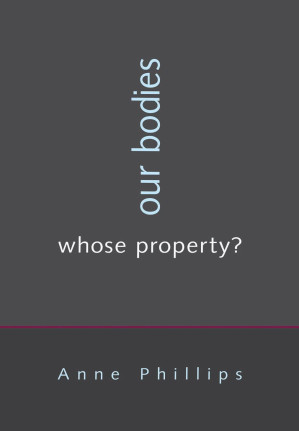
Our Bodies, Whose Property? 🔍
Phillips, Anne
Princeton University Press, 2017
英语 [en] · PDF · 7.4MB · 2017 · 📘 非小说类图书 · 🚀/lgli/zlib · Save
描述
An argument against treating our bodies as commodities
No one wants to be treated like an object, regarded as an item of property, or put up for sale. Yet many people frame personal autonomy in terms of self-ownership, representing themselves as property owners with the right to do as they wish with their bodies. Others do not use the language of property, but are similarly insistent on the rights of free individuals to decide for themselves whether to engage in commercial transactions for sex, reproduction, or organ sales. Drawing on analyses of rape, surrogacy, and markets in human organs, Our Bodies, Whose Property? challenges notions of freedom based on ownership of our bodies and argues against the normalization of markets in bodily services and parts. Anne Phillips explores the risks associated with metaphors of property and the reasons why the commodification of the body remains problematic.
What, she asks, is wrong with thinking of oneself as the owner of one's body? What is wrong with making our bodies available for rent or sale? What, if anything, is the difference between markets in sex, reproduction, or human body parts, and the other markets we commonly applaud? Phillips contends that body markets occupy the outer edges of a continuum that is, in some way, a feature of all labor markets. But she also emphasizes that we all have bodies, and considers the implications of this otherwise banal fact for equality. Bodies remind us of shared vulnerability, alerting us to the common experience of living as embodied beings in the same world.
Examining the complex issue of body exceptionalism, Our Bodies, Whose Property? demonstrates that treating the body as property makes human equality harder to comprehend.
No one wants to be treated like an object, regarded as an item of property, or put up for sale. Yet many people frame personal autonomy in terms of self-ownership, representing themselves as property owners with the right to do as they wish with their bodies. Others do not use the language of property, but are similarly insistent on the rights of free individuals to decide for themselves whether to engage in commercial transactions for sex, reproduction, or organ sales. Drawing on analyses of rape, surrogacy, and markets in human organs, Our Bodies, Whose Property? challenges notions of freedom based on ownership of our bodies and argues against the normalization of markets in bodily services and parts. Anne Phillips explores the risks associated with metaphors of property and the reasons why the commodification of the body remains problematic.
What, she asks, is wrong with thinking of oneself as the owner of one's body? What is wrong with making our bodies available for rent or sale? What, if anything, is the difference between markets in sex, reproduction, or human body parts, and the other markets we commonly applaud? Phillips contends that body markets occupy the outer edges of a continuum that is, in some way, a feature of all labor markets. But she also emphasizes that we all have bodies, and considers the implications of this otherwise banal fact for equality. Bodies remind us of shared vulnerability, alerting us to the common experience of living as embodied beings in the same world.
Examining the complex issue of body exceptionalism, Our Bodies, Whose Property? demonstrates that treating the body as property makes human equality harder to comprehend.
备用文件名
zlib/no-category/Anne Phillips/Our Bodies, Whose Property?_25700684.pdf
备选作者
Anne Phillips
备用出版商
Princeton Electronic
备用版本
Princeton University Press, Princeton, 2013
备用版本
United States, United States of America
备用版本
1, 2013
备用描述
"No one wants to be treated like an object, regarded as an item of property, or put up for sale. Yet many people frame personal autonomy in terms of self-ownership, representing themselves as property owners with the right to do as they wish with their bodies. Others do not use the language of property, but are similarly insistent on the rights of free individuals to decide for themselves whether to engage in commercial transactions for sex, reproduction, or organ sales. Drawing on analyses of rape, surrogacy, and markets in human organs, Our Bodies, Whose Property? challenges notions of freedom based on ownership of our bodies and argues against the normalization of markets in bodily services and parts. Anne Phillips explores the risks associated with metaphors of property and the reasons why the commodification of the body remains problematic. What, she asks, is wrong with thinking of oneself as the owner of one's body? What is wrong with making our bodies available for rent or sale? What, if anything, is the difference between markets in sex, reproduction, or human body parts, and the other markets we commonly applaud? Phillips contends that body markets occupy the outer edges of a continuum that is, in some way, a feature of all labor markets. But she also emphasizes that we all have bodies, and considers the implications of this otherwise banal fact for equality. Bodies remind us of shared vulnerability, alerting us to the common experience of living as embodied beings in the same world. Examining the complex issue of body exceptionalism, Our Bodies, Whose Property? demonstrates that treating the body as property makes human equality harder to comprehend"-- Provided by publisher
开源日期
2022-03-08
🚀 快速下载
成为会员以支持书籍、论文等的长期保存。为了感谢您对我们的支持,您将获得高速下载权益。❤️
如果您在本月捐款,您将获得双倍的快速下载次数。
🐢 低速下载
由可信的合作方提供。 更多信息请参见常见问题解答。 (可能需要验证浏览器——无限次下载!)
- 低速服务器(合作方提供) #1 (稍快但需要排队)
- 低速服务器(合作方提供) #2 (稍快但需要排队)
- 低速服务器(合作方提供) #3 (稍快但需要排队)
- 低速服务器(合作方提供) #4 (稍快但需要排队)
- 低速服务器(合作方提供) #5 (无需排队,但可能非常慢)
- 低速服务器(合作方提供) #6 (无需排队,但可能非常慢)
- 低速服务器(合作方提供) #7 (无需排队,但可能非常慢)
- 低速服务器(合作方提供) #8 (无需排队,但可能非常慢)
- 低速服务器(合作方提供) #9 (无需排队,但可能非常慢)
- 下载后: 在我们的查看器中打开
外部下载
-
对于大文件,我们建议使用下载管理器以防止中断。
推荐的下载管理器:JDownloader -
您将需要一个电子书或 PDF 阅读器来打开文件,具体取决于文件格式。
推荐的电子书阅读器:Anna的档案在线查看器、ReadEra和Calibre -
使用在线工具进行格式转换。
推荐的转换工具:CloudConvert和PrintFriendly -
您可以将 PDF 和 EPUB 文件发送到您的 Kindle 或 Kobo 电子阅读器。
推荐的工具:亚马逊的“发送到 Kindle”和djazz 的“发送到 Kobo/Kindle” -
支持作者和图书馆
✍️ 如果您喜欢这个并且能够负担得起,请考虑购买原版,或直接支持作者。
📚 如果您当地的图书馆有这本书,请考虑在那里免费借阅。
下面的文字仅以英文继续。
总下载量:
“文件的MD5”是根据文件内容计算出的哈希值,并且基于该内容具有相当的唯一性。我们这里索引的所有影子图书馆都主要使用MD5来标识文件。
一个文件可能会出现在多个影子图书馆中。有关我们编译的各种数据集的信息,请参见数据集页面。
有关此文件的详细信息,请查看其JSON 文件。 Live/debug JSON version. Live/debug page.