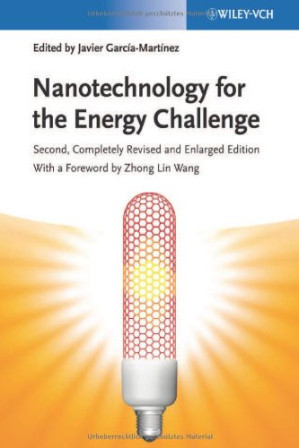
Nanotechnology for the Energy Challenge 🔍
Javier García-Martínez; Zhong Lin Wang
Wiley-Interscience; Wiley-VCH, 2., Auflage, Weinheim, 2013
英语 [en] · PDF · 11.0MB · 2013 · 📘 非小说类图书 · 🚀/lgli/lgrs/nexusstc/zlib · Save
描述
With the daunting energy challenges faced by Mankind in the 21st century, revolutionary new technologies will be the key to a clean, secure and sustainable energy future. Nanostructures often have surprising and very useful capabilities and are thus paving the way for new methodologies in almost every kind of industry.This exceptional monograph provides an overview of the subject, and presents the current state of the art with regard to different aspects of sustainable production, efficient storage and low-impact use of energy.Comprised of fifteen chapters, the book is divided in three thematic parts:Part I Sustainable Energy Production covers the main developments of nanotechnology in clean energy production and conversion, including photovoltaics, hydrogen production, thermal-electrical energy conversion and fuel cells.Part II Efficient Energy Storage is concerned with the potential use of nanomaterials in more efficient energy storage systems such as advanced batteries, supercapacitors and hydrogen storage.Part III Energy Sustainability shows how nanotechnology helps to use energy more efficiently, and the mitigation of impacts to the environment, with special emphasis on energy savings through green nanofabrication, advanced catalysis, nanostructured light-emitting and eletrochromic devices and CO2 capture by nanoporous materials .An essential addition to any bookshelf, it will be invaluable to a variety of research fields including materials science, chemical engineering, solid state, surface, industrial, and physical chemistry, as this is a subject that is very interdisciplinary.
Content: Chapter 1 Nanotechnology for Energy Production (pages 1–39): Elena Serrano, Kunhao Li, Guillermo Rus and Prof. Javier Garcia?MartinezChapter 2 Nanotechnology in Dye?Sensitized Photoelectrochemical Devices (pages 41–55): Augustin J. McEvoy and Michael GratzelChapter 3 Thermal?Electrical Energy Conversion from the Nanotechnology Perspective (pages 57–87): Jian He and Terry M. TrittChapter 4 Piezoelectric and Piezotronic Effects in Energy Harvesting and Conversion (pages 89–132): Xudong WangChapter 5 Graphene for Energy Production and Storage Applications (pages 133–170): Dale A. C. Brownson, Jonathan P. Metters and Craig E. BanksChapter 6 Nanomaterials for Fuel Cell Technologies (pages 171–211): Antonino Salvatore Arico, Vincenzo Baglio and Vincenzo AntonucciChapter 7 Nanocatalysis for Iron?Catalyzed Fischer–Tropsch Synthesis: One Perspective (pages 213–231): Uschi M. Graham, Gary Jacobs and Burtron H. DavisChapter 8 The Contribution of Nanotechnology to Hydrogen Production (pages 233–258): Sambandam Anandan, Jagannathan Madhavan and Muthupandian AshokkumarChapter 9 Nanostructured Materials for Hydrogen Storage (pages 259–275): Saghar Sepehri and Guozhong CaoChapter 10 Electrochemical Energy Storage: The Benefits of Nanomaterials (pages 277–298): Patrice Simon and Jean?Marie TarasconChapter 11 Carbon?Based Nanomaterials for Electrochemical Energy Storage (pages 299–326): Elzbieta Frackowiak and Francois BeguinChapter 12 Nanotechnologies to Enable High?Performance Superconductors for Energy Applications (pages 327–354): Claudia Cantoni and Amit GoyalChapter 13 Green Nanofabrication: Unconventional Approaches for the Conservative Use of Energy (pages 355–405): Darren J. Lipomi, Emily A. Weiss and George M. WhitesidesChapter 14 Nanocatalysis for Fuel Production (pages 407–471): Gary Jacobs and Burtron H. DavisChapter 15 Surface?Functionalized Nanoporous Catalysts towards Biofuel Applications (pages 473–516): Brian G. TrewynChapter 16 Nanotechnology for Carbon Dioxide Capture (pages 517–559): Richard R. Willis, Annabelle Benin, Randall Q. Snurr and Ozgur Yazayd?nChapter 17 Nanostructured Organic Light?Emitting Devices (pages 561–592): Juo?Hao Li, Jinsong Huang and Yang YangChapter 18 Electrochromics for Energy?Efficient Buildings: Nanofeatures, Thin Films, and Devices (pages 593–617): Claes?Goran Granqvist
Content: Chapter 1 Nanotechnology for Energy Production (pages 1–39): Elena Serrano, Kunhao Li, Guillermo Rus and Prof. Javier Garcia?MartinezChapter 2 Nanotechnology in Dye?Sensitized Photoelectrochemical Devices (pages 41–55): Augustin J. McEvoy and Michael GratzelChapter 3 Thermal?Electrical Energy Conversion from the Nanotechnology Perspective (pages 57–87): Jian He and Terry M. TrittChapter 4 Piezoelectric and Piezotronic Effects in Energy Harvesting and Conversion (pages 89–132): Xudong WangChapter 5 Graphene for Energy Production and Storage Applications (pages 133–170): Dale A. C. Brownson, Jonathan P. Metters and Craig E. BanksChapter 6 Nanomaterials for Fuel Cell Technologies (pages 171–211): Antonino Salvatore Arico, Vincenzo Baglio and Vincenzo AntonucciChapter 7 Nanocatalysis for Iron?Catalyzed Fischer–Tropsch Synthesis: One Perspective (pages 213–231): Uschi M. Graham, Gary Jacobs and Burtron H. DavisChapter 8 The Contribution of Nanotechnology to Hydrogen Production (pages 233–258): Sambandam Anandan, Jagannathan Madhavan and Muthupandian AshokkumarChapter 9 Nanostructured Materials for Hydrogen Storage (pages 259–275): Saghar Sepehri and Guozhong CaoChapter 10 Electrochemical Energy Storage: The Benefits of Nanomaterials (pages 277–298): Patrice Simon and Jean?Marie TarasconChapter 11 Carbon?Based Nanomaterials for Electrochemical Energy Storage (pages 299–326): Elzbieta Frackowiak and Francois BeguinChapter 12 Nanotechnologies to Enable High?Performance Superconductors for Energy Applications (pages 327–354): Claudia Cantoni and Amit GoyalChapter 13 Green Nanofabrication: Unconventional Approaches for the Conservative Use of Energy (pages 355–405): Darren J. Lipomi, Emily A. Weiss and George M. WhitesidesChapter 14 Nanocatalysis for Fuel Production (pages 407–471): Gary Jacobs and Burtron H. DavisChapter 15 Surface?Functionalized Nanoporous Catalysts towards Biofuel Applications (pages 473–516): Brian G. TrewynChapter 16 Nanotechnology for Carbon Dioxide Capture (pages 517–559): Richard R. Willis, Annabelle Benin, Randall Q. Snurr and Ozgur Yazayd?nChapter 17 Nanostructured Organic Light?Emitting Devices (pages 561–592): Juo?Hao Li, Jinsong Huang and Yang YangChapter 18 Electrochromics for Energy?Efficient Buildings: Nanofeatures, Thin Films, and Devices (pages 593–617): Claes?Goran Granqvist
备用文件名
lgli/fd09b572d9e1f4523de16d0da2f4588c.pdf
备用文件名
lgrsnf/fd09b572d9e1f4523de16d0da2f4588c.pdf
备用文件名
zlib/Engineering/Javier Garc?a-Mart?nez, Zhong Lin Wang/Nanotechnology for the Energy Challenge_2223205.pdf
备选作者
Zhong Lin Wang, Javier Garc�a-Mart�nez, Ernest J. Moniz
备选作者
Ernest J. Moniz, Javier Garc�a-Mart�nez
备选作者
Javier García-Martínez; Zhong Lin Wang
备用出版商
Wiley & Sons, Limited, John
备用出版商
Wiley-VCH GmbH
备用版本
Second edition, Weinheim, Germany, 2013
备用版本
2nd edition, Weinheim, 2013
备用版本
2nd ed, Weinheim, cop. 2013
备用版本
Germany, Germany
备用版本
Aug 05, 2013
备用版本
1, 2013
元数据中的注释
0
元数据中的注释
lg1054210
元数据中的注释
{"edition":"1","isbns":["3527333800","3527665102","9783527333806","9783527665105"],"last_page":664,"publisher":"Wiley"}
备用描述
Nanotechnology allows for manipulating matter at the nanoscale with unprecedented accuracy and as such holds the promise of providing new materials with distinctly different properties. In recent years, breakthroughs in nanotechnology, especially in their applications in the energy sector, have opened up the possibility of moving beyond conventional energy generation approaches by introducing technologies that are more efficient, environmentally sound and cost effective. The book brings together some of the world's leading experts in nanotechnology and its applications in the energy sector, each covering a specific subject that falls within three general aspects: production, storage and use of energy. The first part covers the main developments of nanotechnology in clean energy production and conversion. Following a general overview on the contributions of nanomaterials for energy production, further chapters elaborate on specific topics such as photodevices, thermoelectric materials and fuel cells. The second part is concerned with the use of nanomaterials in more efficient energy storage systems like batteries, superconductors and materials for hydrogen storage. The third and last part discusses how nanotechnology can lead to a more efficient energy usage while reducing the negative impact to the environment. After the successful first edition of this book Nanotechnology for the Energy Challenge, the second edition has been extensively updated to include the latest progress in this field. It includes three new chapters on graphene, piezoelectric nanomaterials, and nanocatalysts for Fischer-Tropsch synthesis. Praise for the first edition:'The book has a good index of technical terms, good quality graphical illustrations and a good reference list for further information. The book, which can be read either as a monograph, or by dipping into ..
备用描述
With the daunting energy challenges faced by Mankind in the 21st century, revolutionary new technologies will be the key to a clean, secure and sustainable energy future. Nanostructures often have surprising and very useful capabilities and are thus paving the way for new methodologies in almost every kind of industry.
This exceptional monograph provides an overview of the subject, and presents the current state of the art with regard to different aspects of sustainable production, efficient storage and low-impact use of energy.
Comprised of eighteen chapters, the book is divided in three thematic parts:
Part I Sustainable Energy Production covers the main developments of nanotechnology in clean energy production and conversion, including photovoltaics, hydrogen production, thermal-electrical energy conversion and fuel cells.
Part II Efficient Energy Storage is concerned with the potential use of nanomaterials in more efficient energy storage systems such as advanced batteries, supercapacitors and hydrogen storage.
Part III Energy Sustainability shows how nanotechnology helps to use energy more efficiently, and the mitigation of impacts to the environment, with special emphasis on energy savings through green nanofabrication, advanced catalysis, nanostructured light-emitting and eletrochromic devices and CO2 capture by nanoporous materials .
An essential addition to any bookshelf, it will be invaluable to a variety of research fields including materials science, chemical engineering, solid state, surface, industrial, and physical chemistry, as this is a subject that is very interdisciplinary.</p>
This exceptional monograph provides an overview of the subject, and presents the current state of the art with regard to different aspects of sustainable production, efficient storage and low-impact use of energy.
Comprised of eighteen chapters, the book is divided in three thematic parts:
Part I Sustainable Energy Production covers the main developments of nanotechnology in clean energy production and conversion, including photovoltaics, hydrogen production, thermal-electrical energy conversion and fuel cells.
Part II Efficient Energy Storage is concerned with the potential use of nanomaterials in more efficient energy storage systems such as advanced batteries, supercapacitors and hydrogen storage.
Part III Energy Sustainability shows how nanotechnology helps to use energy more efficiently, and the mitigation of impacts to the environment, with special emphasis on energy savings through green nanofabrication, advanced catalysis, nanostructured light-emitting and eletrochromic devices and CO2 capture by nanoporous materials .
An essential addition to any bookshelf, it will be invaluable to a variety of research fields including materials science, chemical engineering, solid state, surface, industrial, and physical chemistry, as this is a subject that is very interdisciplinary.</p>
开源日期
2013-12-05
🚀 快速下载
成为会员以支持书籍、论文等的长期保存。为了感谢您对我们的支持,您将获得高速下载权益。❤️
如果您在本月捐款,您将获得双倍的快速下载次数。
🐢 低速下载
由可信的合作方提供。 更多信息请参见常见问题解答。 (可能需要验证浏览器——无限次下载!)
- 低速服务器(合作方提供) #1 (稍快但需要排队)
- 低速服务器(合作方提供) #2 (稍快但需要排队)
- 低速服务器(合作方提供) #3 (稍快但需要排队)
- 低速服务器(合作方提供) #4 (稍快但需要排队)
- 低速服务器(合作方提供) #5 (无需排队,但可能非常慢)
- 低速服务器(合作方提供) #6 (无需排队,但可能非常慢)
- 低速服务器(合作方提供) #7 (无需排队,但可能非常慢)
- 低速服务器(合作方提供) #8 (无需排队,但可能非常慢)
- 低速服务器(合作方提供) #9 (无需排队,但可能非常慢)
- 下载后: 在我们的查看器中打开
所有选项下载的文件都相同,应该可以安全使用。即使这样,从互联网下载文件时始终要小心。例如,确保您的设备更新及时。
外部下载
-
对于大文件,我们建议使用下载管理器以防止中断。
推荐的下载管理器:JDownloader -
您将需要一个电子书或 PDF 阅读器来打开文件,具体取决于文件格式。
推荐的电子书阅读器:Anna的档案在线查看器、ReadEra和Calibre -
使用在线工具进行格式转换。
推荐的转换工具:CloudConvert和PrintFriendly -
您可以将 PDF 和 EPUB 文件发送到您的 Kindle 或 Kobo 电子阅读器。
推荐的工具:亚马逊的“发送到 Kindle”和djazz 的“发送到 Kobo/Kindle” -
支持作者和图书馆
✍️ 如果您喜欢这个并且能够负担得起,请考虑购买原版,或直接支持作者。
📚 如果您当地的图书馆有这本书,请考虑在那里免费借阅。
下面的文字仅以英文继续。
总下载量:
“文件的MD5”是根据文件内容计算出的哈希值,并且基于该内容具有相当的唯一性。我们这里索引的所有影子图书馆都主要使用MD5来标识文件。
一个文件可能会出现在多个影子图书馆中。有关我们编译的各种数据集的信息,请参见数据集页面。
有关此文件的详细信息,请查看其JSON 文件。 Live/debug JSON version. Live/debug page.